
Content scheduling is better than publishing manually when your articles are approved in advance and do not depend on last-minute facts. Publish manually when timing or final approval remains uncertain; neither method makes weak content more useful or guarantees better search rankings.
- Is content scheduling better than publishing manually? Yes for approved evergreen content; no for articles awaiting final facts.
- WordPress content scheduling separates editorial preparation from publication, but scheduled drafts still need review.
- Manual publishing fits urgent announcements and pages that require a final factual check.
- Improveseoplugin supports local keyword discovery, branded content generation, publishing, and scheduling from the WordPress dashboard.
Why this matters
For a small local business, publishing competes with customer work. Scheduling lets you finish an article when you have time and release it later. Manual publishing keeps the release decision in your hands, but requires you to return when the article should go live.
The useful distinction in 2026 is editorial readiness, not automation versus effort. An approved answer to a recurring customer question fits a schedule. An announcement with unresolved details does not.
The Improveseoplugin WordPress plugin brings local keyword discovery, branded content generation, publishing, and scheduling into the WordPress dashboard. Those functions support the publishing process; your business still needs to verify the facts before an article becomes public.
Is content scheduling better than publishing manually?
Content scheduling wins for prepared, repeatable publishing. Manual publishing wins when the release decision depends on information you cannot confirm in advance. Choose according to what remains unfinished, not how modern either method sounds.
These are 2 publishing methods, not 2 different standards of content quality. Both require an accurate answer, a useful page, and a final review.
| Publishing method | Best for | Main advantage | Main limitation |
|---|---|---|---|
| Scheduled publishing | Approved evergreen articles and planned educational content | Separates preparation from the release time | An outdated or unchecked draft can still publish |
| Manual publishing | Urgent updates and articles awaiting final approval | Keeps the final release decision with a person | Requires someone to be available to publish |
A useful local service guide does not need an owner watching the clock. Once its claims, links, and presentation are approved, scheduling removes the need for a separate publishing visit.
An announcement is different. If an opening date or service detail remains undecided, a scheduled release turns an unresolved fact into a deadline risk. Keep that article unpublished until the details are confirmed.
The deciding question is simple: would you be comfortable making this exact draft public now? If not, choosing a future time does not make it ready.
Scheduled publishing: best for approved evergreen content
Scheduling works when the article will remain accurate between approval and release. Examples include explanations of your service process, answers to recurring customer questions, and educational material that does not rely on a pending announcement.
The advantage is separation. You can research, edit, and approve content during a focused work session without also being present at publication. That is useful when the person responsible for the website also handles customers, operations, or sales.
The limitation is that a schedule cannot recognize every business change. An article approved earlier can become inaccurate if your services, coverage area, or instructions change before release. Someone must remain responsible for the queue.
For your 2026 editorial calendar, label articles by readiness rather than topic alone. An article with a strong keyword but an unresolved claim belongs in drafts, not in the publishing queue.
Best for: a business that can approve durable content before its intended publication date. Do not schedule a page simply because an empty calendar slot needs filling.
Manual publishing: best for facts that need final confirmation
Manual publishing works when you need to make the release decision after a final check. That includes an announcement tied to an actual event, a correction, or content that depends on approval from the person responsible for the service.
The advantage is control at the point of release. You can confirm the facts, inspect the preview, and decide whether the page should become public immediately. There is no earlier publishing instruction waiting to execute.
The limitation is dependence on availability. If the responsible person gets pulled into customer work, the article stays unpublished even when the writing is finished. Manual publishing also does not prevent mistakes if the final review is rushed.
Best for: content whose readiness depends on a changing fact or a specific approval. Once that uncertainty disappears, scheduling becomes a reasonable option again.
Manual publishing is not inherently more careful. The care comes from the review process, not from pressing the publish button yourself.
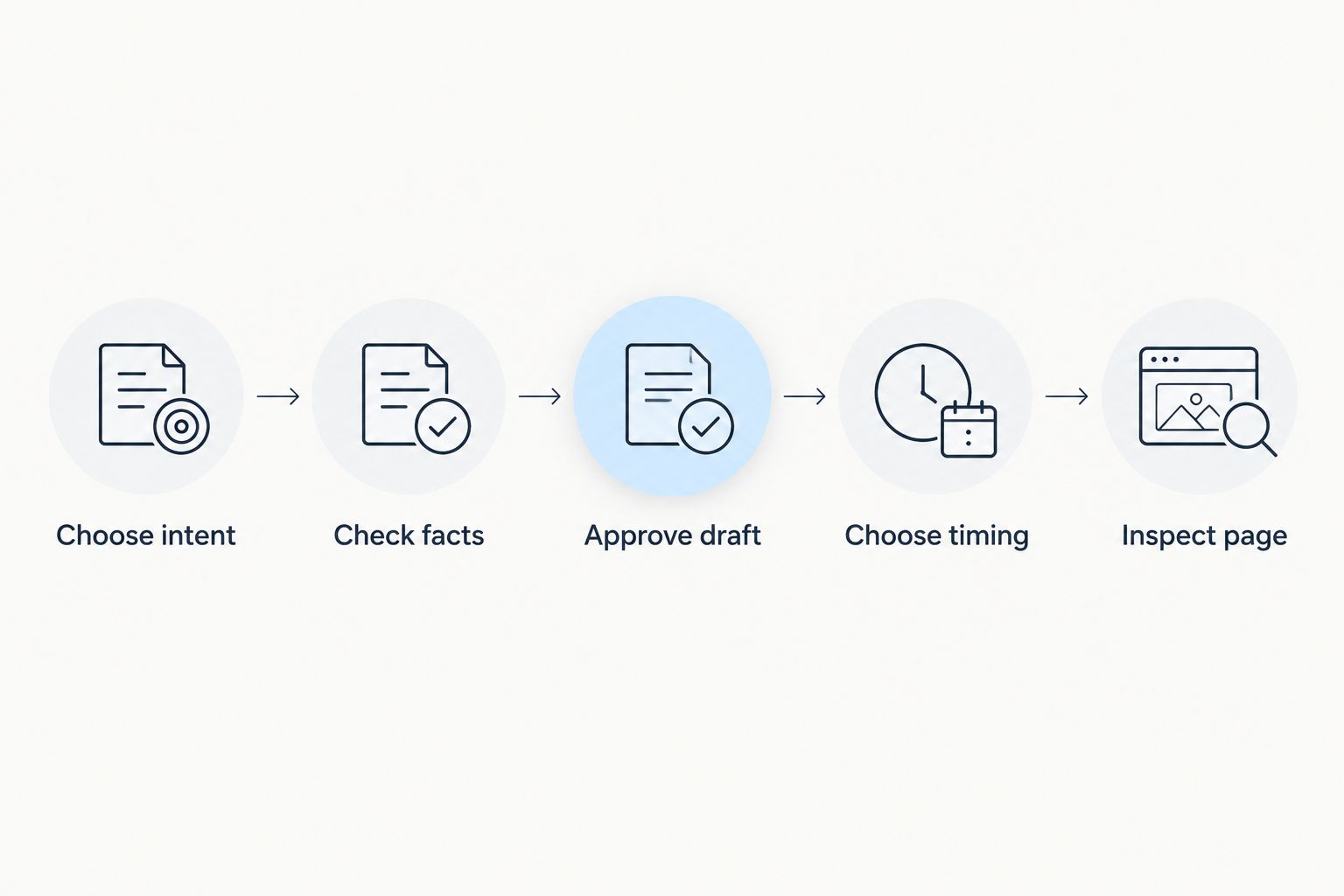
Use 5 steps to choose the right publishing method
A useful process puts approval before timing. Follow these 5 steps for each article rather than assigning every page to the same publishing method.
- Choose intent. Identify the customer question the article answers. Decide whether the reader needs an explanation, a service detail, or a timely announcement.
- Check facts. Verify business claims, service descriptions, locations, and any instructions. Remove statements you cannot confirm.
- Approve draft. Read the preview, check the title and links, and confirm that the article answers the intended question.
- Choose timing. Schedule the approved article if its facts will remain valid. Publish manually if a final event or decision controls the release.
- Inspect page. After publication, open the public page and confirm that the intended content appears correctly.
The order matters. Choosing a publication date before resolving factual questions creates pressure to release a draft that is not ready. Approval should determine whether an article enters the queue.
Keep ownership visible throughout the process. The person checking service accuracy does not have to be the writer, but someone must make that decision explicitly. A scheduled status is evidence of a timing choice, not evidence of editorial approval.
Why the better publishing method varies
The right choice depends on the article and the way your business approves content. These factors explain why a single rule does not fit every page:
- Fact stability: Durable explanations suit scheduling. Details that remain unsettled require another check before release.
- Approval status: A finished draft can still need business approval. Do not treat completed writing as permission to publish.
- Release dependency: An article tied to a confirmed event differs from one waiting for that event to happen.
- Owner availability: Scheduling removes the need to be present at release. Manual publishing requires a person to act.
- Review responsibility: Both methods need someone accountable for accuracy and the public page.
- Editorial purpose: Answering a recurring question differs from issuing an urgent update. The purpose should shape the workflow.
For a 2026 publishing plan, separate these decisions from keyword selection. A relevant local keyword helps define what to write; it does not tell you whether the resulting article is approved or when it should appear.
Avoid turning scheduling into a production target. Publishing more pages is not a substitute for answering distinct customer questions accurately.
Put 3 review gates before publication
Use 3 review gates regardless of whether you schedule or publish manually: business accuracy, reader usefulness, and publication readiness. Each gate checks a different failure that a publishing method alone cannot prevent.
Business accuracy
Confirm that the page describes services you actually provide and locations you actually serve. Check claims about policies, qualifications, and processes against current business information. Delete unsupported details rather than making them sound plausible.
Generated drafts need the same scrutiny as manually written drafts. A fluent sentence can still describe the wrong service or give an instruction your business would not approve.
Reader usefulness
Read the opening answer without the rest of the article. It should address the customer's question directly. Then check whether the remaining sections add useful distinctions instead of repeating the same point.
Local relevance needs substance. Repeating a place name does not explain whether you serve that location, how your service works, or what a customer should do next.
Publication readiness
Check the preview, headings, links, and intended publication setting. For scheduled content, confirm the date and the website's time setting. For manual publishing, confirm that any required approval has actually arrived.
These gates apply throughout 2026. The publishing method can change from article to article; the standard for releasing accurate content should not.
Does scheduling content help SEO more than publishing manually?
Scheduling is an editorial convenience, not a ranking advantage by itself. A publishing method does not replace relevance, useful information, accessible pages, or accurate business details.
The practical benefit is organizational: approved content can go live without another manual publishing session. That helps you carry out a plan, but does not establish that the resulting pages will rank.
Evaluate your 2026 content by the questions it answers and the business information it provides. Do not treat a full calendar as proof of search performance.
Can I schedule some articles and publish others manually?
Yes—use scheduling for approved evergreen articles and manual publishing for unresolved updates. The same website can use both methods without applying different editorial standards.
Assign the method when the draft reaches approval. That keeps a recurring educational article from waiting unnecessarily while preventing a time-sensitive announcement from entering the queue too early.
You do not need to standardize the final button press. Standardize what must be true before anyone presses it.
Is WordPress scheduling enough without a separate plugin?
WordPress includes scheduled publishing, so a separate plugin is not required just to release a post later. Check the publication date and time in the editor, and inspect the public page after release.
A broader content process involves more than release timing. Improveseoplugin is a WordPress plugin best for small local business owners who want local keyword discovery, branded content generation, publishing, and scheduling in the dashboard.
That scope is useful when those are the tasks you need to connect. If your only requirement is setting a future publication time, begin with the scheduling function already in WordPress rather than assuming you need additional software.
FAQ
Is content scheduling better than publishing manually for a small business?
Content scheduling is better for approved articles that remain accurate until release. Manual publishing is better when you still need to confirm a fact or obtain final approval.
Does Google rank scheduled posts higher than manually published posts?
Scheduling does not provide a ranking advantage by itself. Choose the publishing method for editorial control, and assess the page separately for usefulness, relevance, and accuracy.
Can I change a scheduled WordPress post before it goes live?
Yes, you can edit a scheduled WordPress post before publication. Review the updated content and confirm the intended publication setting after making changes.
Should I schedule an article before it has been approved?
No, approve the article before scheduling it for public release. A future date does not resolve an unsupported claim or an unanswered business question.
Do I need a plugin to schedule WordPress posts?
No, WordPress includes scheduled publishing. Consider additional software only when you need functions beyond choosing a future publication time.
What should I check after a scheduled article publishes?
Open the public page and check the content, links, headings, and business details. A successful release does not confirm that every statement is correct.
Should urgent business updates wait for the content calendar?
No, publish an urgent update when its facts and approval are ready. An editorial calendar should not delay information customers need now.
One last thing
The safest queue contains approved articles, not hopeful deadlines. If a draft still depends on an answer from your business, leave it outside the release queue until that answer arrives.
Improveseoplugin connects content preparation and scheduling inside WordPress, but the release decision remains yours. Before adding the next article to your 2026 calendar, ask whether it is ready to be public—not whether you need something to publish.