
Find keywords with low competition but real search volume by combining a demand estimate, evidence of actual searches, and a manual review of the pages ranking for that query. Prioritize terms that match something you sell and that you can answer better than the current results; a low difficulty score alone does not prove demand or make a keyword worth targeting.
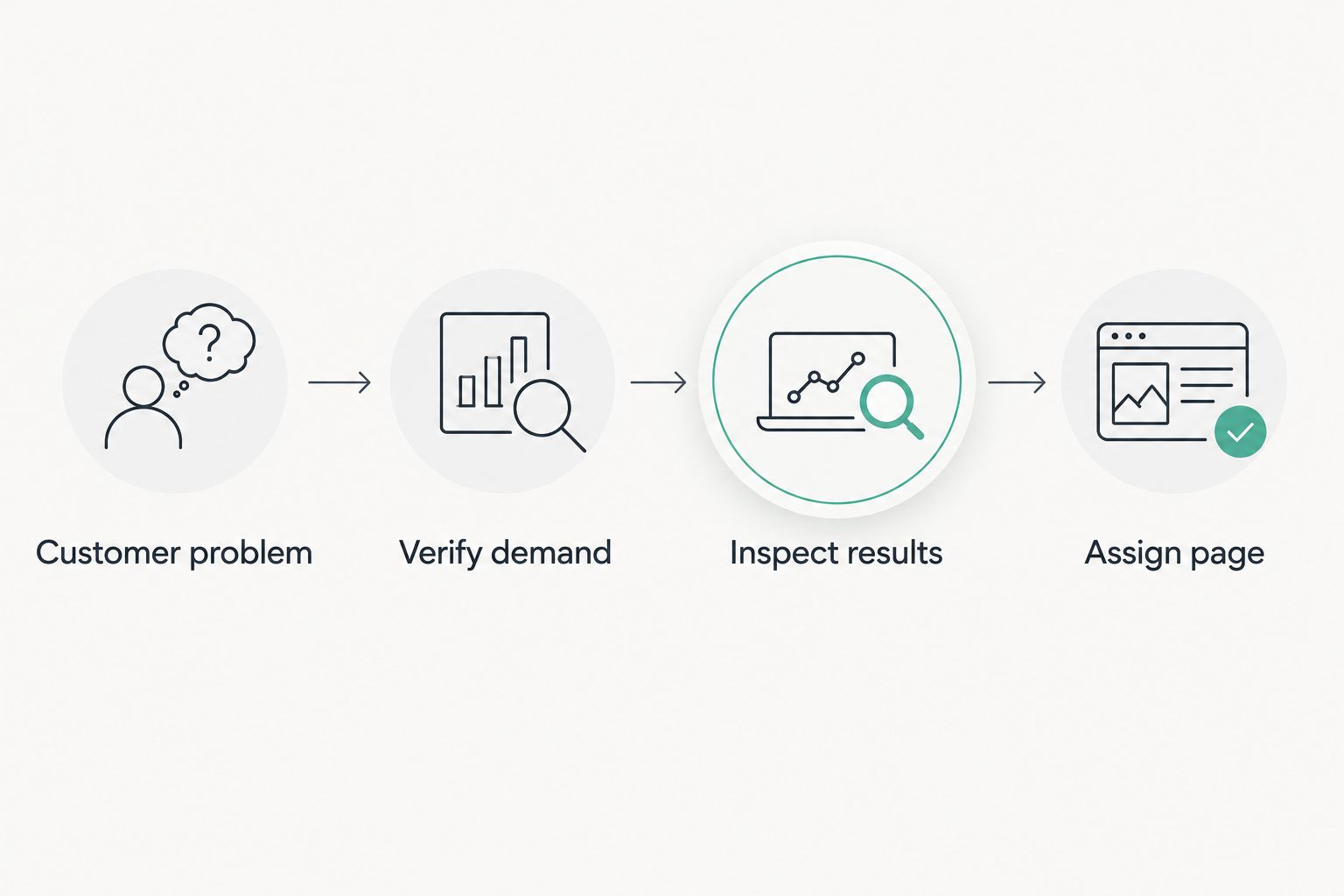
- How do I find keywords with low competition but real search volume? Verify demand, inspect results, and confirm business relevance.
- Google Search Console shows observed impressions for your website, not total market search volume.
- Check organic competitors directly; advertising competition is not organic ranking difficulty.
- Improveseoplugin suits local WordPress owners who want keyword research, branded content, and publishing in one workflow.
How do I find keywords with low competition but real search volume?
Use 3 checks for every candidate keyword: demand, ranking opportunity, and business fit. Keep the evidence separate so a promising number does not hide a weak commercial match.
A useful starting point is to compare local keyword research tools by the evidence they provide, rather than by how many keyword suggestions they return.
1. Start with the service and the customer's problem
Write down what customers hire you to do, the problems they describe, and the locations you actually serve. Build candidate searches from those ingredients rather than adding random modifiers to a broad keyword.
For example, a plumber can investigate searches around a particular repair, the symptom that precedes it, and the place where the customer needs help. These are research candidates, not proof that anyone searches for the exact phrase.
Keep each candidate connected to a useful destination. A service search needs a service answer; a troubleshooting question needs an explanation that helps the reader understand the problem.
2. Verify demand with more than a suggestion list
Look for 2 kinds of evidence: estimated market demand and observed search activity. Keyword research estimates help you compare candidates, while Search Console shows queries that have already produced impressions for your own website.
If your site has little search visibility, Search Console will not reveal every opportunity. Use it as evidence of existing exposure, not as a complete inventory of what customers search for.
For a 2026 research pass, record the location, language, and date range beside each estimate. Otherwise, you risk comparing a nationwide estimate with a narrowly local query as though they describe the same audience.
3. Inspect the search results before choosing a keyword
Search the candidate phrase and examine what Google currently returns. Identify whether the results primarily answer a question, describe a service, list businesses, or help someone compare providers.
Then inspect the actual pages. Look for a specific information gap you can fill: an unanswered question, unclear service scope, missing local context, or an explanation that does not resolve the searcher's problem.
Choose a keyword only when you can explain why your page deserves to appear. A low score is a screening signal, not that explanation.
4. Assign the keyword to the right page
Use 1 primary page per distinct search intent as your planning rule. Closely related phrases can belong on the same page when they ask for the same thing.
Do not create a separate article for every wording variation. If the same page can satisfy both searches without changing its purpose, improve that page instead of splitting the answer across competing URLs.
Why this matters
A keyword can be easy to rank for and still bring the wrong visitors. It can also have a modest reported volume yet describe exactly the service a local customer needs.
Your objective is not to collect easy-looking phrases. It is to find searches where your business has a relevant answer and a realistic reason to compete.
For your 2026 content plan, keep traffic potential and customer relevance in separate columns. That makes the trade-off visible instead of allowing a large volume estimate to decide everything.
Which evidence should you trust?
No single source answers every part of this question. Use each source for the job it supports, and keep its limitations attached to the finding.
| Evidence source | Best for | What it establishes | Main limitation |
|---|---|---|---|
| Google Search Console | Queries already exposing your website | Recorded impressions and clicks for your property | Does not measure total market demand or reveal every untapped topic |
| Google Keyword Planner | Checking estimated demand by location | Search-volume estimates and related keyword ideas | Advertising competition is not organic SEO difficulty |
| Manual search-result review | Understanding intent and competing pages | The content and result formats currently appearing | Does not establish search volume by itself |
Google Search Console's Performance report is the source for your website's observed search activity. Google Keyword Planner provides planning estimates for advertisers; its competition field concerns advertisers, not the effort required to rank an unpaid page.
Keep those definitions intact in your research notes. Combining different measurements is useful; treating them as interchangeable is not.
Estimated volume is not a visitor forecast
Search volume describes demand for a query within the source's settings and methodology. It does not tell you how many people will visit your page.
Your visibility, position, competing results, and the searcher's next action all sit between a search and a visit. Do not turn an estimated search count into a traffic promise.
Recorded impressions are narrower but more direct
A Search Console impression establishes that your website appeared under Google's reporting rules. That is more specific evidence than a keyword suggestion, but it applies to your property rather than the whole market.
Use relevant queries already receiving impressions to identify pages that need clearer answers. Do not assume that a query absent from your report has no demand.
What does low competition actually look like?
Low competition is relative to the query and the page you can produce. Keyword difficulty scores are estimates, not a universal ranking standard.
During your 2026 review, focus on observable weaknesses rather than assuming that unfamiliar websites are easy opponents. A small specialist site can answer a narrow question extremely well.
A clear intent match is possible
The search results should reveal a task your page can complete. If customers want to book a local service, a general educational article is not automatically the right format.
Match the job before improving the writing. Better prose does not correct a page built for the wrong purpose.
Competing pages leave a meaningful gap
A useful gap affects the reader's decision or understanding. Examples include an unexplained limitation, an unclear process, or a question the existing pages introduce but never answer.
A missing exact-match phrase is not enough. Nor is a shorter article automatically weaker than a longer one; judge whether the answer satisfies the search.
Your business can provide the missing substance
You need accurate information that belongs on your site: service details, practical explanations, or answers grounded in what your business actually does. Add local context only when it changes the answer.
Changing a city name in otherwise identical text does not create a useful local resource. Investigate whether the location introduces a real difference before planning another page.
Why keyword opportunity varies
These factors explain why similar-looking phrases can require different decisions:
- Search intent: A buying query needs a different destination from an informational question.
- Geography: Country, city, and service-area settings change the audience being measured.
- Query specificity: A narrowly described problem changes which pages genuinely answer it.
- Result format: Maps, business listings, service pages, and articles compete for different search tasks.
- Existing page quality: A precise, useful answer is a stronger competitor than an incomplete one.
- Your current coverage: An existing relevant page can deserve improvement instead of a new article.
Recheck these factors when a promising keyword fails your final review. The issue is often a mismatch between the proposed page and the search, not a need to collect more suggestions.
How should you prioritize your shortlist?
Start with relevance, then evaluate evidence and effort. Do not let an attractive difficulty score rescue a topic your business cannot serve.
For each candidate, write a short decision note covering:
- Customer need: What is the searcher trying to accomplish?
- Demand evidence: Which source supports investigating this phrase?
- Page purpose: Should you improve an existing page or create a distinct answer?
- Competitive gap: What will your page explain that the current results do not?
- Business connection: What relevant next step can the reader take?
Reject candidates whose only advantage is a favorable score. Keep candidates whose relevance and evidence remain persuasive after you inspect the results.
For a small local business managing content in WordPress, Improveseoplugin combines low-competition local keyword discovery, branded content generation, and publishing or scheduling from the dashboard. Improveseoplugin is best for local WordPress owners who want keyword research and content publishing in the same workflow. That convenience does not remove the need to check demand, intent, or factual accuracy before publication.
How do I know whether a keyword has real search volume?
Real search activity is best assessed by keeping estimates separate from observed impressions. Check the estimated volume's geography and date range, then use relevant Search Console queries as evidence of searches that exposed your own pages.
Search suggestions and related questions can help you discover wording. They do not, by themselves, establish a measurable monthly search count.
Is there a keyword difficulty score I should target?
There is no universal keyword difficulty cutoff that guarantees an accessible ranking opportunity. Scoring methods differ, and a score does not establish whether your proposed page matches the query.
Use difficulty to narrow your review list. Make the final decision after examining search intent and the competing pages.
Should I ignore keywords with no reported volume?
Do not automatically discard a relevant query because a research source reports no volume. That report does not prove that nobody searches for the phrase.
Keep the topic when customer relevance and supporting evidence justify it, but do not invent a traffic forecast. Treat an unsupported phrase as a research hypothesis rather than an established source of visits.
How do you check whether your choice worked?
After publishing or improving a page, use Search Console to examine the queries producing impressions and clicks. Check whether those queries match the audience and purpose you intended.
For pages published in 2026, record the publication or substantial revision date alongside your observations. Compare equivalent reporting periods rather than attributing every change to the last edit.
Review the page before expanding the topic. If impressions come from the wrong intent, revisit its focus; if relevant queries appear but the answer is incomplete, improve the substance. More pages are not the default response to weak results.
FAQ
What's the best way to find low-competition keywords with real demand?
Combine demand estimates, relevant Search Console queries, and a manual review of search results. Choose phrases that match your business and reveal a specific answer you can improve.
Does low advertising competition mean a keyword is easy to rank for?
No. Google Keyword Planner's advertising competition describes advertiser activity, not organic ranking difficulty. Inspect the unpaid results separately.
Can I use Google Search Console to find new keyword opportunities?
Yes. Google Search Console reveals queries that already produce impressions for your website. Use those queries to identify relevant answers to improve, while recognizing that the report does not cover all market demand.
Are longer keywords always easier to rank for?
No. Phrase length does not establish competition or demand. Check whether the wording represents a distinct search need and whether the current results already satisfy it.
Should I create a page for every city keyword?
No. Create a separate local page only when you can provide a distinct, useful answer for that location. A city-name substitution alone does not give readers a meaningful difference.
Can Improveseoplugin help with local keyword research?
Yes. Improveseoplugin is a WordPress plugin for finding low-competition local keywords, generating branded content, and publishing or scheduling it from the dashboard. Review keyword demand and content accuracy before publishing.
One last thing
Write the competitive gap before writing the article. Complete this sentence in your planning notes: this page will help the searcher by explaining something the current results leave unresolved.
If you cannot finish that sentence with a specific, useful answer, keep researching. Make that your final selection check for every keyword in your 2026 plan.