
Yes, small businesses can compete with big brands for local keywords by matching a specific service, location, and customer need more closely than a broad national page. Business size alone does not decide local rankings, but useful content cannot overcome every limitation: proximity, competition, business reputation, and the relevance of the search still matter.
- Can small businesses compete with big brands for local keywords? Yes—target relevant local searches rather than broad category terms.
- Google local results consider relevance, distance, and prominence; company size is not a substitute for those factors.
- Specific service pages support local keyword targeting, but copied city pages add little useful information.
- Track local search visibility and qualified inquiries separately; a ranking alone does not prove business value.
Can small businesses compete with big brands for local keywords?
Yes. A national brand's general category page does not automatically answer a local customer's question better than a small business's detailed service page. Your opportunity is to answer the search accurately, demonstrate that you serve the location, and make the next step clear.
Start with local keyword research tools if your immediate problem is identifying relevant searches. A keyword is useful only when it connects something you actually offer with someone you can serve.
For your 2026 plan, separate these search targets before choosing a strategy:
| Search target | Best for | Main advantage | Main limitation |
|---|---|---|---|
| Broad category searches | Businesses pursuing category-wide visibility | Covers a wide subject | Often lacks a clear local buying need |
| Service-and-location searches | Businesses serving a defined area | Connects the service with a place | Requires genuine service coverage and relevant evidence |
| Specific service questions | Businesses answering a particular buying concern | Lets you explain details a general page leaves out | Some searches are informational rather than ready to convert |
These are targeting options, not promises of easy rankings. Choose the search you can satisfy, not merely the search with the least competition.
Why this matters
Trying to outrank a national brand for every related phrase creates the wrong workload. You do not need to become the most visible business across an entire category to earn relevant local inquiries.
Instead, focus on the intersection of your service, your operating area, and the customer's decision. A page about a specific repair in a town you serve has a clearer purpose than a general article about home maintenance.
That distinction matters in 2026 because your content plan should serve actual customers, not a publishing quota. A large collection of pages is not a substitute for clear service information.
Where small businesses have a practical opening
Service-and-location searches: best for clear local intent
A service-and-location search states what the customer needs and where they need it. For example, a hypothetical search for drain cleaning in a particular town gives a plumbing business a defined subject to address.
Your page should explain the service, the area covered, relevant limitations, and how someone can request help. Add business-specific details only when they are accurate and current.
The advantage is focus. The limitation is that adding a place name does not establish relevance by itself, especially when the rest of the page could describe any business anywhere.
Specific service questions: best for resolving buying concerns
Some customers need an answer before they contact a provider. A homeowner might ask whether a contractor handles a particular repair; a salon customer might ask what a service includes.
Answer the question directly, then connect it to the appropriate service page when you have one. Explain the conditions that affect the answer rather than using a generic reassurance.
The advantage is useful detail. The limitation is intent: someone researching a question is not necessarily looking to book immediately, so evaluate these pages differently from service pages.
Genuine location pages: best for distinct local information
A location page makes sense when the location changes what the customer needs to know. A staffed branch, distinct service coverage, or location-specific instructions can justify a separate page.
The benefit is clarity for customers seeking that place. The drawback is maintenance: each page needs accurate information, and duplicated pages with swapped town names provide little additional value.
Do not claim a physical presence where none exists. Serving an area and operating a location are different facts.
Why local keyword competitiveness varies
Google's Business Profile guidance describes local results in terms of relevance, distance, and prominence. Organic website results and map results are different surfaces, so do not assume a website ranking change will produce the same movement in the local map results.
Use these factors to explain differences between searches:
- Search relevance: Your business and page must match the service or question being searched.
- Search location: Distance matters in local results, so the same query can produce different businesses in different places.
- Business prominence: Reputation, reviews, links, and broader recognition can affect local visibility; a small business does not start on equal footing everywhere.
- Competing pages: A specific query can still be difficult when other businesses answer it well and demonstrate relevant experience.
- Page usefulness: Clear service information and original business details give customers a reason to choose your page over a generic alternative.
- Site accessibility: Search engines need to discover and index your pages; publishing alone does not establish that a page is eligible to appear.
There is no universal keyword-difficulty score that guarantees a local win. Treat difficulty estimates as screening information, then inspect the actual results and the customer need.
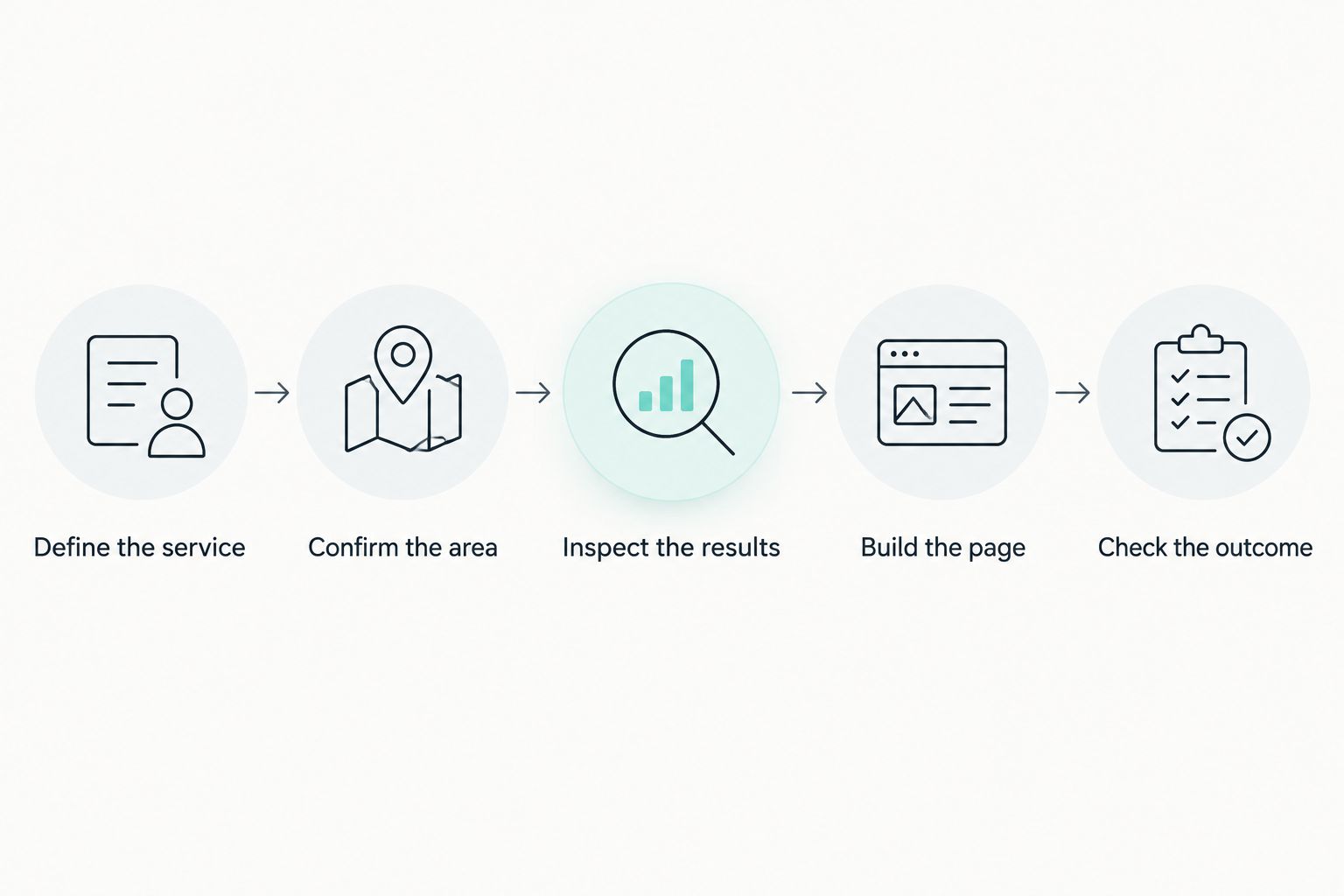
How to build a focused local keyword plan
1. Define the service
List the services you actually provide before opening a keyword tool. Include meaningful distinctions customers ask about, but exclude offerings you cannot deliver.
Choose 1 primary service topic per page as an editorial starting point. Related phrases can belong together when they express the same need; they do not automatically require separate pages.
2. Confirm the area
Write down where you genuinely serve customers and whether they visit you or you travel to them. Use that information to qualify location terms.
Do not select a nearby city just because its name attracts searches. If your coverage has limits, explain those limits rather than implying that every nearby customer qualifies.
3. Inspect the results
Search the proposed phrase and distinguish map listings, service pages, directories, and informational articles. The result types help you understand what searchers are being offered.
Review 3 result types: map listings, service pages, and informational pages when they appear. Note whether your proposed page would answer the same need or a different one; this is a relevance check, not a ranking prediction.
4. Build the page
Lead with the answer or service description. Add the details a customer needs to decide whether to contact you, including genuine coverage, service scope, and relevant restrictions.
Draft 2 supporting questions per page as a starting exercise, not a ranking requirement. Choose questions customers actually ask, and remove any question that only repeats the main description.
5. Check the outcome
After publishing, check whether the page is indexed and which queries bring impressions and clicks in Google Search Console. Separately, review whether the page contributes qualified inquiries through whatever tracking your business has configured.
For a 2026 baseline, record the page, target need, publication date, and intended customer action. Compare later results against that record instead of judging success from a single search on your own phone.
What should your page include that a generic brand page does not?
Your strongest content is information specific to the business and useful to the customer. That does not mean inventing an unusual angle; it means answering practical questions accurately.
Explain what the service covers, what it excludes, and what someone needs to provide when making an inquiry. Where relevant, describe actual access requirements, appointment preparation, or service-area boundaries.
Use original project examples or photographs only when you have them and permission to publish them. Do not manufacture testimonials, local references, or customer stories to make a page appear established.
A useful 2026 content review asks whether every business claim is still true. Old service information can mislead a customer even when the page continues to receive search traffic.
Where a WordPress plugin fits—and where it does not
Improveseoplugin is best for small local business owners who want local keyword research and content publishing inside WordPress. The WordPress plugin helps find low-competition local keywords, generate branded content, and publish or schedule it from the dashboard without requiring SEO expertise.
Improveseoplugin fits the production stage: choosing a topic, preparing a draft, and managing publication. That is useful when moving content between separate tools creates extra work.
The limitation is scope. Improveseoplugin's WordPress publishing workflow does not make an inaccurate service claim true, and content generation is not evidence that a page deserves to rank.
Before publishing a draft, verify its locations, services, business details, and instructions. Keep the convenience of Improveseoplugin's local keyword workflow, but retain responsibility for the facts customers will act on.
Do you need a separate page for every local keyword?
No. Group phrases that describe the same service, location, and customer need on a useful page instead of creating a separate URL for every wording variation.
Create another page when the customer needs materially different information. A different town name alone is not enough justification for another near-identical article.
Can a small business outrank a national brand in map results?
Yes, a small business can appear ahead of a national brand in local map results when the local ranking factors favor that business. Google describes those factors as relevance, distance, and prominence.
That does not guarantee the same order for every searcher. Check the target location and distinguish map visibility from ordinary website rankings.
Should you stop targeting broad keywords entirely?
No. Broad keywords can still describe your core services and help organize your website, but they do not need to dominate your publishing schedule.
Prioritize specific searches when they match a real customer need you can answer well. Keep broad service pages useful rather than turning every page into a narrow location variation.
FAQ
Can small businesses compete with big brands for local keywords in 2026?
Yes, small businesses can compete with big brands for local keywords in 2026 by closely matching a real service, location, and customer need. Rankings still depend on the search context, competing businesses, and the usefulness of the page.
What's the best local keyword for my small business?
The best local keyword matches a service you provide, an area you genuinely serve, and a customer need your page answers. Low competition alone does not make a keyword valuable.
Do I need a bigger website than a national competitor?
No, having more pages than a competitor is not a requirement for local visibility. Focus on useful service coverage rather than producing pages to reach a count.
Is a city page better than a service page?
Neither page type is automatically better; the right choice depends on what the customer needs. A city page needs meaningful local information, while a service page needs a clear explanation of the service.
Will publishing more articles guarantee local rankings?
No, publishing more articles does not guarantee local rankings. Check relevance, factual accuracy, indexing, and customer usefulness before increasing publishing frequency.
How do I know whether local SEO is working?
Check relevant search impressions and clicks alongside qualified inquiries. Separate map visibility, website rankings, and customer actions so one metric does not stand in for all three.
Can a WordPress plugin handle local SEO without review?
No, a publishing workflow does not remove the need to verify business facts. Review service descriptions, locations, and customer instructions before publishing generated content.
One last thing
Before adding another location page, improve the answer on the service page you already have. Identify the buying question it leaves unanswered and add a truthful, specific response.
For your next 2026 update, make that your editing rule: new information first, new URLs only when the customer needs a different page. Competing locally starts with being useful in the place you actually serve.