
Target one primary local keyword per page in 2026, supported by closely related phrases that express the same service, location, and search intent. This is a planning recommendation, not a Google-imposed keyword limit; the extra work is deciding which searches belong together and which need a different page. You do not need a separate page for every wording variation or a fixed quota of secondary keywords.
- How many local keywords should I target per page? Choose one primary phrase and cover closely related local searches.
- Group keywords by service, location, and intent—not by matching words alone.
- Create another page when the customer needs a different answer, not merely a different phrase.
- Improveseoplugin is best for small local business owners who want keyword research and publishing inside WordPress.
Why this matters
A local page needs a clear job: help someone decide whether your business meets a particular need in a particular area. Adding keywords does not fix a page that leaves that question unanswered.
For your 2026 content plan, treat keyword selection as page organization rather than a writing quota. Improveseoplugin brings local keyword research, branded content generation, and publishing or scheduling into the WordPress dashboard; you still need to check that the selected phrases describe your actual services.
The right target is a coherent topic, not the largest keyword list. A short list with a shared purpose gives you a clearer brief than a long list mixing unrelated customer needs.
How many local keywords should I target per page?
Use one primary keyword per page as your editorial focus. Include secondary phrases when they help explain that same service or answer questions the same customer would ask.
The following examples illustrate grouping decisions, not researched keyword opportunities or claims about search volume.
| Keyword group | Example | Page decision | Best for |
|---|---|---|---|
| Primary phrase | Drain cleaning in Austin | Use as the page's main topic | Defining the service and location |
| Close variation | Austin drain cleaning service | Cover naturally on the same page | Capturing equivalent wording |
| Related service question | What causes recurring drain clogs? | Answer briefly when relevant | Helping the customer evaluate the service |
| Different service | Water heater installation in Austin | Give it a distinct service page | Explaining a different customer need |
| Different intent | How to clean a drain yourself | Assess as a separate instructional topic | Serving readers seeking instructions |
The advantage of one focused page is clarity: your headings, examples, and next step can address the same customer. The limitation is scope. You cannot give every related service or educational question equal attention without changing the page's purpose.
A page can contain many relevant expressions without treating each as a separate target. Your primary keyword sets the direction; supporting language makes the answer complete.
What counts as a primary keyword?
A primary keyword is the phrase you use to define the page's main search opportunity. For a local service page, it usually combines what you do with where you do it.
Choose the phrase that accurately describes the service and matches the kind of page you are creating. Do not select a broader phrase just because it appears more attractive: a page about drain cleaning should not become a general plumbing page halfway through the draft.
One primary keyword means one editorial priority—not one permitted phrase. You can use synonyms, grammatical variations, and relevant questions without creating competing objectives.
How many secondary keywords belong on the page?
There is no useful universal quota for secondary keywords. Stop adding targets when they stop helping the reader understand the same service, location, or decision.
A supporting phrase earns its place when it introduces a useful explanation. A phrase that merely repeats an existing heading in different words does not need its own section.
For example, a drain-cleaning page can explain symptoms, the service process, and what information to provide when requesting help. It does not need separate paragraphs that repeat the same offer with rearranged city and service terms.
How to group local keywords before you write
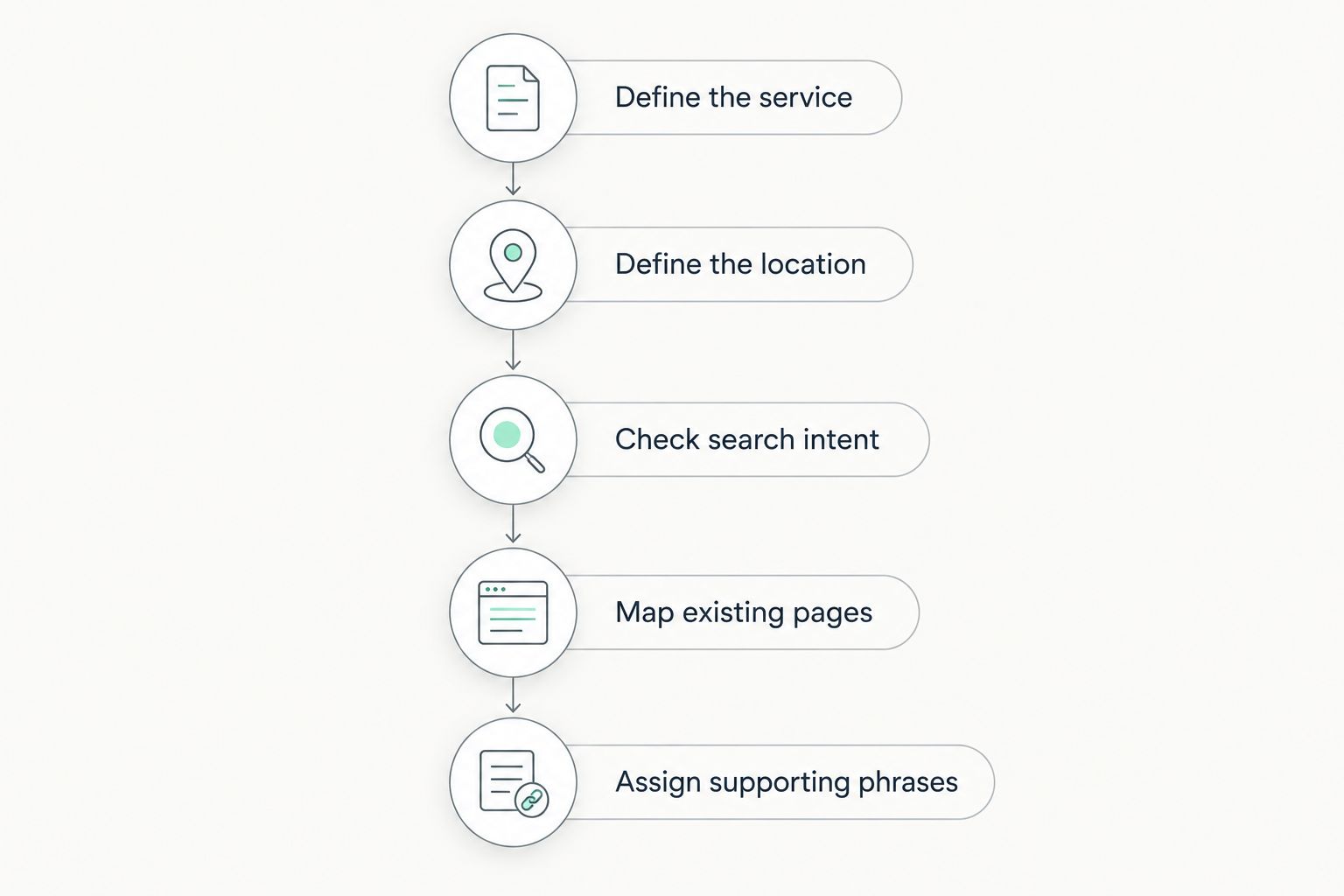
Use this sequence when building a 2026 local content brief. The goal is to decide what belongs on the page before a draft turns a loose keyword list into repetitive copy.
- Define the service. Write down exactly what the page offers. Exclude services the business does not provide and topics that require a different explanation.
- Define the location. Identify the place the page genuinely serves. Do not add nearby place names simply to expand the list.
- Check search intent. Determine whether the searcher wants to hire, compare, learn, or solve a problem independently. Those goals often need different page structures.
- Map existing pages. Check whether another page already answers the same need. Improve an appropriate existing page before commissioning a near-duplicate.
- Assign supporting phrases. Place related terms beside the sections where they help answer a customer question. Leave out phrases without a useful role.
This process gives each page a purpose and each supporting keyword a reason to appear. It also exposes gaps that keyword counting hides, such as a service page without a clear explanation of what the customer should do next.
Why the number of local keywords varies
The right supporting keyword set depends on what the page needs to explain. These factors change the scope without creating a universal numerical limit:
- Service breadth. A narrowly defined service needs a different brief from a page introducing several distinct services. Keep detailed treatment on the page where it belongs.
- Search intent. A hiring query and a do-it-yourself query can share vocabulary while requiring different answers. Similar words do not guarantee a shared purpose.
- Geographic relevance. A service-area page needs truthful local context. A list of place names is not a substitute for explaining where and how the business serves customers.
- Existing coverage. An established service page changes what a new page should cover. Avoid assigning an equivalent target to another page without a clear distinction.
- Customer questions. Supporting searches are useful when they reveal information a customer needs before taking the next step. Include the answer, not just the phrase.
Expand the answer when the customer needs more detail; create another page when the customer needs a different answer. That distinction is more useful than setting an arbitrary secondary-keyword ceiling.
Should I put different services on separate pages?
One primary service per page is a useful starting point when services need different explanations, examples, and next steps. An overview page can introduce your offering, while dedicated pages explain individual services in depth.
The benefit of separate service pages is focus. The drawback is the work required to make each page genuinely useful; a thin page with a changed heading does not provide a meaningful service explanation.
Use this test: would a customer asking about the second service need substantially different information? If yes, plan a distinct page rather than forcing both services into the same keyword brief.
Should I make a separate page for every city?
One primary local keyword per page does not mean one page for every city name you can attach to a service. Create a location page when you can give customers relevant, truthful information about service in that place.
Separate location pages offer room for specific local details. Their limitation is duplication: changing the city name while repeating everything else does not create a distinct answer.
For your 2026 location plan, identify the useful differences before adding pages. Relevant information can include the actual service area, location-specific work examples you can substantiate, or genuine customer questions about that area. Do not manufacture local details to fill a template.
Can one page target several similar local searches?
One primary keyword can anchor several closely related searches when they share the same intent. Different word order, singular and plural forms, or equivalent service wording do not automatically require different pages.
Check the current search results when the relationship is unclear. Compare the kinds of pages appearing for each phrase and what those pages help a visitor accomplish; use that evidence alongside your actual offering, rather than treating shared words as proof.
Search results are a planning aid, not permission to copy another business's structure. Your page still needs an accurate service description and a useful answer for your customer.
Where should local keywords appear?
Put the main topic where readers expect to understand the page: the title, main heading, opening copy, and relevant supporting sections. Write these elements for clarity rather than repeating an exact phrase mechanically.
For a 2026 page review, check these elements together:
- Page title: Describe the service and location accurately.
- Main heading: Make the page's purpose immediately recognizable.
- Opening paragraph: Explain the service and who the page helps.
- Supporting headings: Organize customer questions rather than keyword variations.
- Body copy: Add relevant details, examples, and limitations you can substantiate.
- Next step: Tell the reader how to proceed without introducing a different service focus.
Do not set a keyword-density target. A percentage cannot tell you whether the page answers the question, accurately describes the business, or repeats itself.
Read the draft aloud. If the service-and-city phrase sounds unnatural, revise the sentence instead of preserving it to satisfy a count.
How to review an existing page without starting over
Start with the page's current purpose, not a fresh list of keywords. Identify what a visitor should understand or do after reading it, then compare every major section with that goal.
Mark sections that repeat the same point, switch services unexpectedly, or answer a different kind of search. Combine repetition, move substantial off-topic material to the appropriate page, and fill gaps with information the business can verify.
If you use Improveseoplugin for local keyword research and drafting, treat the generated draft as material to review before publishing. Check service descriptions, geographic claims, and the proposed next step against the business's actual offering.
Keep the page focused without stripping out useful detail. A focused page can answer several questions; the questions simply need to support the same customer decision.
FAQ
How many local keywords should I target per page in 2026?
Target one primary local keyword per page in 2026, with supporting phrases that share its service, location, and search intent. This is an editorial recommendation, not a Google-imposed keyword limit.
Do I need a separate page for every keyword variation?
No, equivalent keyword variations can belong on the same page. Create a separate page when the service, intent, or useful location-specific information requires a different answer.
How many times should I repeat my local keyword?
There is no fixed repetition count to aim for. Make the topic clear in the title, heading, and relevant copy, then remove repetition that adds no information.
Can I target several cities on one service page?
Yes, a service page can describe the places your business genuinely serves. Separate city pages need useful, truthful local content rather than a repeated template with substituted place names.
Should near-me searches have their own page?
A near-me wording variation does not by itself justify another page. First determine whether your existing service page already addresses the same local hiring intent.
What should I do if two pages target the same local keyword?
Compare the pages' purposes before changing either page. If they answer the same customer need, assess consolidation; if they serve different needs, clarify their titles, content, and keyword assignments.
Can Improveseoplugin help me plan local keywords in WordPress?
Improveseoplugin helps small local business owners find low-competition local keywords and generate, publish, and schedule branded content from WordPress. Review the keyword grouping and business facts before publishing; the workflow does not replace those decisions.
One last thing
Before adding another keyword, write this sentence in your brief: This page helps a customer find this service in this place. If completing the sentence requires unrelated services or conflicting customer goals, revise the brief before expanding the draft.
For your next 2026 update, remove a redundant section before creating another page to capture a wording variation. The useful distinction is not how many phrases you can fit into the copy. It is whether the next phrase helps the same customer make the same decision.