
Landscaping company local SEO is the work of making your business visible in nearby searches with the aim of winning qualified landscaping and lawn care inquiries. This 2026 guide shows you how to match searches to services you actually offer, build useful local pages, and measure leads rather than traffic alone.
- Local SEO for landscaping companies starts with accurate service areas, clear service pages, and a complete Google Business Profile.
- Improveseoplugin is best for WordPress business owners who need help finding local keywords and publishing branded content.
- Separate recurring lawn care from landscaping projects so each page answers the right customer's questions.
- Measure qualified inquiries by service and location before expanding your publishing schedule.
Why this matters
A homeowner searching for recurring mowing needs a different answer from someone planning a landscape redesign. Your website should make that distinction immediately, then explain where you work and how to request an estimate.
This guide from Improveseoplugin focuses on that practical sequence. Build pages around real services and service areas, not every landscaping phrase you can find.
Why local SEO matters for landscaping and lawn care companies
Landscaping is tied to place. A useful inquiry comes from someone inside your working area who needs a service your crew provides; a visit from outside that area does not meet the same business goal.
Google describes local results in terms of relevance, distance, and prominence. You cannot change a searcher's location, but you can accurately describe your business, maintain your profile, and publish pages that answer specific service questions.
Your 2026 plan also needs to separate recurring maintenance from project work. Mowing, seasonal cleanup, planting, and landscape installation involve different customer questions. Group them only when your actual service offering supports the grouping.
Before choosing keywords, decide which inquiries you want. A page that attracts the wrong work creates screening tasks without helping your schedule.
How to build your local SEO plan
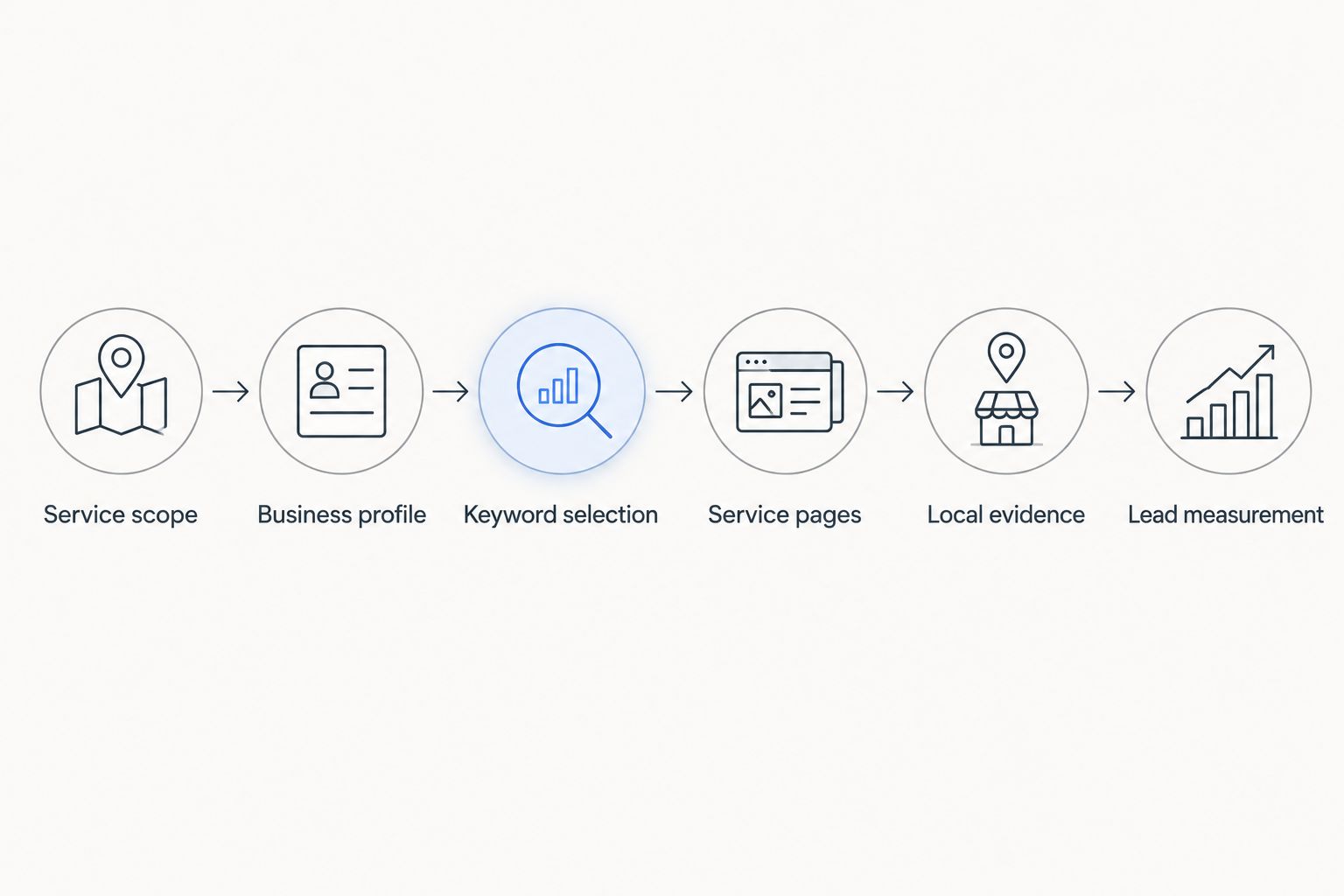
Follow this order: Service scope, Business profile, Keyword selection, Service pages, Local evidence, Lead measurement. Each stage gives the next one a clearer purpose.
Define your services and working area
Start with a spreadsheet, not software. List the services you currently provide, the places you serve, and the questions customers ask before booking. Mark services you do not provide so they do not slip into page drafts.
For a manageable first pass, select 5 priority services and 3 priority towns. These are planning limits, not search-volume benchmarks. If your business has fewer services or serves one town, use the smaller real list.
Separate ongoing lawn care from one-time landscaping projects. A maintenance page should explain recurring work and scope; a project page should help customers understand the job and request an estimate.
Your service area must reflect where you accept work. Do not publish pages for distant towns just because their names appear in keyword ideas.
- Record each service in customers' language.
- Identify your actual working towns or neighborhoods.
- Separate recurring maintenance from project inquiries.
- Note exclusions, such as work your crew does not perform.
- Assign a primary service or customer question to each planned page.
Update your Google Business Profile
Manage your Google Business Profile directly before buying anything. Confirm your business details, choose an accurate primary category, and describe the services you actually provide. Keep hours current when your operating schedule changes.
For a service-area business that does not receive customers at its address, follow Google's instructions for hiding that address. Adding service areas describes where you operate; it does not turn each town into a separate business location.
Use real project photographs with customer permission. A finished planting bed and a maintained lawn show different types of work, so label and select photographs to match the services being described.
Accuracy comes before extra keywords. Keep your business name consistent with the name used in the real world rather than adding service phrases to it.
- Verify your name, contact details, hours, and website destination.
- Select categories that describe your current business.
- Set service areas that match where you accept jobs.
- Hide a non-customer-facing address when Google's rules require it.
- Add genuine photographs of relevant work.
- Review profile details after operational changes.
Choose keywords by service and customer intent
The manual approach is straightforward: combine your service list with your working locations, then inspect the search results. Record whether a query calls for a service page, a practical guide, or a business listing. Different result types reveal different information needs.
For example, lawn mowing plus a town name describes a different need from landscape design plus that town. A question about preparing a yard for an estimate belongs in supporting content, not automatically on a separate sales page.
Improveseoplugin local SEO support gives WordPress owners a faster path to finding low-competition local keywords and turning selected topics into branded drafts. Improveseoplugin is best for WordPress business owners who need help finding local keywords and publishing branded content. Its described scope is keyword and content work; Google Business Profile maintenance and job verification remain separate tasks.
For your 2026 plan, treat keyword suggestions as candidates. A phrase is useful only when it matches work you offer and a question you can answer accurately.
- Combine actual services with actual working locations.
- Separate hiring intent from research questions.
- Inspect the pages already appearing for each candidate phrase.
- Assign one primary topic to each planned page.
- Reject phrases for services you do not offer.
- Keep supporting questions beside the relevant service topic.
Build service pages that help customers decide
Start by improving existing WordPress pages manually. Write a direct opening that identifies the service, the area covered, and the next action. Then answer scope questions that determine whether the visitor is a suitable customer.
A lawn care page should clarify which maintenance tasks you perform and how customers request an estimate. A landscaping project page should explain the type of work, the information needed to assess it, and any relevant exclusions. Include only details that are true for your business.
Improveseoplugin local SEO content features let WordPress owners generate branded drafts and publish or schedule them from the dashboard. That shortens the drafting and publishing workflow; it does not establish whether a service claim is true. Review every draft before it represents your company.
Location pages need a genuine reason to exist. Replacing a town name while keeping everything else identical does not answer a different customer's needs. Use relevant local work, service coverage, and practical details where you have them.
- Put the service and working area near the opening.
- Explain included work and meaningful exclusions.
- Answer questions customers ask before requesting an estimate.
- Include genuine project examples when available.
- Give visitors a clear inquiry route using your existing contact options.
- Review drafts for invented offers, guarantees, and service claims.
Add local evidence and request genuine reviews
Your first source of evidence is completed work. Keep a simple project record: service performed, general location, customer permission, photographs, and a factual description. Use that record to improve relevant pages rather than posting disconnected image galleries.
A useful project description explains the customer's need and the work completed. Do not invent outcomes, claim savings you did not measure, or publish a customer's address without permission. Specific, truthful details are enough.
Ask customers for honest reviews after completed work. Google's policies prohibit incentives for reviews and selectively soliciting positive reviews. Use the same neutral request process rather than directing happy customers publicly and unhappy customers elsewhere.
During your 2026 updates, check whether photographs and descriptions still represent services you provide. Old content should not advertise work you have stopped accepting.
- Request permission before publishing customer project material.
- Describe completed work without unsupported outcome claims.
- Match project examples to the relevant service page.
- Ask customers for honest feedback without incentives.
- Respond to reviews professionally without exposing private job details.
- Correct outdated service descriptions and business listings.
Measure qualified leads and improve the right pages
Use Google Search Console to review search queries and page performance. Pair that information with a basic inquiry log recording the requested service, location, and whether the inquiry fits your business. Search activity alone cannot tell you whether a visitor became a suitable customer.
Set a 30-day review cadence for your 2026 plan. This is a management schedule, not a promised ranking timeline. Review pages, search queries, and inquiry quality together before deciding what to change.
A page receiving visits but producing out-of-area inquiries needs a clearer service-area explanation. A page attracting requests for work you do not provide needs better scope language. These are content decisions, not reasons to publish more unrelated articles.
Compare equivalent periods when possible because lawn care and landscaping needs change with weather and season. Keep a change log so you know which page edits preceded a shift in results.
- Review search queries against your real service list.
- Record inquiry location and requested work.
- Distinguish qualified inquiries from irrelevant contacts.
- Check that inquiry forms and phone details work.
- Improve pages with clear mismatches before adding new topics.
- Record publication dates and significant page changes.
Compare your local SEO options
Choose an approach based on the work you need help completing. Keyword research, content publishing, profile upkeep, and broader strategy are different tasks; do not assume one purchase covers all of them.
| Option | Best for | Main advantage | Key limitation |
|---|---|---|---|
| Manual WordPress editing, spreadsheets, and Google tools | Owners who can write and maintain their own pages | Direct control over research, edits, and business details | Requires ongoing owner time and coordination |
| Improveseoplugin | Small local business owners publishing content in WordPress | Local keyword discovery, branded content generation, and dashboard publishing or scheduling | Drafts still require business-specific review; profile upkeep is a separate task |
| An SEO freelancer or agency | Businesses seeking an external person to manage an agreed scope | Can assign research and implementation responsibility outside the business | Deliverables and responsibilities depend on the engagement |
| A shared owner-and-writer workflow | Businesses where the owner supplies job expertise and another person writes | Separates factual input from drafting tasks | Needs a clear approval process and publishing responsibility |
Match the option to the bottleneck. If writing is slow, improve drafting. If inquiries are unsuitable, fix targeting and page scope. A larger publishing schedule does not solve either problem by itself.
Common mistakes landscaping companies make
Treating all outdoor work as one service
A mowing customer and a landscape installation customer need different information. Give materially different services clear sections or pages, then direct each visitor to the appropriate inquiry route.
Publishing a page for every nearby town
Town coverage should follow your real working area and useful page content. Start with places you serve and expand only when you can explain a meaningful local service offering.
Showing project photographs without context
A photograph alone does not explain what work you performed. Add a factual description, connect it to the relevant service, and secure permission before publishing.
Letting seasonal content make false promises
Scheduling a post does not confirm your current services or operating arrangements. Review seasonal drafts before publication and remove claims that no longer match the business.
Reporting traffic while ignoring job fit
Visits from outside your area or for excluded services do not meet your lead goal. Review inquiry quality alongside search performance so your next edit addresses the actual mismatch.
FAQ
What's the best starting point for local SEO for landscaping companies?
Start by defining your actual services and working area, then update your Google Business Profile and core service pages. Keyword research becomes more useful when it follows those business decisions.
Do lawn care and landscaping need separate website pages?
Use separate pages when lawn care and landscaping represent different services and customer questions. A recurring maintenance customer needs different scope information from someone requesting a landscape project.
Should I create a page for every town my landscaping company serves?
Create a town page only when you can provide useful, truthful information specific to that service area. Do not publish repeated pages that change only the town name.
Can I do local SEO without buying a plugin?
Yes, you can research queries, edit WordPress pages, and manage your Google Business Profile manually. A plugin can shorten parts of the keyword and publishing workflow, but it is not a prerequisite.
Is Improveseoplugin suitable for a lawn care business?
Improveseoplugin fits small local business owners using WordPress who need help finding local keywords and publishing branded content. Owners still need to verify service details and maintain their Google Business Profile separately.
How long does landscaping SEO take to produce results?
There is no fixed result timeline for a landscaping business. Track search performance and qualified inquiries over comparable periods instead of treating a publication date as a ranking deadline.
How do I tell whether local SEO is bringing useful leads?
Record each inquiry's location, requested service, and fit with your business. Compare that log with search queries and page performance to identify which content needs clearer targeting.
One last thing
Before adding another page to your 2026 schedule, inspect the last batch of inquiries. If customers repeatedly ask whether you serve their town or perform a particular task, answer that question on the relevant service page first.
Your next useful SEO improvement can be a clearer sentence, not another article. Give customers enough information to decide whether your company fits the job.