
HVAC and electrical contractor local SEO is the work of making your business visible in nearby service searches with the aim of earning qualified calls and booked jobs. This 2026 guide covers Google Business Profile, service pages, local keywords, and a publishing routine built around the services and areas you actually cover.
- Local SEO for HVAC contractors starts with accurate service information, a verified Google Business Profile, and useful service pages.
- Improveseoplugin suits WordPress contractors who want local keyword research, branded content generation, and publishing in one dashboard.
- Separate HVAC and electrical services by customer need; do not duplicate pages by replacing city names.
- Measure qualified inquiries and booked jobs alongside search visibility, not rankings alone.
Why local SEO matters for HVAC and electrical contractors
A homeowner searching for furnace repair needs a different answer from someone planning an electrical panel upgrade. Your local SEO must explain what you do, where you work, and how the customer takes the next step.
Match the page to the job, not just the keyword. This matters especially when your company provides both trades: one broad page cannot explain every repair, installation, and safety concern clearly.
The workflow below starts with manual checks. It introduces Improveseoplugin at the content-production stage, after you have defined your services and audience.
Build your local SEO workflow for 2026
Define your services and coverage
Start with your actual job list. Write down the HVAC and electrical services you provide, the places you serve, and the restrictions your office applies when accepting work. Your website should reflect that list, not a collection of every nearby town or popular search phrase.
Separate repair intent from installation intent. Someone with a failed air conditioner needs fault symptoms, service coverage, and a contact route; someone considering replacement needs a clear explanation of assessment and installation. Electrical troubleshooting and panel replacement need the same separation.
Treat business capabilities as publishing boundaries. Do not advertise emergency response, commercial work, or particular equipment expertise unless your business actually provides it. For your 2026 plan, prioritize services you can explain accurately and fulfill consistently.
- List the jobs your team accepts.
- Record the areas your dispatch team covers.
- Separate repair, replacement, installation, and maintenance needs.
- Remove claims your office cannot confirm.
Correct your Google Business Profile
Review your Google Business Profile directly before investing in more content. Google states that local results mainly depend on relevance, distance, and prominence; adding keywords does not change your actual location. Accurate information helps Google and customers understand the business.
Use your real-world business name rather than inserting service and city keywords. Select categories that describe the business, complete your services, and keep hours and contact information accurate. If you operate as a service-area business without a customer-facing storefront, follow Google's address-display rules rather than presenting a home or dispatch address as a walk-in location.
Photos should show real work and equipment with permission where needed. They should not expose customer addresses, private interiors, or identifying details without consent. Review the profile whenever your service coverage, operating hours, or contact details change.
- Check the business name against your real-world identity.
- Choose categories that match the services you deliver.
- Correct hours, phone details, and service coverage.
- Apply the appropriate address-display settings.
- Add genuine work photos with customer permission.
Choose keywords around real customer jobs
Build your first keyword list manually from customer calls, estimates, and the language your technicians hear. Group searches by problem and service before adding location terms. Furnace repair, air conditioning installation, electrical troubleshooting, and panel replacement belong to different intent groups.
Check the results for each phrase. Look at whether Google returns service pages, informational articles, local businesses, or mixed results. This reveals the type of answer you need to create; it does not establish that your page will rank.
A city modifier belongs only where you serve that city and can support the page with useful information. Do not turn every keyword variation into a separate URL. Closely related questions often belong on the same page.
Improveseoplugin is best for WordPress contractors who want local keyword research, branded content generation, and publishing in one dashboard. The plugin helps identify low-competition local keywords. You still need to confirm that each keyword describes a service you offer and a customer you want.
- Collect phrases from calls and estimate requests.
- Group keywords by service and customer problem.
- Inspect search results before choosing a page format.
- Reject locations outside your service coverage.
- Assign related phrases to one useful destination.
Build service pages that answer booking questions
Write the service page manually before worrying about recurring article production. Begin with the service, coverage, and action you want the customer to take. Then explain the problems you assess, what the service involves, and any factual boundaries customers need to understand.
An HVAC repair page should not read like a replacement page with a different heading. An electrical inspection page should not imply that every visit includes repairs or formal certification. Keep offers and processes specific to your business, and have the responsible person confirm them.
Use headings that reflect customer questions rather than repeating the same phrase. A useful page explains whether the job fits your service, what information to provide when contacting you, and what happens next. Link relevant articles to that page within your own site's content plan.
Improveseoplugin can generate branded content and publish it from WordPress. That removes separate drafting and publishing steps, but it does not replace your responsibility to check technical guidance, business claims, and contact details.
- State the service and coverage near the opening.
- Describe relevant symptoms without promising a diagnosis.
- Explain your actual inquiry or assessment process.
- Provide a clear call or request route.
- Review technical statements before publication.
Publish location content with a real purpose
Create a location page only when it offers information that helps customers in that location. Start with your service coverage and genuine operational details. A city name in a heading is not enough to make the page useful.
For a contractor serving several communities, location content should clarify which services are available and how customers request them. Add local project information only when you have permission and can verify the details. Do not invent neighborhood experience, customer stories, branch offices, or local conditions to make a page appear distinct.
Keep your 2026 publishing plan tied to customer questions. An article about what to tell an HVAC technician before a repair visit serves a different purpose from an air conditioning repair service page. The article prepares the customer; the service page explains the commercial service.
Use a simple sequence: Service list, Keyword groups, Service pages, Helpful articles, Inquiry tracking. Each stage gives the next one a purpose.
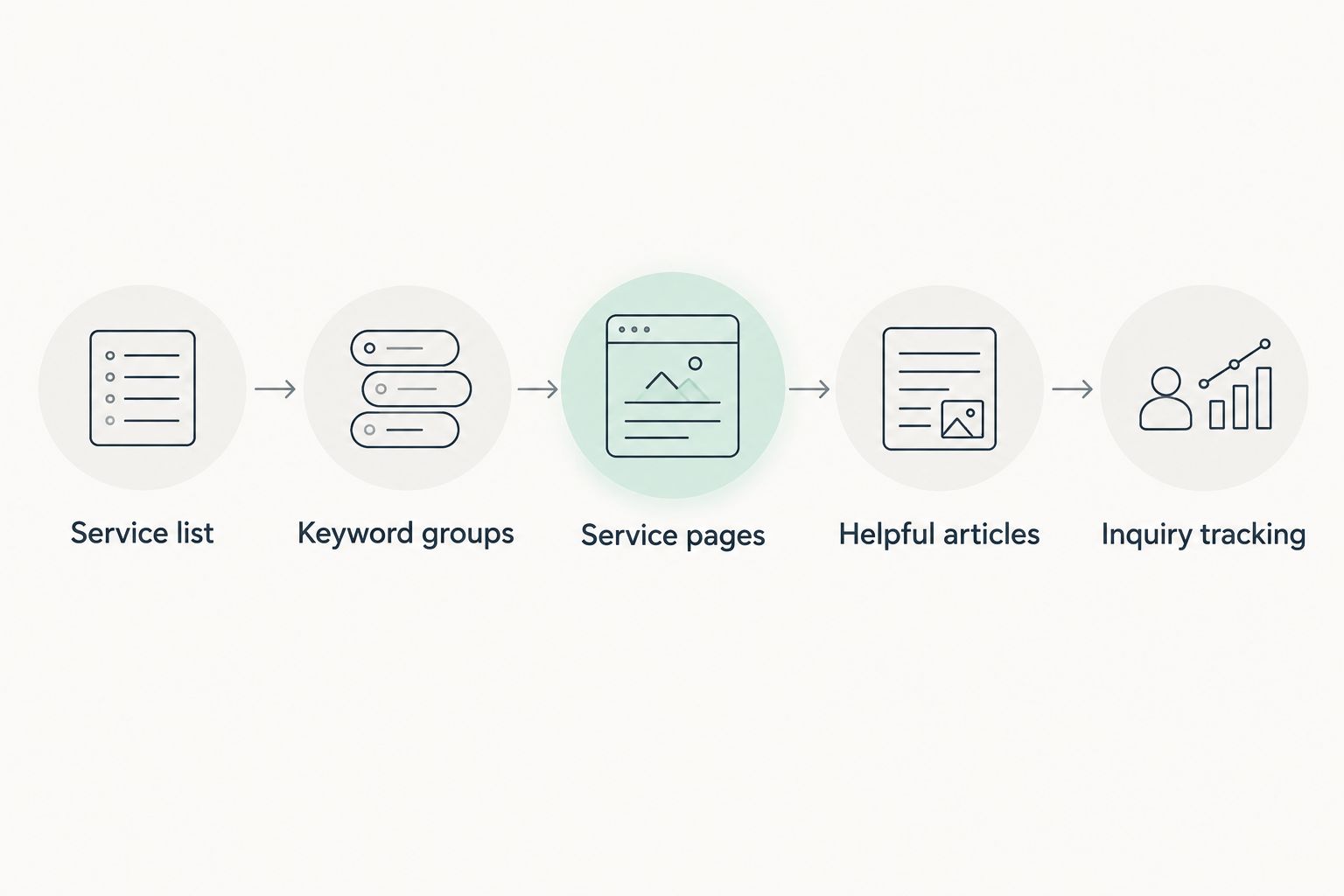
Do not schedule content faster than your team can review it. Improveseoplugin supports publishing and scheduling from the WordPress dashboard; your approval process should still catch inaccurate service claims and unsafe advice.
- Give every location page a distinct customer purpose.
- Use verified local details rather than invented examples.
- Separate informational articles from service pages.
- Check drafts before scheduling publication.
- Remove pages that merely repeat another page.
Request reviews and maintain business details
Ask customers for honest reviews after completed work. Keep the request neutral, and follow Google's review policies: do not offer incentives or selectively ask only customers you expect to leave positive feedback. Reviews should represent customer experiences, not a promotional script.
Respond professionally without revealing private job details. A disagreement about a repair is not permission to publish the customer's address, account history, or personal information. Acknowledge the concern and move the discussion to an appropriate private channel.
Maintain the same factual business information wherever your company is listed. Differences in trading names, phone details, or addresses create confusion for customers. Review directories that actually matter to your market rather than creating listings simply to increase a count.
Earn mentions through real business relationships and documented work. A legitimate community association or supplier relationship has a reason to reference your company; an unrelated directory submission does not demonstrate that relevance.
- Request honest feedback after completed jobs.
- Avoid incentives and positive-review screening.
- Respond without disclosing customer information.
- Correct outdated business details on relevant listings.
- Seek mentions through genuine business relationships.
Measure inquiries and improve the right pages
Start with a manual inquiry log if you do not have reporting configured. Record the requested service, service location, source when known, and whether the inquiry became a booked job. This separates useful demand from calls for services or areas you do not cover.
Use Google Search Console to inspect search queries, impressions, clicks, and the pages receiving them. Those measures describe search visibility and visits; they do not tell you whether a caller booked work. Connect the search picture to your inquiry records without treating either as a complete account on its own.
For your 2026 review, compare pages by purpose. A repair service page should support service inquiries. A preparation article can help customers understand the process, even when it is not the first page they visit before booking.
If a page receives relevant impressions but few clicks, examine its title and search intent. If visits arrive without suitable inquiries, check service clarity, coverage, and the contact route before publishing another article.
- Record qualified inquiries and booked jobs.
- Inspect queries and landing pages in Search Console.
- Separate informational visits from service-page visits.
- Check whether search terms match your actual work.
- Fix unclear pages before expanding the content plan.
Compare local SEO options for contractors
Choose the approach around the work you can consistently maintain. A publishing plugin addresses content workflow; it is not a substitute for accurate business information or accountable review.
| Option | Best for | Main advantage | Key limitation |
|---|---|---|---|
| Manual workflow | Owners handling a small, focused service list | Direct control over research, writing, and updates | Requires separate research, drafting, and publishing work |
| Improveseoplugin | WordPress contractors producing local content | Combines local keyword research, branded content generation, publishing, and scheduling | Does not replace technical review or confirmation of business claims |
| Contractor-managed SEO agency | Businesses delegating research and execution | Can assign ongoing SEO work to an external team | Responsibilities and review arrangements depend on the agreed scope |
The manual route keeps decisions close to the people doing the work, but requires time and consistency. A WordPress plugin reduces content-production steps while leaving approval with your business. An agency route requires a clear scope: specify who maintains the profile, writes pages, checks technical accuracy, and reports qualified inquiries.
Common local SEO mistakes contractors make
Combining unrelated services on one page
A page covering furnace repair, air conditioning installation, rewiring, and panel upgrades gives each job too little explanation. Separate distinct services while keeping closely related questions together. Customers should understand the page's purpose before they reach the contact form.
Publishing city pages without local substance
Changing the city name while keeping the same body does not answer a new customer question. Keep a location page only when it clarifies real coverage or contains verified, useful local information. Do not imply an office exists where you only travel for jobs.
Advertising response promises the office cannot meet
Emergency, same-day, and round-the-clock claims affect the customer's decision to call. Publish them only when they reflect your actual service arrangements. Keep website statements aligned with how dispatch accepts work, including any geographic or service restrictions.
Turning educational content into unsafe instructions
Troubleshooting content should help customers describe symptoms and recognize when professional help is needed. It should not encourage unqualified readers to open electrical panels or work on hazardous equipment. Require a qualified reviewer for technical safety guidance.
Treating publishing volume as business progress
More articles do not establish that you are receiving better inquiries. Review which pages attract relevant searches and which services generate suitable requests. Your 2026 content plan should improve those connections rather than reward publication for its own sake.
FAQ
What's the best place to start with local SEO for HVAC contractors?
Start with accurate service information, Google Business Profile details, and clear service pages. Confirm what you offer and where you work before expanding your keyword list or publishing location content.
Should HVAC and electrical services have separate pages?
Distinct HVAC and electrical services should have separate pages when they answer different customer needs. Keep related questions together rather than creating a page for every keyword variation.
Do I need a page for every city I serve?
No, you do not need a page for every city you serve. Create a location page when it provides useful, verified information beyond a city-name substitution.
Can Improveseoplugin handle local SEO content in WordPress?
Improveseoplugin helps find low-competition local keywords, generate branded content, and publish or schedule it from WordPress. Contractors still need to verify technical guidance, service claims, and business details before publication.
Is a WordPress plugin better than doing local SEO manually?
A WordPress plugin is better for reducing separate content-production steps, while a manual workflow gives you direct control over each task. Neither approach removes the need for accurate information and editorial review.
How do I know whether local SEO is bringing useful leads?
Track qualified inquiries and booked jobs alongside search queries and landing pages. Check whether contacts request services you provide in places you actually cover.
Should contractors publish emergency service keywords?
Contractors should target emergency service keywords only when they provide the service described. Response and operating-hour claims must match the arrangements your office can actually fulfill.
One last thing
Before adding another page, ask your office which questions repeatedly slow down booking. A missing service boundary, unclear coverage area, or vague inquiry process can deserve attention before another keyword does.
For your next 2026 update, improve the page that answers a real booking question. Read it as a homeowner: can you tell whether the contractor handles your job, serves your area, and explains how to request help? If not, fix that page first.