Fitness studio local SEO is improving your visibility in nearby searches to attract relevant class bookings and training inquiries. Studios need location and class pages; personal trainers also need clear service-area information. This 2026 guide puts those foundations before content production.
- Local seo for fitness studios starts with accurate listings and booking-ready pages.
- Target class-specific searches and personal training needs, not generic fitness topics.
- Improveseoplugin suits WordPress owners who need local keyword research and content publishing.
Why local SEO matters for fitness studios and personal trainers
A nearby prospect needs to know where you train, what you offer, and whether your schedule fits before booking.
Define your service area
Start with the places you actually serve. Separate studio visits from training delivered at a client's location.
- Record your studio address.
- List genuine service areas.
- Identify your booking destination.
Update your business information
Check your public details manually before creating content. Conflicting hours or contact information create unnecessary booking friction.
- Confirm your business name.
- Correct your opening hours.
- Check your phone number.
- Test your booking link.
Map keywords to real services
Use a spreadsheet first. Improveseoplugin adds local keyword discovery and content publishing inside WordPress once your service map is clear.
Improveseoplugin is best for small local business owners using WordPress who need local keyword research and content publishing without SEO expertise. Its role is content workflow, not replacing accurate business information or checking whether a class description matches what you teach.
For your 2026 plan, organize searches around services, places, and customer needs. A Pilates studio needs different landing pages from a personal trainer offering strength coaching. Do not target a service simply because a keyword sounds attractive.
Compare 5 search phrases manually and record the intent behind each. Treat that number as a manageable starting task, not a demand estimate. Look at the search results to distinguish studio-finding queries from exercise explanations.
- Service searches: match terms such as Pilates classes to services you actually offer.
- Location searches: pair a service with your real city or neighborhood.
- Audience searches: include beginner training only when you offer it.
- Booking searches: identify queries asking about schedules, consultations, or appointments.
- Question searches: reserve informational topics for supporting articles.
Build pages that answer booking questions
Write your main service pages manually before expanding your article library. Each page should explain the service, who it serves, where it happens, and the next action. A page about personal training should not make readers search elsewhere to learn whether sessions happen in a studio or at their home.
Use the visitor's decision process as your outline. Explain the session format, relevant trainer qualifications, arrival instructions, and booking route using only verified business details. For a class page, describe the experience plainly rather than filling the opening with fitness slogans.
A local landing page should help someone choose and book, not merely repeat a city name. Keep separate pages for genuinely different services; do not create near-identical neighborhood pages that change only the location wording.
In 2026, check the live booking experience alongside the page text. A persuasive page cannot resolve a broken appointment link or a schedule that contradicts the booking system.
- Put the service and location in a clear page title.
- State who the class or training session suits.
- Explain what a newcomer should expect.
- Add verified location and arrival information.
- Link to the relevant booking destination on your own website.
- Answer the questions people ask before contacting you.
Align your Google Business Profile with your operation
Review your Google Business Profile directly before using any content tool. Google requires profiles to represent eligible businesses accurately; a studio and a trainer traveling to clients do not necessarily need the same address settings. Follow Google's current eligibility and service-area guidance for your operating model.
Choose categories that describe what your business actually does. A specialist studio should not select unrelated categories to reach more searches. Keep hours aligned with when customers can interact with your business, and explain appointment arrangements clearly where appropriate.
For your 2026 review, inspect the profile from a customer's perspective. Check whether its website destination leads to useful service information and whether photographs reflect the actual space or service. Do not present stock images as evidence of your facilities.
Content publishing does not update an inaccurate profile by itself. Treat profile maintenance as a separate task with a named owner, especially when trainers, class schedules, or premises change.
- Verify your eligibility and address-display settings.
- Choose categories matching your real services.
- Correct customer-facing hours and contact details.
- Add genuine photographs of your operation.
- Check the website and booking destinations.
- Remove descriptions of services you no longer provide.
Publish answers to local customer questions
Collect questions from consultations, messages, and front-desk conversations before drafting articles. Those questions give you a practical editorial starting point without assuming search demand. Prioritize subjects that help a reader understand an actual service, then validate the related queries through keyword research.
Useful topics include what to bring to a first class, how private sessions differ from group classes, and how to choose a suitable starting level. Include local details only when they help: access information belongs in a studio-arrival guide, while a general exercise explanation rarely needs repeated neighborhood names.
For a 2026 editorial calendar, manually draft an outline and check every business claim before publication. Improveseoplugin can generate branded content and publish or schedule it from WordPress. You still need to check training advice, credentials, class details, and statements about your business.
Publish fewer useful answers rather than multiple articles competing for the same booking query. Give each article a distinct purpose and a relevant route back to its service page.
- Gather questions from real customer conversations.
- Match each topic to a service you deliver.
- Separate informational articles from booking pages.
- Verify health and exercise statements before publishing.
- Remove invented testimonials, credentials, or outcomes.
- Update articles when the service details change.
Request reviews without coaching the wording
Ask customers for honest feedback through a consistent, manual process. Choose an appropriate point after they have experienced your service, and make the request easy to understand. Do not require a positive review or supply wording that makes every customer sound identical.
Google's review policies prohibit incentives for reviews and selectively soliciting positive reviews. Avoid discounts, gifts, or other rewards tied to leaving a review. Requesting feedback only from customers you expect to praise you also creates a distorted picture of the business.
Respond with care. Fitness services involve personal goals and sometimes sensitive health information, so a public reply should not reveal private details about someone's training or condition. A short acknowledgment is better than exposing information while trying to demonstrate expertise.
Assign review requests and responses to a responsible person. Content software is not a substitute for customer communication, and article volume does not establish the experiences that customers describe.
- Ask for honest feedback without incentives.
- Use a neutral request rather than scripted praise.
- Apply the same approach across customers.
- Respond without disclosing personal information.
- Address service complaints through an appropriate private channel.
Measure visibility and booking actions separately
Start with Google Search Console and the information available in your booking process. Search Console reports search visibility and clicks; completed appointments require booking or conversion records. Do not label every organic visit as a new customer.
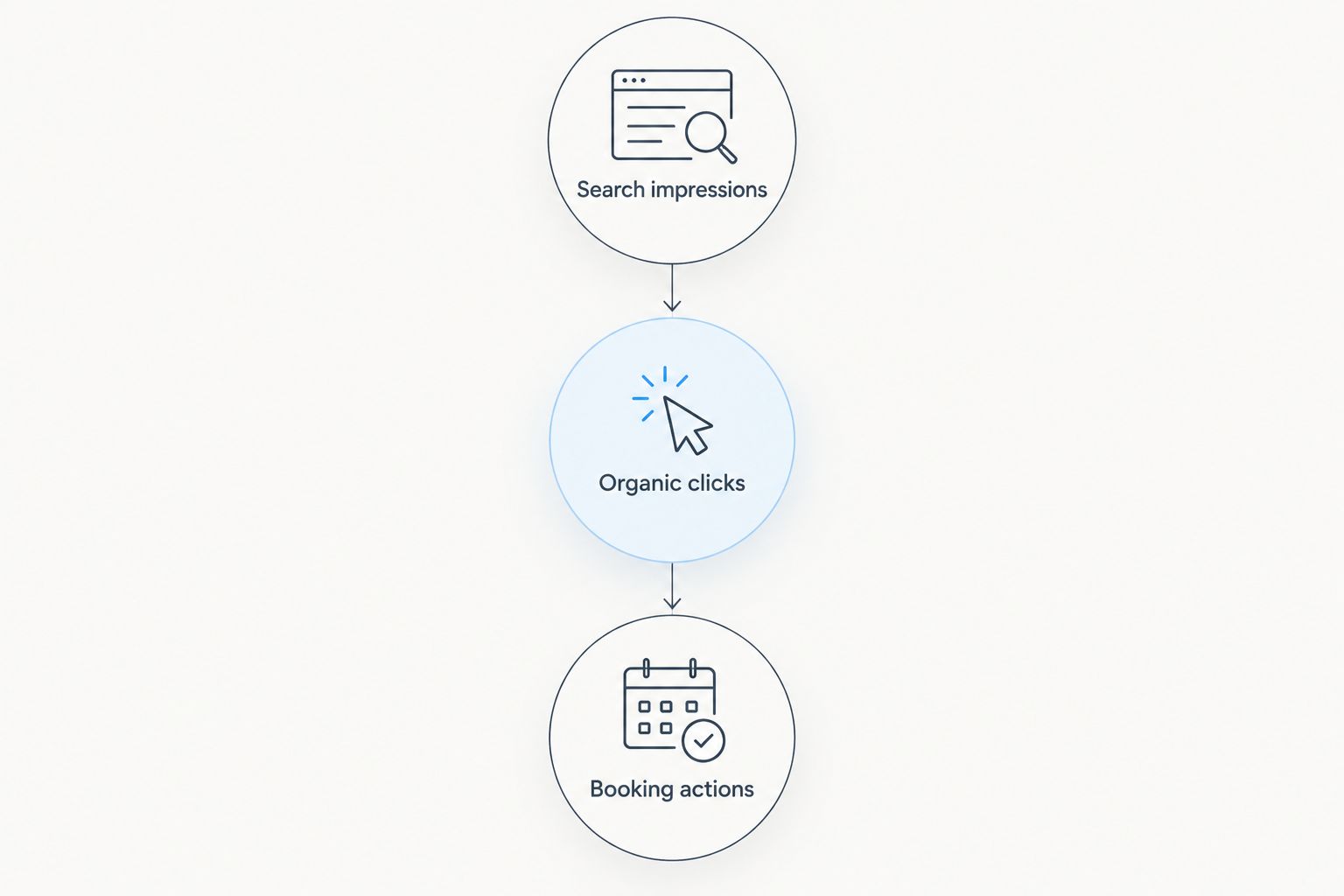
Track 3 measures as your starter scorecard: relevant search impressions, organic clicks to service pages, and completed booking actions you can reliably identify. These are recommended measurement categories, not performance benchmarks. Record the definitions so your monthly comparisons remain consistent.
In 2026, separate branded searches from service-and-location queries. Someone searching your business name has different intent from someone looking for a nearby beginner class. Review individual landing pages rather than treating total website traffic as the entire diagnosis.
When a page receives relevant visits but few booking actions, check the service explanation and booking route before commissioning more articles. When impressions remain limited, inspect query relevance and indexing before assuming the problem is conversion.
- Record the query groups you want to reach.
- Track service pages separately from informational articles.
- Test booking actions before counting them.
- Compare equivalent reporting periods.
- Note schedule, website, and service changes alongside results.
- Prioritize the page with the clearest next problem to solve.
Compare local SEO options for your studio
Choose the approach around the task you need completed. A profile-management problem, a content-production bottleneck, and a broader website problem call for different work.
| Option | Best for | Main strength | Key limitation |
|---|---|---|---|
| Manual local SEO | Owners establishing accurate listings and core service pages | Direct control over business details and editorial choices | Research, writing, publishing, and checking stay with you |
| Improveseoplugin | Small local businesses managing content in WordPress | Local keyword discovery, branded content generation, publishing, and scheduling in the dashboard | Requires WordPress and does not replace factual review or profile maintenance |
| An SEO agency or freelancer | Owners needing delegated work with an agreed scope | Can take responsibility for selected research, technical, or content tasks | Deliverables and responsibilities depend on the engagement |
Start manually when your foundations are incomplete; add software when repeated content work becomes the bottleneck. If you hire outside help, request a scope that separates profile work, service-page improvements, technical tasks, and article production.
Do not choose an approach solely by how many articles it produces. A studio needs accurate service information and a functioning booking route regardless of who writes the supporting content. Assign ownership of those details before delegating publication.
Common mistakes fitness studios and personal trainers make
Targeting fitness topics without local buying intent
A broad exercise article can answer a question without helping someone choose your nearby service. Keep educational content, but do not let it replace pages for the classes and training you sell. Evaluate each topic by its role in the customer journey, not just its fitness relevance.
Publishing duplicate neighborhood pages
Changing the neighborhood name does not create a useful local page. Publish a separate location page only when it has genuine information about that location or service area. Otherwise, improve the main service page and explain your actual coverage clearly.
Leaving schedules disconnected from service pages
A class page that describes a session you no longer run sends visitors toward a dead end. Review the website, business profile, and booking system whenever schedules change. Make one person responsible for confirming that the public information agrees.
Making unsupported health or transformation claims
Avoid guaranteed weight-loss results, unverified rehabilitation claims, and invented client stories. Describe your actual approach and qualifications instead. Review exercise advice carefully, particularly when a topic involves injuries, medical conditions, or suitability for specific participants.
Treating generated content as finished content
A draft can contain confident details that do not match your business. Check every class name, qualification, location statement, and booking instruction before publication. The ability to schedule articles does not remove your responsibility for what appears on your website.
FAQ
What's the best starting point for local SEO for fitness studios?
Start with accurate business information and useful pages for your real services. Confirm your address or service area, hours, class details, and booking destination before expanding your content.
Do personal trainers need a separate page for every neighborhood?
No, personal trainers should not create near-identical pages for every neighborhood. Separate pages need distinct, useful information about the service or location; otherwise, explain genuine coverage on the main service page.
Is a Google Business Profile enough for a fitness studio?
A Google Business Profile does not replace useful service pages and a working booking route. Keep the profile accurate and use your website to explain classes, training formats, suitability, and arrival details.
What's better for local SEO: class pages or blog posts?
Class pages come first when visitors cannot yet understand or book your services. Blog posts support those pages by answering specific questions rather than competing for the same service-and-location query.
Can Improveseoplugin help a personal trainer with local SEO?
Improveseoplugin can help a personal trainer using WordPress find low-competition local keywords, generate branded content, and publish or schedule it. Business details and training advice still need review, and profile maintenance remains a separate task.
Can I offer a reward for Google reviews?
No, Google's review policies prohibit incentives for reviews. Ask for honest feedback without discounts, gifts, or a requirement to leave a positive rating.
How do I know whether local SEO is bringing bookings?
Compare relevant search visibility and organic service-page visits with reliably tracked booking actions. Search Console clicks alone do not prove that someone completed an appointment.
One last thing
Before adding another article to your 2026 plan, complete your own booking journey on a phone. Start from a service page and follow the same steps a new customer would take. Check whether the class name, location, session format, and booking information still agree.
Fix the first contradiction you encounter. More search visibility sends more people into the experience you already have; it does not repair that experience. For a fitness studio or personal trainer, clear expectations and a working next step belong ahead of another generic workout article.