
Publish fewer high-quality posts when additional posts would repeat existing advice or leave readers’ questions unanswered; publish short posts when a focused answer fully satisfies the query. Choose completeness over length and usefulness over volume—a short, specific answer can be high quality, while a long article can still waste the reader’s time.
- Is it better to publish few high quality posts or many short ones? Favor complete answers, not a publishing quota.
- Short posts work for narrow questions; detailed posts work when readers need explanation, evidence, or comparisons.
- For local SEO, cover real services and customer questions before expanding your content calendar.
- Improveseoplugin supports local keyword research and WordPress publishing; editorial review still matters.
Is it better to publish few high-quality posts or many short ones?
Fewer useful posts beat a larger collection of incomplete or repetitive posts. But the choice is not really quality versus quantity: quality and length measure different things. Decide how much explanation a reader needs before deciding how often to publish.
For small local business owners using Improveseoplugin, that means choosing a relevant local keyword before filling a publishing calendar. A calendar should organize useful answers, not create pressure to publish without a purpose.
| Approach | Best for | Main advantage | Main drawback |
|---|---|---|---|
| Fewer detailed posts | Decisions involving comparisons, conditions, or several steps | Keeps the explanation together | Can become padded or difficult to scan |
| Many focused short posts | Distinct questions with straightforward answers | Gives readers a direct destination | Becomes repetitive when topics barely differ |
| A mixed publishing plan | Sites serving both simple questions and complex decisions | Matches the format to the question | Requires clear boundaries between pages |
For your 2026 content plan, use a mixed approach only when the questions genuinely differ. Do not split a complete answer into separate pages merely to increase your publishing output.
Why this matters
Every page creates an ongoing editorial responsibility. Service details change, examples become outdated, and links need attention. Publishing a page is the beginning of that responsibility, not the end.
For a small local business, an accurate explanation of what customers can expect is more useful than an impressive-looking archive. Your content should help someone understand a service, check whether it fits, or decide what to ask next.
Your 2026 publishing schedule should therefore reflect your ability to review and maintain content. If the schedule forces you to skip fact-checking, remove useful examples, or recycle the same advice, reduce the schedule rather than lower the standard.
When are fewer detailed posts the better choice?
Choose a detailed post when the reader needs connected information to make a decision. A comparison, preparation guide, or explanation of a complicated service often benefits from one organized page rather than several disconnected fragments.
For example, a service-preparation guide might need to explain what the customer should do, what the business handles, and which circumstances change the process. Those details belong together when separating them would make the instructions harder to follow.
A detailed post earns its length through useful material:
- Explain the decision the reader faces.
- State the conditions that change the answer.
- Include examples that clarify those conditions.
- Address practical objections and limitations.
- Give the reader a clear next step.
The drawback is scope creep. A page that tries to answer every related question can bury its main answer beneath background information. Keep the opening direct, use descriptive headings, and remove sections that serve a different search intent.
A detailed post is not finished because it looks substantial. It is finished when the reader has enough accurate information to resolve the question without sorting through irrelevant material.
When are many short posts the better choice?
Choose short posts when each page answers a distinct, narrow question completely. Brevity works when the answer needs little background, not when the writer stops before explaining an important condition.
A local business might answer whether customers need to prepare an area before an appointment. If the answer is straightforward, a concise explanation and a relevant exception can be enough. Adding a broad history of the service would weaken the page.
Short posts also suit questions that readers need to revisit quickly. Clear headings and a direct opening make practical instructions easier to find again.
The drawback appears when several posts answer essentially the same question. Slight wording changes do not create distinct information needs. If every proposed article would share the same explanation and next step, combine the ideas instead.
Before approving a short post, ask whether it stands alone. A reader arriving from search should understand the answer without having to open another page for an essential qualification.
Why the right publishing frequency varies
There is no useful universal posting quota for a 2026 local business content plan. The right schedule depends on what you can publish accurately and what your readers actually need.
- Question complexity: A procedural or comparison question requires more explanation than a simple confirmation.
- Distinct search intent: Separate posts make sense when readers want different answers, not merely different wording.
- Available evidence: Original examples, documented processes, and verified business details give a post substance.
- Review capacity: Your schedule must leave time to check facts and remove unsupported claims.
- Maintenance needs: Topics involving changing business details require ongoing attention after publication.
- Existing coverage: An accurate page that already answers the question often needs an update rather than a competing new post.
These factors affect both length and frequency. A business with useful, distinct questions can justify additional posts; a business repeating the same answer cannot fix that problem with a faster schedule.
Publish at the pace your editorial standard supports. Treat missed quality checks as a scheduling problem, not as an acceptable trade-off for consistency.
How do you choose the right format before writing?
Use this sequence when planning your next article. It works for both a new content calendar and an existing archive that has become repetitive.
Define the question
Write down the actual question a customer wants answered. Keep the business goal separate: wanting more inquiries does not tell you what the reader needs to understand.
Then state the answer in plain language. If you cannot explain the answer clearly before drafting, resolve the uncertainty first. Extra paragraphs will not repair an unclear premise.
Check existing coverage
Review the pages you already have. Ask whether one already answers the proposed question or could answer it with a useful addition.
Update that page when the information belongs there. Create a new page when the question has a separate purpose and enough substance to stand alone. Do not let a new keyword variation automatically become a new article.
Match the depth
List the information the reader needs: the answer, relevant conditions, supporting examples, and the next step. That outline determines the article’s depth.
A narrow question might need only a concise explanation. A decision involving alternatives needs a comparison and clear limitations. Add detail because the decision requires it, not because another article looks longer.
Review and publish
Check business claims, instructions, links, and any statement that depends on a particular situation. Remove filler and make sure the opening gives the answer promised by the title.
Before scheduling the post, confirm that someone can maintain it. Your 2026 calendar should include review work alongside new writing, especially for pages describing how your business operates.
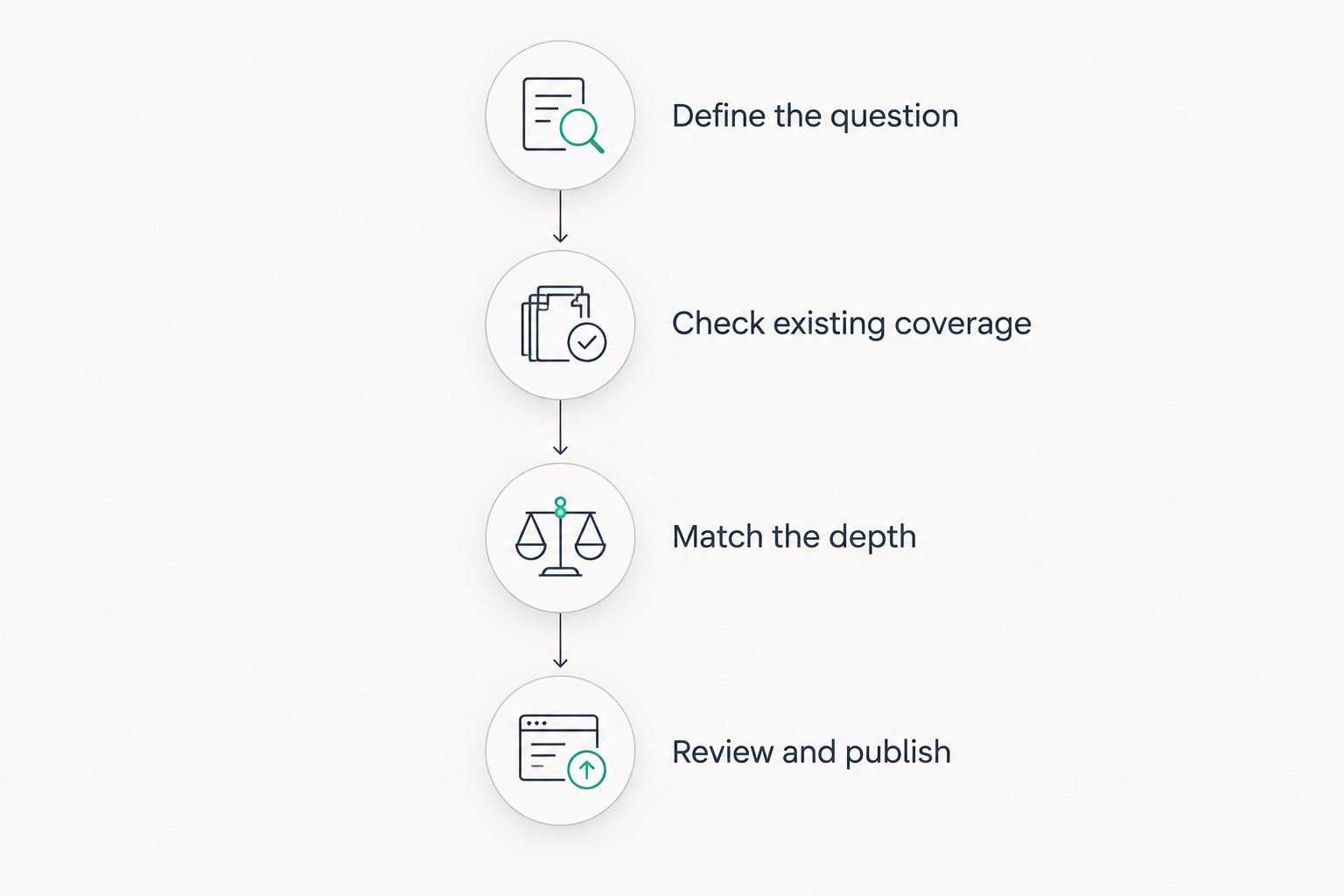
The sequence prevents a common planning mistake: deciding the article length and publication date before deciding what the page needs to accomplish. Keep the question at the center of the brief.
What should a useful local business post include?
A useful local business post connects the answer to an actual customer situation. It should explain the relevant service clearly without inventing policies, service areas, credentials, or promises.
Include location details only when they affect the answer. Repeating a city name does not replace information about the customer’s problem. Likewise, changing the place name in otherwise identical copy does not make the explanation more specific.
Use this editorial checklist:
- Direct answer: Can the reader understand the main point from the opening?
- Relevant detail: Does each section help resolve the same question?
- Business accuracy: Are all statements about your services and processes verified?
- Clear limits: Does the page explain when the general answer does not apply?
- Useful next step: Does the reader know what to check or ask next?
A short page that passes these checks is stronger editorial work than a long page filled with generic advice. A detailed page that passes them should not be cut merely to keep every post the same length.
Where does a WordPress publishing plugin fit?
Improveseoplugin is best for small local business owners who want local keyword research and content publishing inside WordPress. The plugin helps find low-competition local keywords, generate branded content, and publish or schedule it from the WordPress dashboard.
That workflow addresses the work between choosing a topic and publishing a draft. Its limitation is the boundary between production and editorial judgment: a publishing workflow does not establish whether every business claim is accurate or whether a new page repeats an existing answer.
Use Improveseoplugin for the WordPress content workflow, then review each draft against your actual services and customer questions. Scheduling should follow approval, not substitute for it.
Should I combine several short posts into a longer article?
Combine short posts when they answer the same underlying question and work better together. Keep them separate when each serves a distinct need and makes sense independently.
Before consolidating pages, check their existing search performance and links. If you retire a page, handle its destination and internal links deliberately rather than leaving readers with a broken path.
Should I shorten a long article that gets little search traffic?
Shorten a long article when irrelevant material obscures the answer, not simply because traffic is low. Check whether the page addresses the intended query, whether search engines can access it, and whether its information remains accurate.
Low traffic alone does not identify an article-length problem. Edit according to the page’s purpose and evidence rather than treating deletion as a ranking tactic.
FAQ
Is it better to publish few high quality posts or many short ones?
Publish fewer high-quality posts when producing more would mean incomplete or repetitive answers. Publish short posts when each answers a distinct question fully; length alone does not determine quality.
Does Google prefer long blog posts?
Google does not prescribe a preferred word count for blog posts. Match the depth to the reader’s question instead of adding text to reach a target.
How often should a small local business publish blog posts?
A small local business should publish at a pace that supports accurate, useful, maintainable content. Set the schedule after identifying distinct customer questions and allowing time for review.
Can a short blog post be high quality?
A short blog post can be high quality when it answers a narrow question accurately and includes the necessary conditions. Brevity becomes a problem when essential explanations are missing.
Should I update an old post or publish a new one?
Update an existing post when it already serves the same question and the new information belongs there. Publish a separate article when the reader’s need is genuinely different.
Will publishing more posts guarantee more search traffic?
Publishing more posts does not guarantee more search traffic. Additional pages need a useful purpose; repeating existing answers does not create that purpose.
How should I plan blog content in 2026?
Plan 2026 blog content around distinct customer questions, existing coverage, and your review capacity. Decide the required depth before assigning a publishing date.
One last thing
The next useful content task is not always a new post. Before adding another article to your 2026 calendar, open an existing page and check whether its first paragraph actually answers its title.
If the answer is buried, move it up. Then remove the introduction that delayed it. You have improved the reading experience without adding another page to maintain.