
AI-generated content is not inherently bad for SEO in 2026; inaccurate, unhelpful, or spam-driven content is the problem, regardless of who writes it. Using AI does not guarantee rankings or trigger an automatic penalty, and publishing a draft without checking its facts can damage the usefulness of your page.
- Is AI generated content bad for SEO? No: Google evaluates usefulness and spam-policy compliance, not authorship alone.
- Google’s scaled content abuse policy covers low-value publishing, whether content comes from people, automation, or both.
- For local SEO, review business facts, search intent, and location details before publishing WordPress content.
Is AI-generated content bad for SEO in 2026?
No. Google Search Central’s guidance on AI-generated content focuses on content quality rather than the production method. Its spam policies separately address scaled content abuse: creating many pages primarily to manipulate rankings rather than help users.
For local businesses using WordPress, Improveseoplugin supports keyword research, branded content generation, publishing, and scheduling. Those functions support production; they do not replace editorial judgment.
| Publishing approach | Best for | Benefit | Limitation or risk |
|---|---|---|---|
| AI-assisted writing with human review | Owners who can supply firsthand business details | Turns supplied information into an editable draft | Requires checks for invented facts and irrelevant advice |
| Human-written content with subject expertise | Topics requiring original experience or careful judgment | Brings direct knowledge into the answer | Human authorship alone does not guarantee accuracy or usefulness |
| Automated publishing without meaningful review | Content that already has a dependable validation process | Reduces manual production work | Unchecked errors and repetitive pages can reach the live site |
The deciding question is whether the published page helps someone, not whether a person typed every sentence. A useful draft can come from AI, and an unhelpful page can come from a professional writer.
Why this matters
An AI-versus-human debate distracts you from the editorial decisions that affect your website. Your customer needs a correct answer, a clear explanation, and reliable information about your business.
For your 2026 content plan, treat generation as a production step rather than a quality standard. You still need to decide which questions deserve pages, what evidence supports the answers, and whether the finished article adds anything to your site.
The practical distinction is between creating content efficiently and publishing content indiscriminately. The first can support a useful website; the second fills it with material that nobody has taken responsibility for.
What does Google actually say about AI content?
Google Search Central’s document, Google Search’s guidance about AI-generated content, explains that appropriate use of AI or automation is not against its guidelines. The guidance emphasizes helpful, reliable, people-first content and explains that automation used primarily to manipulate search rankings violates spam policies.
Google’s Spam policies for Google web search describe scaled content abuse in terms of purpose and value, not a particular writing tool. Generating many pages without adding value is the issue; replacing the generator with human writers does not automatically solve it.
For a 2026 editorial decision, keep these distinctions separate:
- Content quality: Does the page answer the searcher’s question accurately and usefully?
- Spam compliance: Was the page created to help readers, or mainly to manipulate rankings?
- Search performance: Does the page compete successfully for the query it targets?
These questions overlap, but they are not interchangeable. A page can comply with spam policies and still fail to rank because it does not offer a useful answer for that search.
Likewise, a page losing traffic does not establish that AI authorship caused the decline. Examine the page, the query, and the competing results before assigning a cause.
Why AI-generated content quality varies
The writing method does not determine the final result. These factors explain why generated pages differ in usefulness:
- Source material: A draft based on verified business information has a firmer foundation than one built from a vague instruction.
- Search intent: A direct answer to the customer’s actual question is more useful than a broad article targeting the same words.
- Firsthand detail: Real processes, limitations, and examples give readers information that a generic summary lacks.
- Editorial review: Someone must check claims, remove unsupported statements, and correct misleading implications.
- Page differentiation: Separate pages need distinct purposes, not just different titles or city names.
- Maintenance: Published content needs correction when business details or the subject itself changes.
Fix the weakest input before asking for more output. Generating another draft does not solve an unclear topic, missing evidence, or a page that should not exist separately.
How should you review AI content before publishing?
Use the following 5 checks as an editorial workflow, not as a Google ranking formula. Each check answers a different question about whether the draft deserves publication.
Intent check
Write down what the reader needs to accomplish. Then compare that need with the opening paragraph, headings, and conclusion.
A customer asking whether a repair is necessary needs decision criteria. An article that spends most of its space explaining the history of the equipment misses that intent, even if every sentence is grammatically correct.
Remove sections that do not help answer the question. More coverage is not automatically more useful.
Fact check
Verify every business-specific claim against information you control. Review services, service areas, qualifications, policies, product names, and any promises made to customers.
For external claims, identify a dependable source and confirm that it supports the actual wording. A citation about a general topic does not validate a specific recommendation.
If you cannot verify a claim, remove it or rewrite the passage without it. Confident phrasing is not evidence.
Experience check
Add information that comes from doing the work: how you assess a problem, what customers need to prepare, or which limitations affect the result. Use only details that are true for your business.
Do not invent a customer story to make an article sound experienced. A straightforward explanation of your real process is more useful than a fabricated anecdote.
Page check
Read the draft alongside the closest existing page on your website. Decide whether the new article serves a distinct question or simply repeats the same answer with different wording.
If both pages serve the same purpose, improve the existing page or combine the material. A separate URL needs a reason beyond another keyword variation.
Publish check
Preview the complete page in WordPress. Check headings, links, formatting, images, and the opening answer—not just the text inside the editor.
Assign responsibility for corrections before scheduling the article. A publishing calendar organizes release dates; it does not establish that the content is accurate.
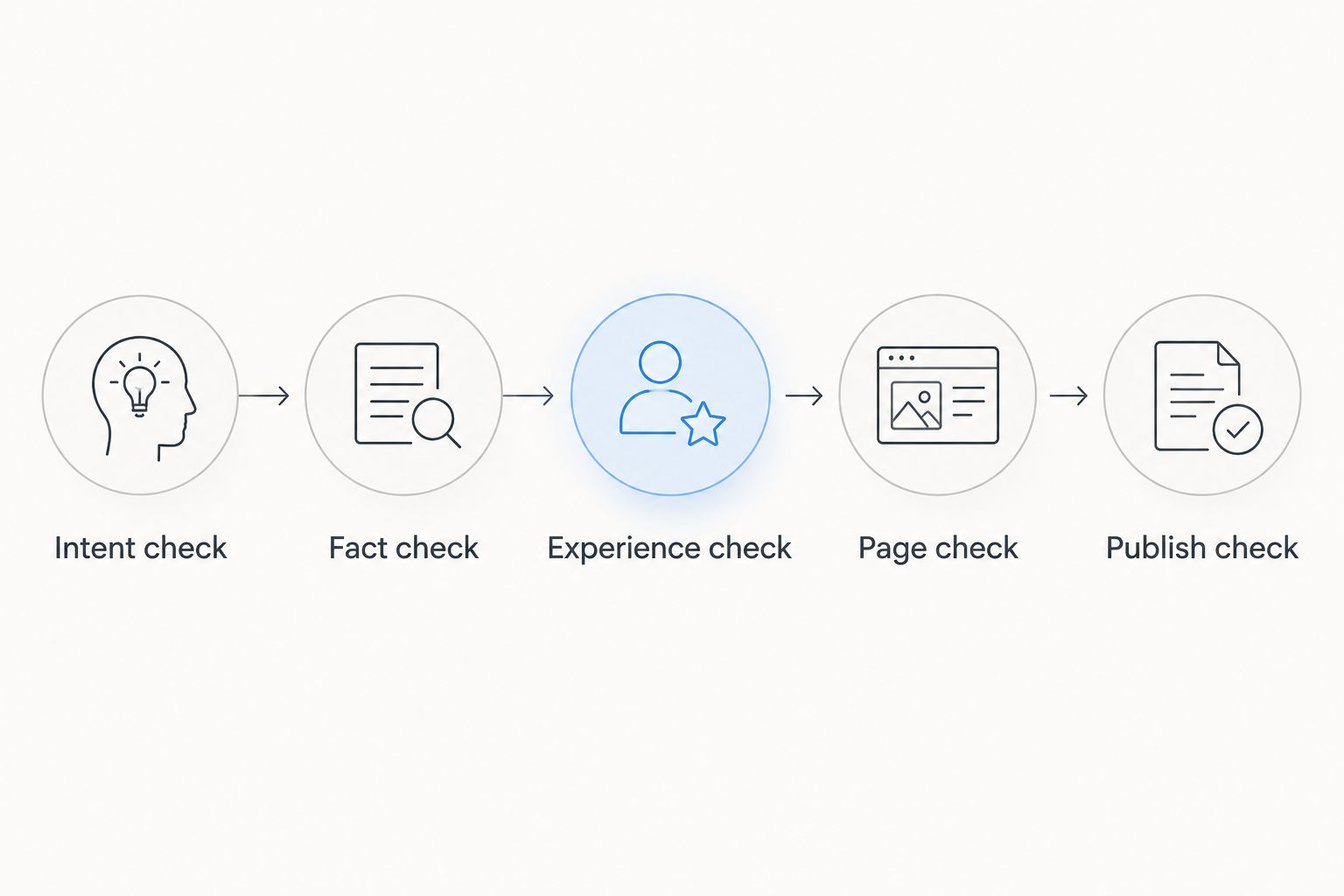
These 5 checks keep the review focused on the published result. Save the checklist with your editorial instructions so that a scheduled article meets the same standard as one you publish manually.
What makes AI content risky for local SEO?
Local content becomes misleading when it implies a business presence, service, or experience that does not exist. Changing a city name does not turn a generic article into a useful local page.
Before publishing location content in 2026, answer these 3 questions:
- Do you actually serve the location described?
- Does the page contain relevant information beyond the place name?
- Does a visitor have a clear reason to use this page instead of your general service page?
A legitimate location page can explain real service boundaries, location-specific procedures, or other verified differences. Do not manufacture those differences just to justify another page.
Google’s doorway abuse policy is also relevant when substantially similar pages target related searches and funnel visitors toward the same destination. That does not make every location page a doorway; the page’s purpose and usefulness matter.
Publish local pages because customers need distinct information, not because a generator can produce more city variations.
Where does a WordPress content plugin fit?
Improveseoplugin is best for small local business owners who want keyword research, branded content generation, and WordPress publishing in one workflow. Its stated functions include finding low-competition local keywords and publishing or scheduling content from the WordPress dashboard.
That workflow addresses production work. The owner still needs to confirm that a proposed topic matches the business and that the draft describes its services accurately.
The benefit of Improveseoplugin is the connected workflow; the limit is that generated content still needs business-specific review. Use publishing automation after editorial approval, not instead of it.
Keep 2 reviews distinct: factual approval and publishing approval. A draft can describe your business correctly while still containing broken links, awkward formatting, or an opening that fails to answer the question.
Will Google penalize my website for using AI?
Google does not impose an automatic penalty merely because you used AI to write content. Its published guidance distinguishes appropriate automation from practices that violate spam policies.
Do not confuse poor performance with a penalty. If an article does not rank, inspect its usefulness, relevance, originality, and technical accessibility before concluding that its writing method caused the problem.
For your 2026 publishing decisions, use Google Search Console to investigate indexing and any reported manual actions. Neither a low-ranking page nor an AI-detector result proves a policy violation.
Should I delete existing AI-generated articles?
Do not delete an article solely because AI helped create it. Review whether the page is accurate, useful, relevant to your business, and distinct from other pages on your site.
Keep and improve pages that serve a clear purpose. Correct unsupported claims, combine overlapping articles where appropriate, and remove material that cannot be made useful or accurate.
Start with customer-facing errors rather than cosmetic rewriting. An incorrect service promise matters more than whether a sentence sounds machine-written.
FAQ
Is AI-generated content bad for SEO in 2026?
AI-generated content is not inherently bad for SEO in 2026. Google’s guidance focuses on useful, reliable content and compliance with spam policies rather than banning a writing method.
Can AI-written articles rank on Google?
AI-written articles can rank on Google; AI authorship does not automatically exclude a page from search results. The content still needs to satisfy the query and meet Google’s applicable policies.
Do I have to disclose that AI helped write an article?
Google’s guidance does not set a blanket disclosure requirement for every AI-assisted article. Consider explaining how content was created when readers would reasonably expect that information, and follow any separate requirements that apply to your business.
Should I use an AI detector before publishing?
An AI detector is not a substitute for editorial review. Check accuracy, usefulness, originality, and policy compliance rather than treating a detector score as a Google ranking signal.
Is human-written content always better than AI content?
Human-written content is not automatically better than AI-assisted content. A human writer can publish unsupported or repetitive material, while a carefully reviewed AI-assisted draft can answer a reader’s question accurately.
Can I schedule AI-generated posts in WordPress?
You can schedule AI-generated posts in WordPress after reviewing them. Improveseoplugin supports content generation, publishing, and scheduling from the WordPress dashboard, but scheduling does not replace factual approval.
Should every local keyword get its own page?
Every local keyword does not need a separate page. Group searches that share the same intent, and create a distinct page only when it serves a distinct customer need.
One last thing
Before rewriting an article to make it sound less like AI, ask what a customer can learn from it that they cannot learn from a generic summary. If the answer is nothing, changing the tone will not fix the underlying problem.
For your next article, add a verified detail from your actual work before adding another section. The strongest improvement is often better source material, not a different writing tool.