Google updates local rankings on an ongoing basis, not on a published daily, weekly, or monthly schedule. In 2026, a change in your position does not mean Google has released a new algorithm update: location, search wording, competitors, and changes to business information also affect the results you see.
- How often does Google update local rankings? Ongoing reassessment, with no published refresh schedule.
- Google local search results depend mainly on relevance, distance, and prominence—not a fixed update day.
- Compare the same keyword, location, and search surface before treating a ranking change as a trend.
- Improveseoplugin supports WordPress local content work, not control over Google's ranking schedule.
How often does Google update local rankings?
Google does not publish a fixed refresh interval for local rankings. Its public guidance describes how local results are ranked, but it does not provide a countdown for when your business will move after an edit, review, or website change.
Use this sequence to interpret a position change:
- Match the search. Repeat the same search phrase rather than comparing different service terms.
- Match the location. A result seen near your business is not directly comparable with one seen across town.
- Match the surface. Compare Google Maps with Google Maps, or the local pack with the local pack.
- Check the pattern. Review repeated observations before changing your website or business profile.
The practical answer is not to find Google's next refresh date. It is to establish whether visibility changed under comparable conditions. For website work, Improveseoplugin helps small local business owners find low-competition local keywords and create, publish, and schedule branded content in WordPress.
Why this matters
If you treat every position change as an algorithm update, you risk editing a page that was not the problem. You also risk overlooking a genuine issue, such as an incorrect business category or a page that no longer loads.
For your 2026 reporting, separate three events: a change to your business information, Google's processing of that change, and a change in search visibility. Those events are related, but they are not interchangeable. An approved profile edit is not proof of a ranking improvement.
Measure whether the right customers can find the right service—not whether one search produces yesterday's order.
Local pack, Maps, and organic results are different views
Google's local pack, Google Maps, and ordinary website results do not represent a single position. The local pack typically displays three business listings, while organic results link to web pages outside that business-listing group.
Keep these views separate in your records. Each answers a different question about visibility, and none gives a complete picture alone.
| Search surface | Best for measuring | Useful evidence | Limitation |
|---|---|---|---|
| Local pack | Visibility in the business listings within Google Search | Position for a fixed query and location | One location does not represent your whole service area |
| Google Maps | Business discovery within Maps | Results from a consistent search area | Moving the map changes the geographic context |
| Organic results | Visibility of your website's pages | Search Console queries, pages, clicks, and impressions | Organic position does not report your local-pack position |
A service page appearing higher in ordinary search does not prove that your Maps listing moved. Likewise, a local-pack movement does not establish that Google has reprocessed a recent website edit.
Does Google Search Console show local-pack rankings?
Google Search Console reports website search performance; it is not a local-pack rank tracker. Use its query and page reports to investigate website visibility, then assess business-listing visibility separately.
This distinction prevents a common reporting error: presenting a website's average position as the business's position across every local search. Average position is an aggregate, not a promise that every customer sees that placement.
Why Google local rankings vary
Google's public local-ranking guidance identifies relevance, distance, and prominence as its main factors. These explain why a business does not have one permanent position across a city.
The following factors help you interpret movement without inventing an update schedule:
- Relevance: Your business information needs to match what the searcher wants. An accurate category and clear service information help describe that match.
- Distance: Google considers how far a business is from the location associated with the search. Changing the search location changes that context.
- Prominence: Google considers how well known a business is, including information such as links and reviews. This is broader than editing a profile field.
- Search wording: A broad category search and a specific service search express different needs. Do not combine their positions into a single observation.
- Changes to businesses: Your business and competing businesses can change their information, websites, and review profiles. Your own edits are not the only events to investigate.
These are diagnostic categories, not a formula you can calculate. Google does not publish weights that let you convert a new review or a page update into a guaranteed position gain.
Distance also sets a practical limit on interpretation. A strong result near your premises and a weaker result farther away do not, by themselves, prove that your optimization failed.
How should you monitor local rankings in 2026?
Use a repeatable measurement process rather than frequent searches from whatever device happens to be nearby. The objective is a useful comparison, not a larger collection of screenshots.
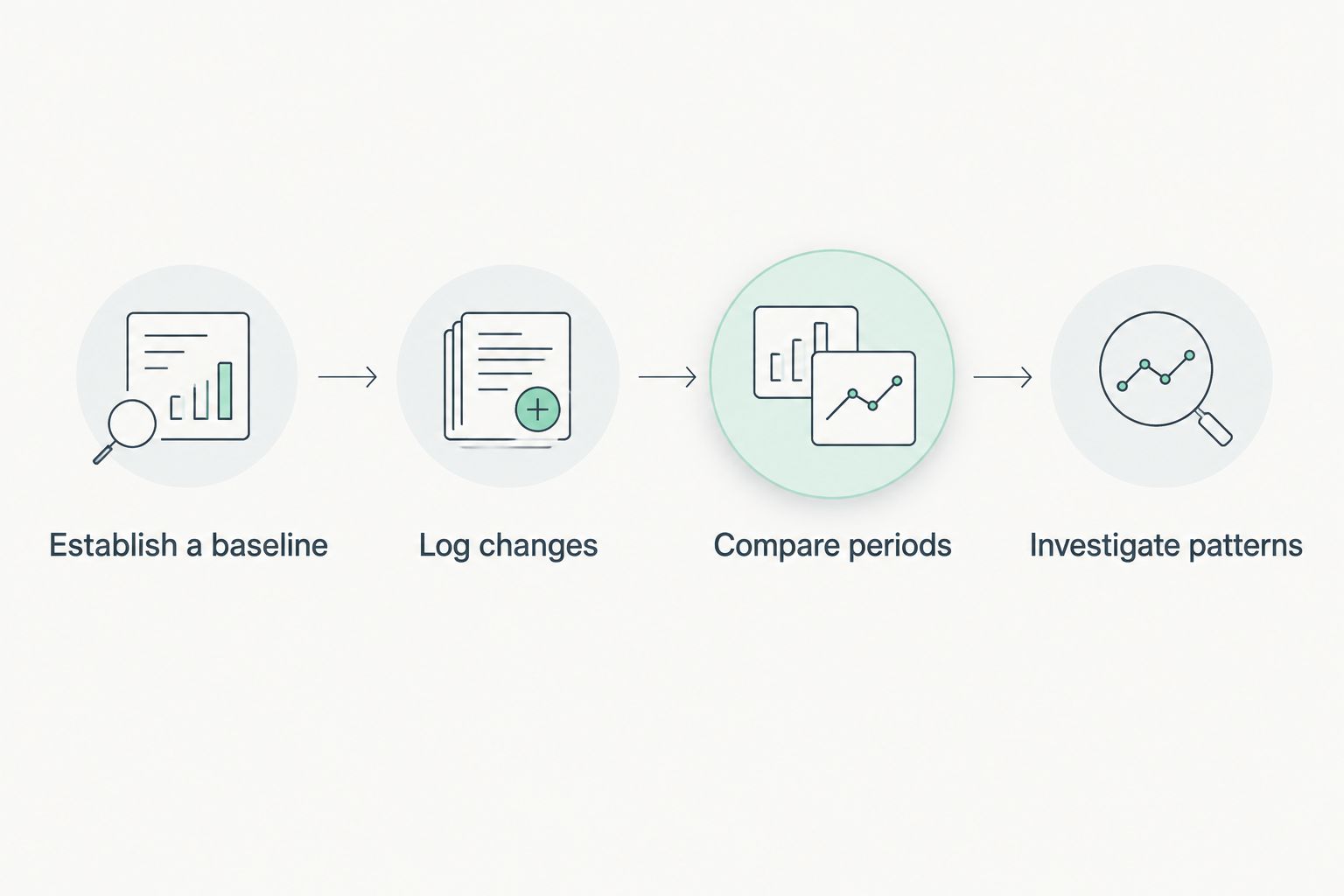
Establish a baseline
Choose the services and locations that matter to your business. Record the exact query, observation location, search surface, date, and landing page or business listing being measured.
Start with a manageable set. For example, select 3 service queries and review them from the same locations each week; that is a suggested monitoring routine, not Google's refresh frequency. Add queries only when they represent a distinct customer need.
Log changes
Keep a dated record of meaningful edits: business category, address, hours, website pages, redirects, and service descriptions. Record problems and corrections too.
A change log does not prove causation. It gives you a timeline to compare with visibility changes and prevents you from relying on memory when several edits overlap.
Compare periods
Compare equal reporting windows. A 28-day review window is a practical choice for recurring analysis, not a required waiting period or a promised time to rank.
In your 2026 reports, keep that window consistent and account for changes in demand. More impressions can reflect more searches, while a lower click count can have several explanations; neither metric alone identifies an algorithm change.
Investigate patterns
Look for changes that repeat across comparable observations. Then inspect the relevant business information, website pages, and search results before deciding what to fix.
Avoid changing several unrelated elements in response to one observation. A narrower correction leaves a clearer record of what happened and makes the next review more useful.
How long after an edit should you expect a ranking change?
There is no universal waiting period that applies to every business-profile edit or website update. Google must process the relevant information, and processing does not guarantee a different ranking.
Separate the question into the action you took:
- Business-profile edit: Check whether the edit is approved and visible. Publication confirms the information changed, not that your position must improve.
- Website update: Check that the page is accessible and eligible for indexing. A published WordPress page is not automatically an indexed Google result.
- New review: Confirm that the review appears, but do not assign it an expected position increase. Google's guidance does not promise a per-review ranking gain.
- Technical correction: Verify that the underlying problem is resolved. Removing an indexing obstacle restores eligibility; it does not guarantee a particular placement.
Confirm the change first, then measure its effects. Repeatedly rewriting the same information while waiting makes your timeline harder to interpret.
Does publishing more local content update rankings faster?
Publishing more content does not give you control over Google's ranking timetable. A useful page addresses a real service question and accurately describes the area you serve; publication frequency alone does not establish quality or relevance.
Improveseoplugin is best for small local business owners who want local keyword research and content publishing inside WordPress. The plugin supports that workflow, but it does not replace accurate business information, editorial review, or Google's indexing and ranking decisions.
Before scheduling a page, check its service claims, locations, and contact instructions. Do not publish pages for services you do not provide or imply that you have premises where you do not.
What should you check when local rankings drop?
Start by establishing whether you are comparing the same thing. A changed location, different keyword, or switch from Maps to ordinary search can explain an apparent drop without a site problem.
If the decline persists under matched conditions, inspect the following:
- Profile accuracy: Confirm that the business name, address or service area, category, hours, and website details remain correct.
- Profile status: Check for restrictions, verification issues, or unintended edits that require attention.
- Website access: Open the relevant pages and check for errors, redirects, or accidental indexing restrictions.
- Query coverage: Determine whether the decline affects one service term, several terms, or only a particular location.
- Business outcomes: Review website clicks and relevant customer inquiries alongside positions.
Use Google's published Search Status Dashboard when investigating an announced Search ranking update. Its announcements provide context, but an overlapping date does not prove that the update caused your local result to move.
For a 2026 investigation, keep the diagnosis specific: which query changed, where it changed, and which surface changed. A statement such as “Google rankings are down” is too broad to guide a correction.
Should you change your business profile every week?
Change your business profile when the information needs correction or when your business actually changes. A weekly editing ritual is not a published Google ranking requirement.
Keep opening hours, services, and business details accurate. Do not add keywords to your business name unless they are genuinely part of the name represented in the real world; Google's business representation guidelines govern that field.
The benefit of maintenance is accurate customer information. The limitation is that maintenance cannot remove distance from the ranking equation or guarantee a local-pack position.
FAQ
Does Google update local rankings every day?
Google does not publish a daily refresh schedule for local rankings. Results are reassessed on an ongoing basis, and the query and search location affect the results you see.
How long does it take to rank after changing my Google Business Profile?
There is no universal ranking deadline after a Google Business Profile edit. Confirm that the change is approved and visible, then compare visibility under consistent search conditions.
Why do my Google Maps rankings change across town?
Distance is one of Google's main local-ranking factors. A search made across town has a different geographic context from a search made beside your business.
Will more reviews guarantee a higher local ranking?
More reviews do not guarantee a higher local ranking. Google's guidance identifies reviews as part of local prominence, while relevance and distance also affect results.
Should I check my local rankings every hour?
Hourly checks are not necessary for a useful routine. Use consistent queries and locations, keep a change log, and investigate repeated patterns rather than reacting to isolated observations.
Does a new website page immediately improve Google Maps rankings?
A new website page does not guarantee an immediate Google Maps improvement. Publication, indexing, and local ranking are separate events.
What is the best way to track local rankings in 2026?
The best starting point is a consistent record of the query, location, search surface, and observation date. Review website performance separately from local-pack and Maps visibility.
One last thing
Your business does not have one local ranking. It has different visibility for different searches and locations, so the most useful next step is to define what you are measuring before trying to improve it.
For your next 2026 review, choose one important service query, one relevant location, and one search surface. Record that baseline, correct any factual problems, and compare like with like. A clean comparison tells you more than another guess about Google's next update.