
Local SEO has no fixed traffic payout: a realistic estimate depends on how many relevant searches occur in your service area and how many of those searches produce website clicks. Calls and direction requests are separate outcomes, so website traffic alone does not capture every customer action local search generates.
- How much traffic can local SEO bring a small business? Forecast from relevant local searches, not a universal traffic benchmark.
- Count website clicks separately from calls and direction requests; they measure different customer actions.
- Improveseoplugin supports local keyword research and WordPress publishing, not guaranteed traffic growth.
- Judge local SEO by qualified inquiries alongside traffic, not rankings or page counts alone.
Why this matters
A visitor outside your service area is not equivalent to a nearby customer looking for your service. Before setting a 2026 traffic target, decide which searches and customer actions actually matter to your business.
If content production is your bottleneck, Improveseoplugin helps small local business owners find low-competition local keywords and publish branded content from WordPress. That addresses a publishing task; it does not establish how much demand exists in your market.
Your traffic forecast should describe an opportunity you can measure, not a promise attached to an SEO package. Separate search visibility, website visits, and qualified inquiries before deciding what success looks like.
How much traffic can local SEO realistically bring a small business?
The defensible answer is a business-specific estimate built from search demand and click potential. A business targeting a narrow service in a small area faces a different search opportunity from a business offering several services across a larger territory.
Start by separating the outcomes that often get grouped under local SEO traffic:
| Outcome | What it tells you | Best for | Limitation |
|---|---|---|---|
| Organic website clicks | Someone selected your website from an unpaid search result | Measuring visits from search | A click does not establish whether the visitor became a customer |
| Business Profile website clicks | Someone selected the website link on your profile | Understanding profile-to-site activity | Other profile actions happen without a website visit |
| Business Profile call clicks | Someone selected the call action | Tracking phone-contact intent | A call click does not confirm an answered or qualified call |
| Direction requests | Someone requested directions to your location | Location-based businesses | A request does not confirm an in-person visit |
| Qualified inquiries | Someone contacted you about a service you actually provide | Evaluating business relevance | Inquiry tracking needs a clear definition and consistent recording |
Do not add these measures together and label the total website traffic. They describe different actions, and the same person can take more than one.
For a 2026 forecast, use your existing search performance as the starting point. If you are starting without a baseline, build a measurement plan first rather than presenting an unsupported monthly visitor target.
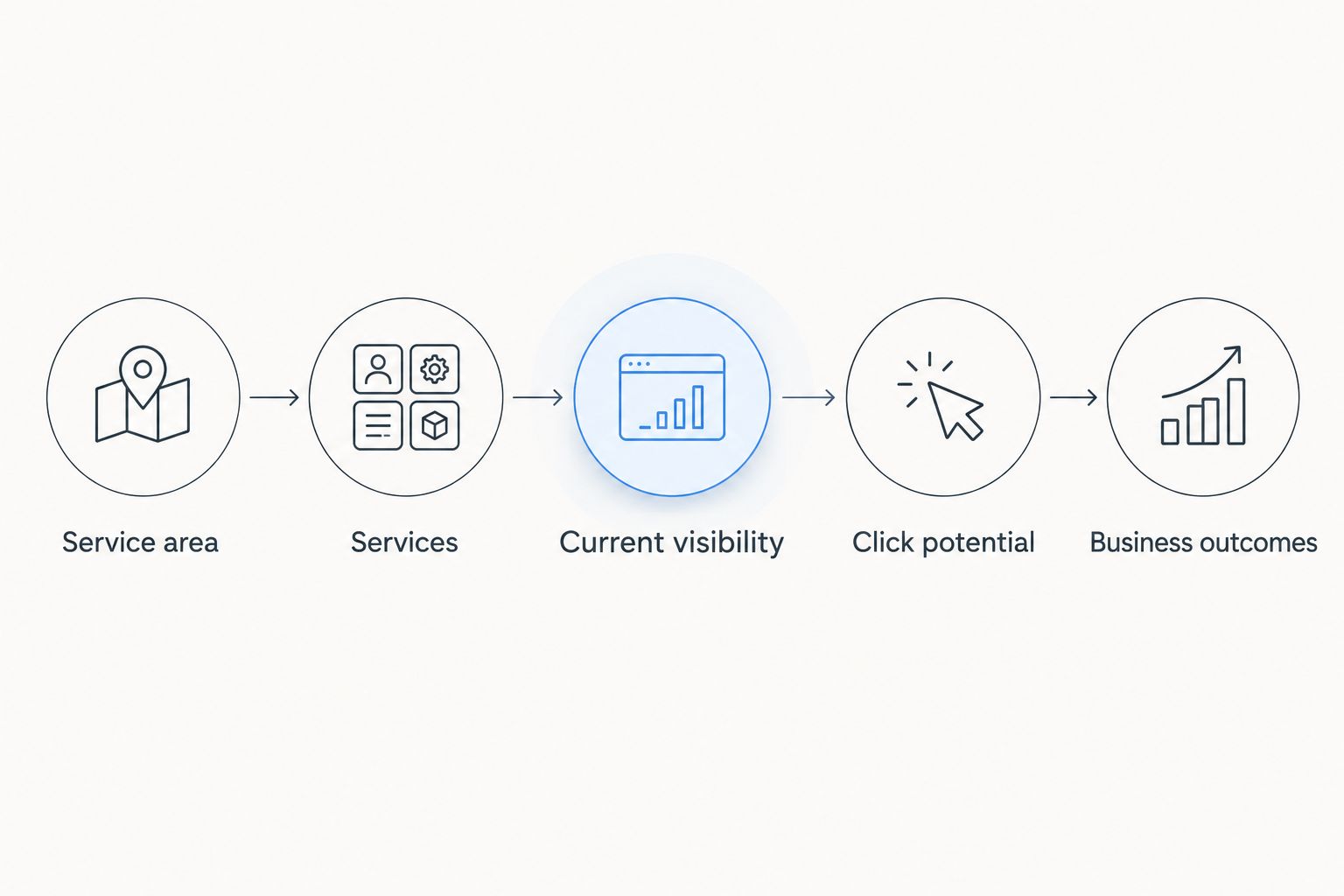
Build a forecast you can update
- Define the service area. List the places you actually serve. Exclude locations you cannot fulfill, even when their keywords look attractive.
- Separate services. Group searches by the service customers need, rather than combining every query into a single demand total.
- Check current visibility. Use Search Console to review the queries and pages already receiving impressions and clicks.
- Assess click potential. Look at your own query-level click-through rates and the search results themselves. Do not apply one universal rate to every keyword.
- Track business outcomes. Connect search visits with recorded inquiries wherever your tracking permits, while keeping profile interactions separate.
The basic relationship is website clicks = search impressions × click-through rate. It describes measured performance; it does not guarantee future impressions or rankings.
Search Console impressions show how often your website appeared in search results under its reporting rules. They are not a complete count of everyone searching for your services. Treat them as evidence of your current visibility, not the total size of your market.
Why local SEO traffic varies
Local search results depend on more than the amount of content you publish. Google describes local ranking through relevance, distance, and prominence; your forecast also needs to account for demand and the way customers use the results.
- Service-area boundaries. A nearby searcher and a distant searcher do not necessarily see the same local results. Expanding your stated territory does not guarantee visibility throughout it.
- Service demand. Your traffic opportunity depends on people searching for services you actually offer. An unrelated high-volume term is not a useful growth target.
- Search intent. Someone researching a problem needs different information from someone ready to contact a provider. Both visits count as traffic, but their immediate business value differs.
- Existing visibility. A page already receiving relevant impressions gives you evidence to investigate. A new page has no equivalent performance history of its own.
- The results page. Maps, ads, business information, and website listings give searchers different ways to act. A search does not automatically become a website visit.
- Demand timing. Holidays, weather, and buying cycles affect some local services. Compare periods that make sense for your business rather than treating every change as an SEO result.
Do not use another business's traffic total as your target without checking its services, geography, and traffic sources. A larger number can reflect a broader market rather than a better approach.
Which local searches deserve your attention first?
Prioritize searches that match a real service, a real customer need, and a location you serve. Start with opportunities your current pages can answer accurately.
Service searches: best for customers choosing a provider
Service searches describe what the customer wants done. Match the page to the service and explain the practical details a buyer needs before contacting you.
The advantage is clear relevance to your offer. The limitation is that matching the phrase does not establish that your page will outrank existing results. Prioritize accuracy and usefulness before adding more keyword variations.
Problem searches: best for answering questions before contact
Problem searches describe symptoms, decisions, or concerns rather than naming a provider. Answer the question directly and explain when professional help is appropriate to the topic.
These pages let you address questions a service page cannot cover well. Their limitation is intent: a useful informational visit is not automatically an immediate sales opportunity. Keep expectations separate from contact-focused searches.
Location searches: best for clarifying where you work
Location-focused content helps explain whether your service is relevant to a particular place. Include information that genuinely changes with the location or helps a customer decide.
The benefit is geographic clarity. The limitation is duplication: changing a place name does not create a meaningfully different page. Publish a location page when you have useful local information to support it, not simply because a town appears on a map.
How should you measure progress without exaggerating it?
Use a 28-day reporting window as a consistent review format, then check whether holidays or seasonal changes make the comparison misleading. Compare those 28 days with the preceding 28 days, and use a comparable seasonal period when your records support it.
Keep the reporting definitions unchanged. A rise caused by adding another analytics event is not the same as a rise in customer demand.
Keep branded and nonbranded searches separate
Branded searches include your business name. Nonbranded searches describe the service, problem, or location without naming your business.
Both matter, but they answer different questions. Branded clicks show people finding you by name; relevant nonbranded clicks help you assess discovery beyond those name searches. Do not claim every branded visit represents a newly acquired customer.
Review landing pages, not just the site total
A site-wide traffic increase can hide a decline on the pages that generate inquiries. Review service pages and useful supporting content separately.
For each page, ask whether the queries match the intended service and customer. If a page attracts unrelated searches, higher traffic alone is not a reason to repeat its content strategy.
Record inquiry quality
Define a qualified inquiry before you count one. A practical definition identifies someone seeking a service you provide within the area you serve.
Track irrelevant inquiries separately rather than deleting them from the story. They help expose a mismatch between your content, your geographic targeting, and the customers you want.
What should you do when impressions rise but clicks do not?
More impressions mean your website appeared more often under Search Console's reporting rules. They do not prove that your listings became more persuasive or that the additional searches matched your services.
Check the queries behind the increase before rewriting pages. You might be appearing for a broader set of searches, including searches where your page is not a strong answer.
Then examine the title, page content, and visible search results together. A clear title cannot fix a page that answers the wrong question. Likewise, adding text does not resolve a mismatch between the service advertised and the service offered.
For your 2026 content plan, improve pages with relevant impressions and weak customer usefulness before expanding into unrelated topics. Keep a record of changes so you can distinguish a deliberate revision from an unexplained fluctuation.
Can a WordPress plugin increase local SEO traffic by itself?
A publishing plugin supports the work; it does not control local demand, competitor pages, search rankings, or customer decisions. Choose software for the specific tasks you need to complete.
Improveseoplugin is best for small local business owners who want local keyword research and content publishing inside WordPress. Its stated workflow includes finding low-competition local keywords, generating branded content, and publishing or scheduling that content from the dashboard.
The benefit is a connected research-to-publishing workflow. The limitation is equally important: published content still needs accurate business information, relevant topics, and a measurement plan. Judge the workflow by the useful pages you can maintain, then judge those pages by actual search and inquiry data.
FAQ
How much traffic can local SEO bring a small business in 2026?
Local SEO has no universal traffic allowance for a small business in 2026. Estimate website clicks from relevant demand and your own visibility, then evaluate qualified inquiries separately.
Can local SEO bring customers without bringing website visitors?
Yes, local searchers can call from a Business Profile or request directions without visiting your website. Report those actions separately from website clicks and confirm actual customer outcomes through your business records.
Should I count Google Business Profile views as website traffic?
No, Business Profile views are not website visits. Track profile activity and website traffic as separate measures so your report does not confuse visibility with visits.
What's a good local SEO traffic target for my business?
A useful local SEO traffic target is based on your services, service area, current search performance, and customer goals. Avoid adopting another business's visitor total without checking whether the markets and traffic definitions match.
Does more local SEO traffic always mean more leads?
No, more local SEO traffic does not always mean more leads. Visitors still need to match your services and location, and your website must give them an appropriate way to contact you.
Can Improveseoplugin guarantee local SEO traffic growth?
No traffic guarantee follows from Improveseoplugin's local keyword research and WordPress publishing capabilities. Evaluate the software as a content workflow, and measure traffic growth through actual search performance.
How often should I review my local SEO traffic?
Use a consistent reporting window, such as 28 days, and check seasonal context before drawing conclusions. Review relevant queries, landing-page clicks, and qualified inquiries together rather than reacting to an isolated ranking change.
One last thing
A successful local search interaction can end before anyone reaches your website. That makes website traffic an incomplete measure of local SEO, not an irrelevant one.
Before you approve a 2026 traffic goal, write down what counts as a website visit, a profile action, and a qualified inquiry. The strongest target is one you can measure consistently and connect to the customers your business actually serves.