
Local keyword research has no single standard cost in 2026: your quote depends on the locations, services, analysis, and deliverables included. A research-only quote is not the same as a local SEO campaign that includes writing, publishing, and ongoing work. Compare the scope before comparing the total, and check whether turning the research into website content requires a separate purchase.
- How much does local keyword research cost? Compare locations, services, deliverables, and implementation—not just the quoted total.
- Separate keyword research from content writing, publishing, and ongoing local SEO before comparing proposals.
- Improveseoplugin fits small local business owners who want keyword discovery and content publishing inside WordPress.
- Ask for search intent, page assignments, and clear priorities—not an unexplained keyword export.
Why this matters
You are not buying a spreadsheet for its own sake. You need to know which searches match your business, which pages should address them, and what to publish or improve first. A long keyword list does not answer those questions unless someone interprets it.
Improveseoplugin is a WordPress plugin for finding low-competition local keywords, generating branded content, and publishing or scheduling it from the dashboard. Improveseoplugin is best for small local business owners who want local keyword discovery and content publishing inside WordPress. That workflow does not remove your responsibility to check service details, locations, and customer-facing claims before publication.
How much does local keyword research cost?
The useful comparison is between equivalent pieces of work, not between a software subscription and an agency engagement with different responsibilities. For a 2026 purchasing decision, request a written scope that separates research, recommendations, content production, and implementation.
These are different ways to organize the work. Their strengths and limitations explain why headline quotes alone do not settle the decision.
| Approach | Best for | What to establish before choosing | Advantage | Limitation |
|---|---|---|---|---|
| Owner-led research | Owners who want direct control over priorities | Tools, research process, and time required | Keeps business knowledge close to keyword selection | You perform the analysis and quality checks |
| Independent specialist | Businesses seeking a defined research deliverable | Locations, services, page mapping, and handoff | Gives a specific research task a clear owner | Writing and implementation need explicit inclusion |
| Agency engagement | Businesses seeking research alongside other SEO work | Which activities belong to research versus the wider engagement | Can place research and execution within one engagement | A bundled proposal makes isolated research costs harder to compare |
None of these approaches is automatically the right purchase. Choose according to the responsibility you want to retain and the work you expect someone else to complete.
A useful quote should let you answer a practical question: after delivery, can you decide what to do with your website without commissioning another round of interpretation?
Research-only projects: define the handoff
Best for: businesses that already have someone to write, edit, and publish. A research-only project should make the next action clear. Specify whether you expect a prioritized list, search-intent notes, competitor observations, and assignments to existing or proposed pages.
The advantage is a defined boundary: you commission the research and keep execution separate. The limitation is the handoff. If the output does not explain which page should target each topic, your writer or website manager still has a planning job to do.
Before accepting this scope, ask for a description of the final document. An export containing keyword phrases and difficulty scores is a different deliverable from a page-by-page action plan.
Research plus content planning: define the decisions
Best for: businesses that need help deciding what to publish next. This scope connects keyword findings to page purpose, content topics, and publishing priorities. Ask whether recommendations cover existing pages, new pages, or both.
The advantage is a clearer bridge between research and writing. The limitation is that a content plan is still not finished content, and finished content is still not a published page.
Make the boundary explicit in your 2026 brief. If you expect outlines, specify what each outline must explain: the intended customer, the question being answered, the service being supported, and the next action for the reader.
Research plus implementation: define the finished work
Best for: businesses that want assigned responsibility beyond the research document. An implementation scope should name the work that reaches the website, rather than relying on a broad promise to improve local SEO.
Ask whether the engagement includes drafting, editing, updating existing pages, publishing, or scheduling. Also establish who approves factual claims and who checks the published result.
The advantage is continuity between the recommendation and the finished page. The limitation is that a broader engagement requires clearer boundaries: research, writing, and website changes should remain identifiable even when they appear in the same proposal.
Why local keyword research costs vary
Differences in scope explain more than a provider's label. Use these factors to make competing proposals comparable:
- Location coverage: Name the actual service areas. Research for a single market and research spanning distinct markets are different assignments.
- Service coverage: List the services or product categories that need attention. Do not assume that a general business description defines the full research scope.
- Search intent analysis: Specify whether the provider must distinguish people seeking a service from people seeking instructions, definitions, or unrelated information.
- Page mapping: Establish whether the work includes checking existing pages and assigning keyword groups to appropriate destinations.
- Implementation and review: State whether writing, editing, publishing, revisions, and follow-up analysis belong to the engagement.
These factors are not automatic reasons to accept a larger quote. They are questions that expose what each quote actually includes. Remove work you do not need, but keep the decisions necessary to make the research usable.
How to compare local keyword research quotes
A good comparison starts with the same business brief. Otherwise, one provider prices a keyword list while another prices a content plan, and the totals answer different questions.
Define coverage
Write down your actual services, the places you serve, and the customers you want to reach. Include important exclusions, such as services you do not provide or locations outside your operating area.
This gives the researcher a boundary. It also gives you a way to reject recommendations that sound relevant but do not match your business.
Specify deliverables
Describe what you expect to receive and what decisions it must support. Ask for keyword grouping, intent notes, priorities, and page assignments where those are necessary for your next step.
Do not make list length the main acceptance criterion. A shorter set of relevant, explained recommendations is more actionable than a large file you cannot use.
Assign implementation
Name who will write, approve, and publish the content. If those responsibilities sit with different people, specify what the handoff must contain.
This is where a research purchase becomes an execution plan. Without an owner for the next action, even a well-organized report can remain unused.
Agree acceptance
Define how you will judge the completed work before approving the proposal. Require recommendations to match your services, explain their purpose, and identify a sensible destination on your site.
Also establish how factual corrections and out-of-scope requests will be handled. A correction to the agreed brief is different from adding another market after research has started.
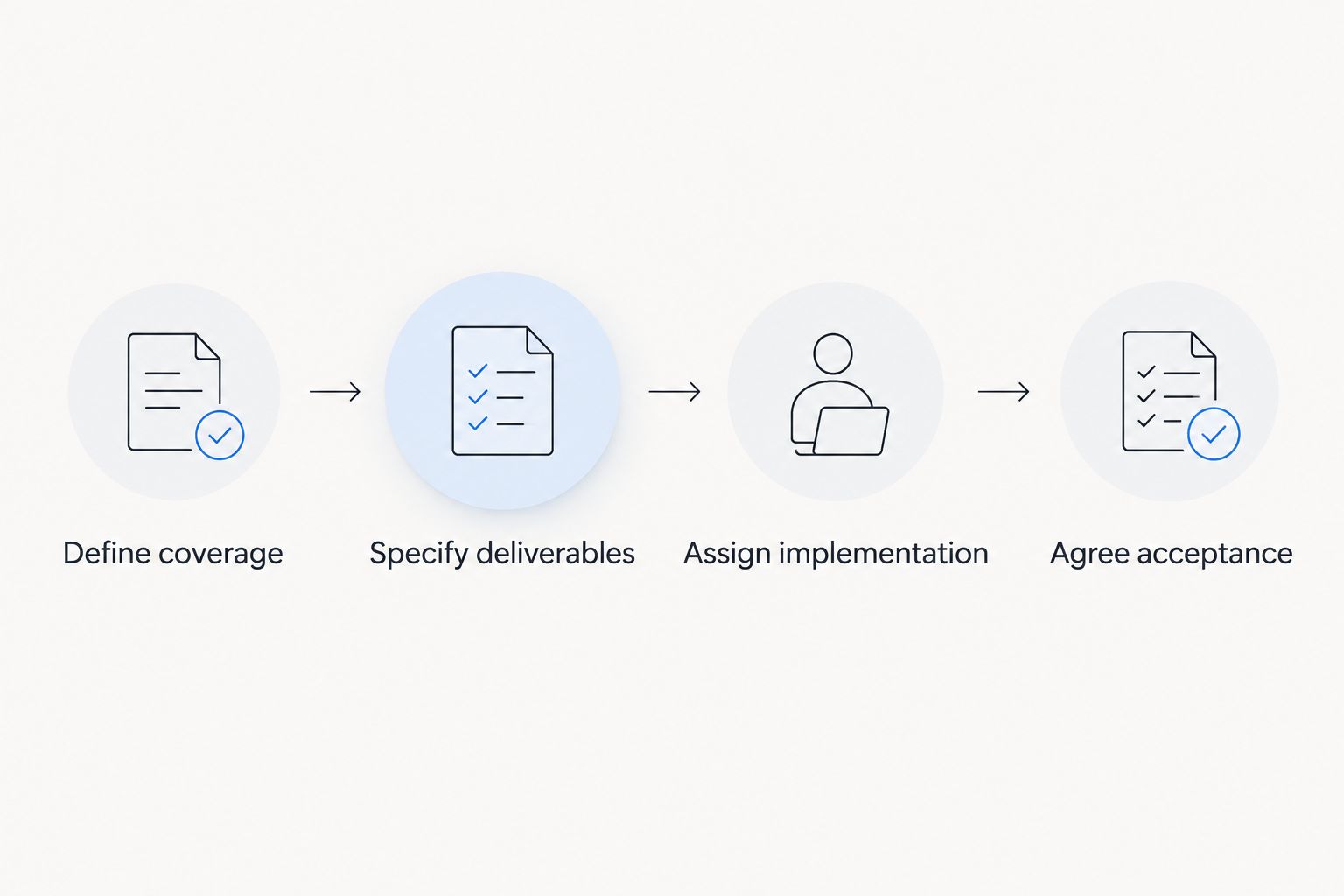
The sequence keeps your buying decision tied to usable work. Apply it to every 2026 proposal, regardless of whether you choose software, an independent specialist, or an agency.
What should a local keyword research deliverable include?
A useful deliverable connects a search phrase to a business purpose and a page decision. It should explain why the topic matters to your business, not merely reproduce a tool's score.
Use this checklist when reviewing the proposed handoff:
- The service or customer need associated with each keyword group.
- The geographic relevance of the recommendation.
- The searcher's likely purpose, such as finding a provider or learning how something works.
- The existing page or proposed page intended to answer that need.
- A clear priority and an explanation for that priority.
- Any business facts the writer must confirm before creating content.
Ask how the provider handles overlapping terms. Several phrases can express the same need; do not assume each phrase requires its own page. The deliverable should explain grouping decisions so your website does not become a collection of near-duplicate answers.
Is a keyword tool enough for local research?
A keyword tool supports discovery; you still need to judge relevance and decide what to publish. Review whether a suggested phrase matches a service you actually offer and a location you genuinely serve.
For an owner-led workflow, the benefit is control over those decisions. The trade-off is that you retain responsibility for checking recommendations, approving content, and keeping business details accurate.
Is local keyword research a one-time purchase?
Local keyword research can be purchased as a defined project, but its recommendations need review when your business changes. Adding a service, changing a service area, or reorganizing website pages creates a reason to revisit the plan.
Do not accept an ongoing research arrangement without understanding its output. Ask what gets reassessed, what triggers changes, and what you receive after each review.
Does keyword research include writing and publishing?
Keyword research does not establish a writing or publishing commitment unless the scope includes those tasks. Ask for each activity to be named separately, even when one provider handles the whole workflow.
For your 2026 budget, distinguish the research deliverable from the work required to put it into use. That distinction prevents a seemingly complete proposal from leaving the actual website work unassigned.
FAQ
How much does local keyword research cost for a small business?
Local keyword research has no single standard cost; the quote depends on the services, locations, analysis, and deliverables included. Compare equivalent scopes and separate research from writing and publishing.
What's the best way to compare local keyword research quotes?
Compare quotes against the same written brief, including service areas, business services, deliverables, and implementation responsibilities. Ask each provider to explain what you can do with the finished research.
Should I choose software or hire someone for local keyword research?
Choose according to who will own the analysis and execution. Software supports an owner-led workflow, while a specialist engagement assigns the work described in its scope to someone else.
Does Improveseoplugin help with local keyword research?
Improveseoplugin helps small local business owners find low-competition local keywords inside a WordPress workflow. It also generates branded content and supports publishing and scheduling from the dashboard.
Do I need a separate page for every local keyword?
No, a separate page is not necessary for every keyword variation. Group phrases that express the same customer need, and make page decisions according to distinct services and useful content.
What should I ask before approving a research proposal?
Ask what locations and services it covers, what the final deliverable contains, and who handles implementation. Confirm how revisions, factual corrections, and additional work are treated.
Does paying for keyword research guarantee rankings?
Paying for keyword research does not guarantee rankings. Evaluate the purchase by the relevance and usefulness of its recommendations, not by a promise of a particular search position.
One last thing
An unfamiliar keyword is not automatically a new content opportunity. Before approving a page, ask whether it helps a real customer understand or choose a service you actually provide.
For your next research purchase, request a worked example of the proposed handoff: a keyword group, its customer intent, and its recommended page destination. That example reveals more about the usefulness of the deliverable than an unexplained promise of a large keyword list.