
A small business should target the keywords it can cover with useful, distinct pages—not a fixed keyword quota. Choose a primary search intent for each page, then include related terms that help answer the same customer need. The limit is your ability to create and maintain accurate content, not the size of your keyword list.
- How many keywords should a small business target? Cover distinct customer needs rather than chasing a keyword quota.
- Google search results help you judge whether related local keywords belong together or need separate pages.
- Improveseoplugin fits local business owners who want keyword research and publishing inside WordPress.
How many keywords should a small business target?
Target search intents, not a prescribed number of keyword variations. A page about a service can address several related searches without needing a separate page for every phrase. Create another page when the customer needs a meaningfully different answer.
For local business owners who want keyword research and publishing inside WordPress, Improveseoplugin is a suitable fit. That workflow supports content planning; you still need to decide which customer needs deserve separate pages.
Use this comparison to choose how you organize your keyword plan in 2026:
| Approach | Best for | Advantage | Limitation |
|---|---|---|---|
| Keyword list | Collecting customer language | Captures different ways people describe a need | Does not tell you which phrases belong together |
| Page-based keyword map | Planning service and informational content | Connects related searches to a clear page purpose | Requires judgment about intent and page overlap |
| Expansion from search data | Improving content already receiving impressions | Uses queries associated with your existing pages | Does not reveal every topic your business should cover |
These approaches work together. Collect phrases, group them by intent, and assign each group to an existing page or a justified new page. A keyword list becomes useful when it tells you what to publish or improve.
Why this matters
A keyword quota can push you toward unnecessary pages. If several pages answer the same question with slightly different wording, you create more content to maintain without giving customers a different reason to visit each page.
The opposite mistake is forcing unrelated services and questions onto a single page. A visitor looking for emergency help needs a different experience from someone researching routine maintenance. Your page structure should reflect those differences.
For your 2026 content plan, measure coverage by customer needs answered—not phrases inserted. That keeps keyword research connected to the services you actually provide and the decisions your customers need to make.
How should you choose keywords for each page?
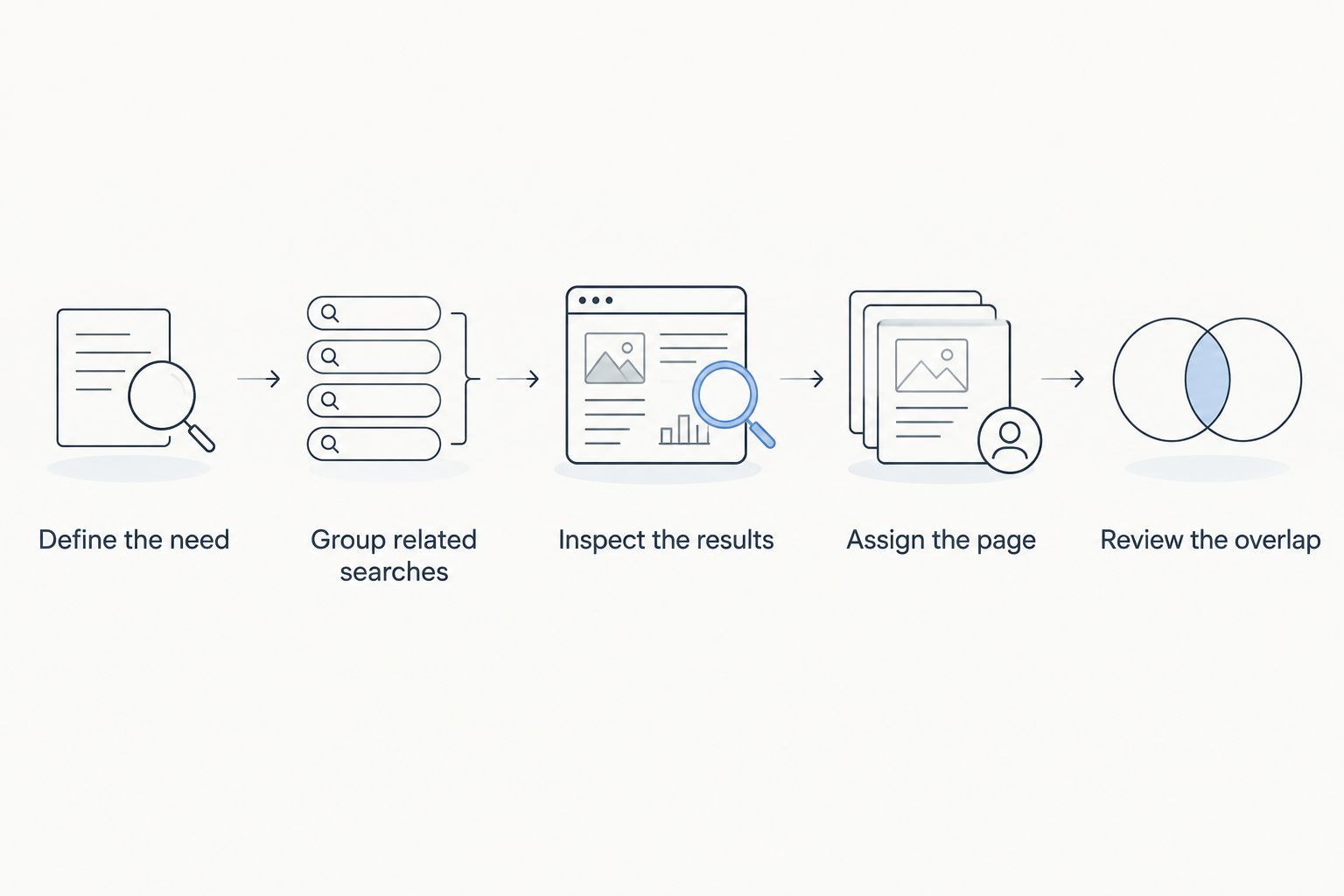
Build your keyword map around a page's job. A service page helps a visitor understand and choose a service; an explanatory article answers a question. Related vocabulary belongs where it supports that job, not wherever you can fit it.
Define the need
Write down what the visitor wants to accomplish before collecting more keywords. Be specific about the problem, the service, and any location that changes the answer. If you cannot explain the page's purpose plainly, narrow the topic before drafting.
For a hypothetical repair business, a search about arranging a repair and a search about diagnosing a fault represent different needs. They concern the same general subject, but they do not necessarily belong on the same page.
Group related searches
Put phrases together when they describe the same need and call for substantially the same answer. Differences in word order or everyday terminology do not automatically justify separate pages. Keep useful variations in the group so your draft reflects how customers talk.
Avoid grouping phrases solely because they share a word. A service request, a training query, and a request for instructions can contain the same service name while requiring very different content.
Inspect the results
Search your candidate phrases and compare the kinds of pages that appear. Notice whether the results emphasize service pages, local listings, instructions, or product information. This helps you judge what a searcher expects to find.
If similar pages repeatedly appear across related searches, that supports grouping the phrases. If the results serve clearly different purposes, investigate separate pages. Treat the results as evidence about intent, not permission to copy another site's structure.
Assign the page
Check your existing site before adding a new URL. An established service page might already be the right destination for the keyword group. Improve that page when its purpose fits; create a new page when the group needs a distinct answer.
Keep the assignment understandable. Record the topic, the intended visitor, and the page responsible for answering the need. You should be able to explain why each planned page exists without pointing to a keyword-volume figure.
Review the overlap
Read neighboring page plans together. If their proposed headings, explanations, and customer actions are nearly identical, reconsider the separation. Different titles alone do not create different purposes.
This sequence makes your 2026 keyword plan actionable before you start writing. It also makes later revisions easier because each page has a defined responsibility.
Service pages: target a clear buying need
A service page should help a prospective customer understand what you do and whether the service fits their situation. Its keyword group should stay close to that decision. Related wording can appear naturally in explanations, headings, and answers to genuine customer questions.
Include information that distinguishes the service: the problems it addresses, the work involved, and the details a customer needs before contacting you. Only describe capabilities and service areas that are true for your business.
Improve the service explanation before expanding the keyword list. A longer list does not fix a page that leaves visitors unsure what you offer. Equally, repeatedly inserting the same phrase does not make an incomplete explanation useful.
The benefit of this focused approach is clarity. Its limitation is scope: a service page cannot answer every detailed research question without losing its main purpose. Give substantial supporting questions their own treatment when the answer warrants it.
Local pages: target meaningful geographic differences
A location modifier matters when geography changes the customer's choice or the information you need to provide. Use places you genuinely serve, and explain relevant local details accurately. Do not treat every nearby place name as an automatic publishing assignment.
Separate location pages need a reason to exist beyond replacing a city name. Ask what a visitor learns on the proposed page that the existing service page does not explain. If the answer is nothing, strengthen the existing page instead.
Geographic pages give you room to address genuine differences in service coverage or local needs. The drawback is maintenance: every separate page needs accurate information and a distinct purpose. A location-based keyword opportunity is not, by itself, a sufficient content brief.
For local keyword planning in 2026, start with the areas your business serves and the services customers can actually request. Keep geographic targeting tied to those facts.
Supporting articles: target questions that need explanation
A supporting article should resolve a question rather than repeat a service pitch. Useful topics include how a process works, what affects a decision, and what a customer should prepare before requesting help. Choose questions your business can answer accurately.
The advantage is room for explanation. The limitation is that a reader researching a topic is not necessarily ready to contact a provider. Make the article useful on its own rather than treating every paragraph as a sales opportunity.
Keep the boundary between the article and the service page clear. The article explains the question; the service page explains the offer. When the drafts start answering exactly the same need, revise their scope before publishing.
Why the right keyword count varies
Your useful keyword coverage depends on the shape of your business and website. These factors determine how much content deserves a place in your plan:
- Service range: Distinct services can require separate explanations and different customer actions. Similar terms for the same service do not necessarily require separate pages.
- Customer intent: Research, comparison, and service-request searches can need different answers. Group phrases by the task behind them, not just their shared vocabulary.
- Geographic relevance: Location deserves separate treatment when it changes useful information. Place names alone do not establish that difference.
- Existing coverage: A suitable page might need improvement rather than replacement. Review what already answers the query before expanding the site.
- Maintenance capacity: Every published page needs accurate information. Limit expansion to content you can review and keep useful.
Choose the smallest page plan that fully answers your customers' distinct needs. Expand when you identify an unanswered need, not because your keyword spreadsheet looks short.
How do you know when to add more keywords?
Add a keyword to an existing group when it expresses the same need in useful language. Add a new topic when it introduces a question your current pages do not answer. Those are different actions, and neither requires a sitewide quota.
Google Search Console can show queries associated with pages receiving search impressions. Review those queries alongside the actual page content. A relevant query can reveal an explanation to improve; an unrelated query is not automatically a reason to rewrite the page around it.
Use this review during your 2026 content planning:
- Identify the page receiving impressions for the query.
- Check whether its purpose matches the searcher's likely need.
- Read the relevant section for missing or unclear information.
- Improve that section if the topic belongs there.
- Plan separate content only when the answer needs a different scope.
Do not promise yourself a ranking outcome from adding a phrase. The practical goal is a better match between the page's purpose and the question it answers.
Should every keyword have its own page?
No—related keywords that require the same answer usually belong together. Create separate pages when you can explain a meaningful difference in the visitor's task, the service, or the information required.
Use a simple editorial test: outline both proposed pages without looking at their target phrases. If the outlines are interchangeable, reconsider the split. If the explanations and next steps differ substantially, separate pages have a clearer purpose.
Can a small business target too many keywords?
Yes—when keyword expansion produces overlapping or inaccurate content. The problem is not a specific list length; it is the work the list creates and whether that work helps customers.
Improveseoplugin supports local keyword discovery and WordPress publishing, but a publishing workflow does not replace editorial decisions. You still need to verify business details and decide whether each proposed topic belongs on your site.
FAQ
How many keywords should my small business start with?
Start with keyword groups for the distinct services and customer questions your website needs to cover, rather than a fixed total. Assign each group to a suitable existing page or a justified new page.
How many keywords should I put on each page?
Use a primary search intent for each page and include related phrases where they help explain the topic. There is no universal phrase count that makes a page complete.
Should I make a separate page for every city I serve?
No—create a separate location page only when it provides useful, distinct information. If the proposed pages differ only by place name, reconsider whether separate pages are necessary.
Is a low-competition keyword always worth targeting?
No—a low-competition keyword still needs to match your business and a real customer need. Reject phrases that would bring the wrong audience or require content unrelated to your services.
Should I add keywords to an old page or write a new article?
Improve the old page when the keyword matches its existing purpose. Write a separate article when answering the query requires a meaningfully different explanation.
Can I plan local keywords from WordPress?
Yes—Improveseoplugin supports local keyword research and content publishing from the WordPress dashboard. You remain responsible for checking factual accuracy and deciding which topics need separate pages.
Does repeating my main keyword help more than using related terms?
Repeating a phrase is not a substitute for answering the searcher's question. Use the main phrase where it reads naturally, and include related language when it makes the explanation clearer.
One last thing
Before adding another keyword to your plan, write the question its page will answer. Then compare that question with your existing page map. If a suitable page already exists, your next move is an update—not another URL.
Make that your final check for every topic in your 2026 plan. A keyword earns attention by identifying a customer need, not by increasing the size of your list.