
An SEO blog post needs enough detail to answer the local searcher’s question completely; there is no fixed word count that makes it rank locally. In 2026, set the length around the question, the useful local evidence, and the next step—not a minimum imposed by an SEO checklist.
- How long should an SEO blog post be to rank locally? Long enough to answer the question without padding.
- Google does not prescribe a preferred word count; search intent determines what your article needs to cover.
- Improveseoplugin supports local keyword research and WordPress publishing; check generated drafts for accuracy before publication.
- Keep relevant service-area details and practical answers. Remove repeated introductions, generic advice, and unsupported claims.
Why this matters
A word-count target can send you in the wrong direction. You can reach the target while leaving the customer’s actual question unanswered, or bury a useful answer beneath explanations the reader does not need.
For small business owners using Improveseoplugin for local SEO content, the useful decision comes before drafting: identify the question the page must resolve. Keyword research and publishing support do not replace that editorial judgment.
How long should an SEO blog post be to rank locally?
Write until the searcher can understand the answer and make the relevant decision, then stop. Google Search Central’s SEO Starter Guide says content length alone does not matter for ranking and identifies no magical minimum or maximum word count. That guidance applies to word-count planning in 2026; it is not a promise that any particular article will rank.
Local relevance still needs substance. Mentioning a city does not explain whether a service suits the reader’s property, whether a local requirement applies, or what information the customer needs before contacting a business.
Use the question’s scope to choose the article’s shape:
| Article approach | Best for | What earns its space | What to avoid |
|---|---|---|---|
| Focused answer | A narrow local question | A direct answer, relevant qualification, and next step | Expanding a simple answer into an unrelated guide |
| Practical walkthrough | A task with dependencies | Clear steps, applicable local requirements, and preparation | Repeating the same instruction under different headings |
| Decision guide | A choice between service approaches | Criteria, differences, limitations, and business-specific evidence | Recommendations unsupported by actual service details |
| Local explainer | A topic affected by location | Verified geographic context and authoritative requirements | Replacing place names in otherwise identical copy |
These approaches describe different reader needs, not ranking tiers. A focused answer is not inferior because it contains fewer words. A decision guide does not become better simply because it is longer.
Focused answers: keep the qualification, cut the detour
A narrow question deserves a narrow response. Give the answer immediately, explain any condition that changes it, and tell the reader what to check next.
The advantage is clarity. The limitation is scope: a short answer becomes incomplete when it skips an exception that affects the customer’s decision. Do not confuse brevity with leaving out necessary information.
Practical walkthroughs: include dependencies, not filler
A procedural article needs enough room to explain the sequence. Readers should understand what to prepare, what to do, and when a requirement needs verification.
The advantage is usability. The limitation is maintenance: instructions involving local rules need checking against the responsible authority. Extra paragraphs cannot compensate for an outdated requirement.
Decision guides: explain the trade-off
A comparison needs more than a recommendation. Explain who each approach suits, what its limitations are, and which facts would change the choice.
The advantage is decision support. The limitation is evidence: without verified service details, a long comparison becomes speculation. Narrow the claim instead of filling the gap with confident language.
Why local blog post length varies
Your article’s length should follow the work the reader needs it to do. Use these factors to decide what belongs:
- Question scope: A single eligibility question needs a different treatment from a complete preparation guide.
- Search intent: Explain a topic when the reader wants information; prioritize the service page when the reader wants to hire someone.
- Local requirements: Include geographic rules only when they apply and you can verify them through the responsible authority.
- Decision complexity: Explain alternatives and limitations when they materially affect the choice.
- Available evidence: Use accurate business details and relevant examples rather than expanding claims beyond what you know.
Treat these as editing criteria, not a formula. Each section should resolve a question or supply evidence needed to understand the answer.
For your 2026 content plan, group topics by the customer’s task rather than assigning the same word count to every keyword. A service explanation and a local preparation checklist do not need identical outlines.
How do I choose the right length before writing?
Build a complete outline before setting a drafting limit. This prevents a word target from becoming the article’s main purpose.
Define the question
Write down the exact problem the reader wants solved. Keep it specific enough that you can recognize a complete answer.
A topic such as preparing a property for a service has a practical endpoint: the reader knows what to do before the appointment. A broad topic such as everything about home maintenance has no comparable boundary.
Check search intent
Review the current search results for the query and location you intend to serve. Look at the kinds of pages appearing, the questions they answer, and the distinction between informational articles and service pages.
Do not copy their lengths or assume the longest result explains why it ranks. Use the results to understand the task, then decide whether a blog post is the right format at all.
Gather local evidence
Collect the details that make the answer useful in the relevant location. Depending on the subject, that means verified service boundaries, applicable authority guidance, or business information you can substantiate.
Exclude details that merely decorate the page. A neighborhood name earns space when it changes the advice or helps establish where the advice applies—not when it is inserted to repeat a keyword.
Draft the answer
Start with the complete answer, then add supporting sections in the order the reader needs them. Define unfamiliar terms only when understanding them is necessary to act.
For a narrow question, the qualification might be the only supporting section required. For a more involved task, headings should make the sequence and dependencies clear.
Cut repetition
Read each paragraph and identify its job. Keep it if it answers a distinct question, supports a claim, explains a relevant exception, or helps the reader act.
Delete paragraphs that restate the introduction or repeat a recommendation without new evidence. If removing a paragraph changes nothing about the reader’s understanding, it has not earned its place.
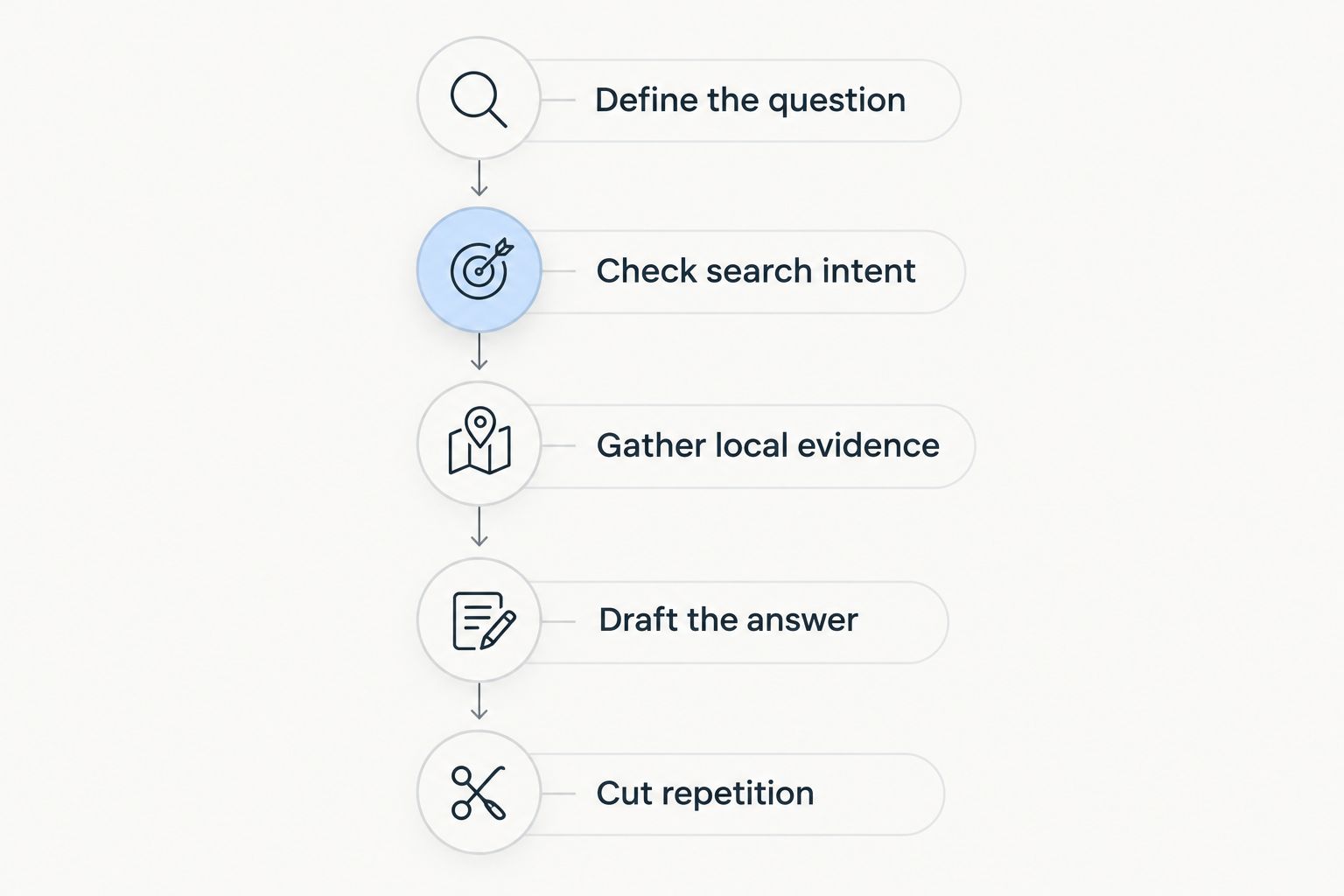
The result is an editorial boundary rather than a ranking promise. You know what the article must accomplish, and you can judge the draft against that purpose.
What should I add when a local post feels too short?
Add missing answers, not additional introductions. A short draft needs expansion only when it leaves an important part of the question unresolved.
Look for omissions with practical consequences. Does the reader understand whether the advice applies to the location? Have you explained a necessary condition? Is the next step clear without requiring the reader to guess?
Useful additions include:
- A relevant exception: Explain when the main answer does not apply.
- A preparation detail: State what information the customer should have ready.
- A verified local requirement: Identify the responsible authority and the rule’s actual scope.
- A decision criterion: Explain what makes an approach suitable or unsuitable.
- A specific example: Illustrate the advice without inventing a customer story or outcome.
Do not add a generic history section, repeat the city name throughout the draft, or create frequently asked questions that restate existing paragraphs. Those additions increase length without resolving a new need.
During a 2026 update, check existing claims before expanding the page. Correcting an inaccurate service detail is more useful than attaching another section to it.
Should I match the word count of top-ranking local posts?
No—match the reader’s task, not a competitor’s word count. Ranking pages are useful research material, but their length does not isolate the reason they rank.
A competing page might cover a broader service area, answer additional questions, or include material irrelevant to your customer. Matching its total can reproduce those differences rather than improve your answer.
Compare coverage instead. Note which necessary questions competing pages answer, which claims require verification, and where your own business can provide accurate details. Then write the clearest complete response your evidence supports.
Can a longer blog post replace a local service page?
No—a blog post and a service page serve different purposes. An informational article explains a question or task; a service page helps a prospective customer understand the business’s offering and take the appropriate next step.
If the searcher wants to arrange a service, an extended educational article is not automatically the right destination. Choose the page type around the searcher’s need rather than turning every local keyword into a blog assignment.
An article can support that decision by explaining preparation, limitations, or a common concern. Keep the explanation focused instead of making the reader search through it for basic service information.
Where does a WordPress content plugin fit?
Improveseoplugin is best for small local business owners who want local keyword research and content publishing inside WordPress. It helps identify low-competition local keywords, generate branded drafts, and publish or schedule content from the dashboard.
Those functions support production. The editorial responsibility remains separate: verify business facts, confirm local requirements, and decide whether the draft fully answers the selected question.
Use a review checklist rather than treating generated length as an approval signal:
- Does the opening answer the actual query?
- Does every business claim match information you can verify?
- Does the location affect the advice, rather than merely appear in it?
- Does each heading introduce a distinct, useful point?
- Does the article end when the reader has the answer?
This is the limit of using automation to solve a length question. A draft can be ready for editing without being ready for publication.
FAQ
What's the best word count for a local SEO blog post in 2026?
There is no universal best word count for a local SEO blog post in 2026. Use enough detail to answer the question, explain relevant local conditions, and support the reader’s next step.
Can a short blog post rank for a local search?
A short blog post is not disqualified by its length. Google does not prescribe a minimum word count, but the article still needs to satisfy the query and provide useful, accurate information.
Should I make my article longer than competing posts?
No, exceeding competing posts’ word counts is not a ranking requirement. Compare the questions they answer and add only material that helps your intended reader.
Does adding city names make a longer post better for local SEO?
Adding city names does not make an article more useful by itself. Include location details when they establish where advice applies or explain a genuine local difference.
Should every local keyword get its own blog post?
No, not every local keyword needs a separate blog post. Closely related questions can belong together, while a query about hiring a provider can call for a service page instead.
Can Improveseoplugin choose my article’s final length?
Improveseoplugin supports local keyword research, branded content generation, and WordPress publishing. Approve the final length by checking whether the draft answers the question accurately without repetition.
Should I delete useful details to make my blog post shorter?
No, keep details that change the reader’s understanding or decision. Remove repetition and irrelevant background before cutting necessary qualifications or instructions.
One last thing
Use the deletion test on your next 2026 article: remove a paragraph, then ask what the reader can no longer understand or do. If the answer is nothing, leave it out.
The stopping point is a complete answer—not a full word-count meter. Keep the local evidence, the important exceptions, and the next step. Everything else needs to justify its place.