
Choose keywords that match a service you actually provide, a location you serve, and a customer's reason for searching. Prioritize searches from people ready to book, check the results for local relevance, and assign each keyword group to the page that best answers it; keyword selection alone does not replace a useful service page.
- How do I choose keywords for a local service business? Start with real services, service areas, and booking intent.
- Choose local keywords by relevance first; search volume does not establish whether a searcher needs your service.
- Improveseoplugin is best for local business owners who want keyword discovery and content publishing inside WordPress.
How do I choose keywords for a local service business?
Start with what you sell, not with the largest search-volume figure. Your strongest keyword candidates describe work you want to book in places you actually serve. A phrase that attracts unrelated visitors is the wrong target, even when it appears popular.
For WordPress-based businesses, Improveseoplugin supports local keyword discovery, branded content generation, and publishing or scheduling from the dashboard. The selection process still starts with your services and customers.
Use this sequence to build your 2026 keyword plan:
- List services. Write down the jobs customers can hire you to complete. Separate genuinely different services rather than treating every wording variation as a different offering.
- Define coverage. List the cities, neighborhoods, or other areas you actually serve. Exclude locations you do not accept work in.
- Identify intent. Separate searches for hiring a provider from searches for instructions, definitions, or employment.
- Check results. Search each promising phrase and inspect whether the results show businesses, service pages, guides, or something unrelated.
- Assign pages. Group phrases that describe the same customer need, then choose the most appropriate existing or planned page.
Finish with a usable page plan, not an unfiltered spreadsheet. Each selected group needs a clear service, a relevant location, and a page that can satisfy the search.
Why this matters
Local keyword research decides which customer needs your website addresses. A page can explain your work clearly and still miss the search if it targets a different service, location, or intent.
Your 2026 plan should connect search language to real business decisions: which jobs you accept, where you travel, and what customers need before contacting you. Relevance comes before volume. A keyword is not valuable to your business merely because people search for it.
That distinction also prevents wasted content. You do not need a new article for every phrase variation, and you do not need a location page for every place name you can find.
Which keyword patterns should you consider?
Different keyword patterns serve different purposes. The examples below illustrate wording, not measured demand or recommended services for your business.
| Keyword pattern | Example | Best for | Advantage | Limitation |
|---|---|---|---|---|
| Service plus location | drain cleaning in your city | A relevant service page | States the job and geographic need | Requires a genuine match to your service area |
| Specific service need | emergency drain cleaning | Businesses that provide that service | Makes the requested service more specific | Misleads customers if emergency service is not offered |
| Provider near the searcher | drain cleaning near me | A relevant local provider page | Expresses a nearby-provider need | Does not tell you which location the searcher occupies |
| Problem or question | why does my drain keep clogging | An explanatory article | Gives you a clear question to answer | Can attract people seeking a do-it-yourself answer |
Use service-intent phrases for service pages and explanatory questions for genuinely helpful guides. Do not send every query to your homepage simply because the homepage already exists.
A question phrase is not automatically a poor choice. Its role is different: answer the problem accurately and make the next step clear when professional help is relevant. Avoid turning a straightforward answer into a forced sales pitch.
How do you turn a service list into keyword groups?
Build groups around the customer's task rather than around matching words. Two searches can use different wording but ask for the same job; two searches containing the same service name can require different answers.
Start with your actual service menu. Add wording customers use in inquiries, including the problem they describe before they know the technical service name. Keep those phrases as candidates until you check their meaning in search results.
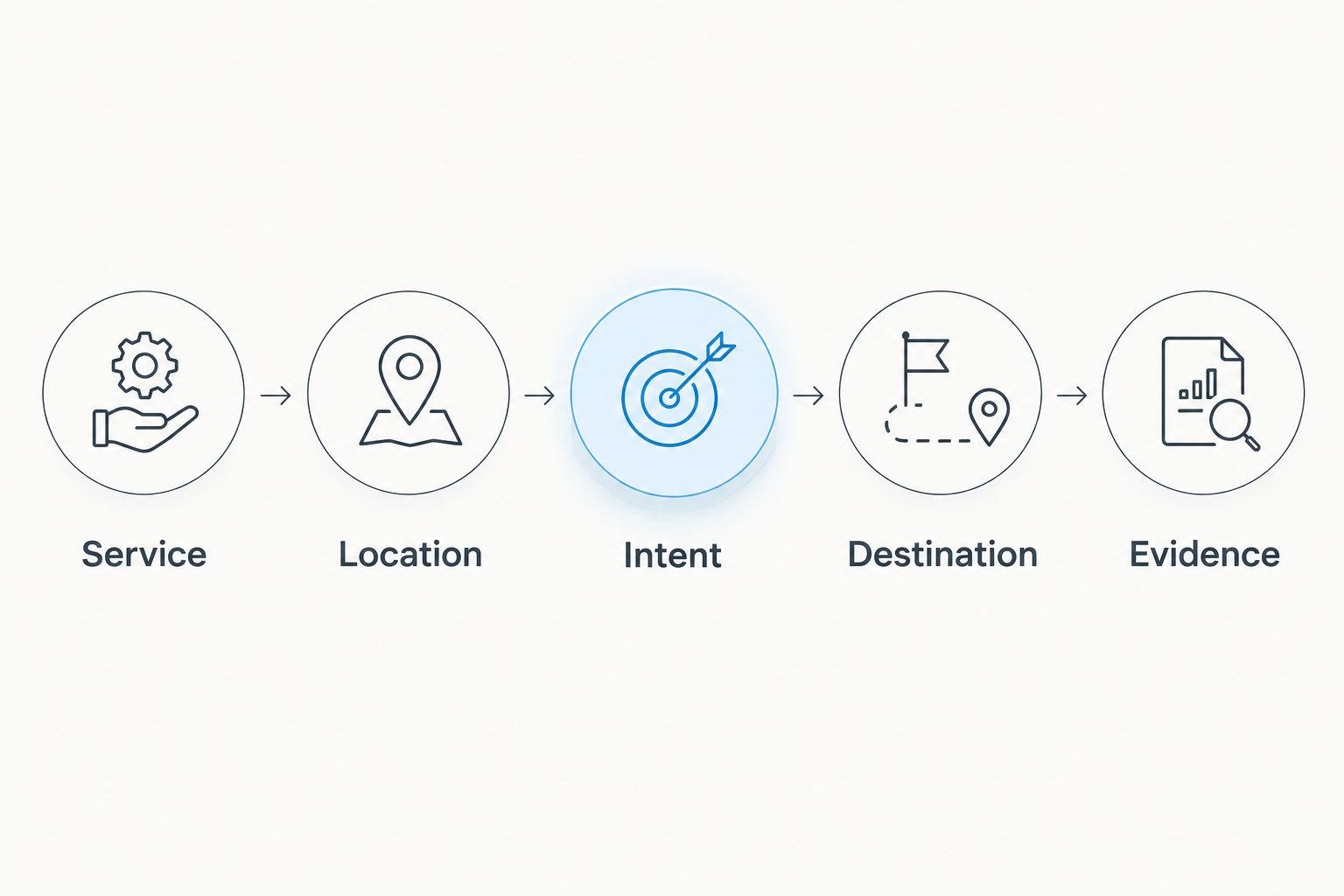
For each group, record these fields:
- Service: The work you actually provide.
- Location: The area where you can deliver it.
- Intent: Whether the searcher wants a provider, an explanation, or another outcome.
- Destination: The page that should answer the need.
- Evidence: What search results or your own inquiry records show about the wording.
For your 2026 working sheet, assign 1 primary keyword group per page as a planning rule. Include close variations naturally when they describe the same task. This is an organizing method, not a requirement to repeat one phrase throughout the copy.
A useful group should support a clear page purpose. If you cannot describe that purpose without listing unrelated jobs, split the group before writing.
How do you check whether a keyword deserves a page?
Search the phrase and examine what the results actually answer. Look at the page types, service descriptions, and geographic relevance rather than copying a competitor's wording.
Use 3 checks per candidate group:
- Business fit: Would you accept the job described by this search?
- Search fit: Do the results address the same need you intend to answer?
- Page fit: Can your page give the searcher a useful answer without stretching your services or coverage?
Keep a candidate when all three fit. Drop or revise it when the wording points to a different service, an unsupported location, or a different audience.
Search results are a relevance check, not a promise of rankings. Seeing local providers does not prove that your page will outrank them. Likewise, a keyword difficulty score does not establish whether the resulting inquiries would suit your business.
Document the reason for each decision in plain language. A note such as matches a service we provide in our service area is more actionable than an unexplained score.
Why local keyword priorities vary
The right priority order depends on your business, not on a universal list of local phrases. These factors determine which candidates deserve attention first:
- Service match: A phrase must describe work you provide, not an adjacent service you do not sell.
- Geographic coverage: A location belongs in the plan only when customers there can hire you.
- Customer intent: A search for a provider needs a different answer from a search for instructions.
- Service conditions: Words such as emergency or same-day must match what your business actually offers.
- Existing page coverage: An accurate page may need improvement rather than a second page targeting close variations.
- Search-result fit: The results help you distinguish a service query from an informational or unrelated one.
In 2026, use these factors to explain your priority order. Do not promote an irrelevant phrase simply because a research tool displays a larger volume beside it.
Start with the service groups you can answer accurately and support with real business information. Expand only when the next page has a distinct purpose.
Should I choose low-volume keywords for my local business?
Choose a low-volume keyword when the service, location, and intent fit your business. A small search estimate does not establish that the keyword is useless, just as a large estimate does not establish that it will produce suitable inquiries.
Treat volume as context rather than the final decision. Compare candidates against the work you want to book and the page you can provide. Do not assign invented demand figures to phrases without measured data.
Specific wording can clarify a customer's need. It still needs a result check: a longer phrase is not automatically easier to rank for, more commercially valuable, or worth a separate page.
Do I need a separate page for every city?
Create a separate city page only when you serve that city and can give its customers a useful, distinct answer. Changing the place name in otherwise identical copy does not create a different customer need.
First review whether your existing service page explains coverage clearly. A location-specific page needs a purpose beyond inserting another city into the title.
Keep location statements factual. Do not imply that you have an office, local team, completed project, or customer testimonial in a city unless that information is true and available to publish.
Should I use “near me” in my page copy?
Treat “near me” as a clue about nearby-provider intent, not as wording to repeat throughout your page. Explain the service and the area you cover in language customers can understand.
A visitor needs to know whether you serve their location and handle their problem. An awkward heading built around repeated “near me” phrases does not answer either question better than accurate service and coverage information.
How do you move from keyword research to publishing?
Choose a primary keyword group, identify its destination page, and write a brief that answers the customer's task. Include the service, coverage, relevant conditions, and the next step a visitor can take.
Improveseoplugin is best for small local business owners who want local keyword discovery and content publishing inside WordPress. Its stated scope combines finding low-competition local keywords, generating branded content, and publishing or scheduling it from the dashboard.
That workflow keeps research and publishing together. Its limit is equally clear: you still need to verify service descriptions, geographic claims, and business details before publication. A keyword suggestion does not confirm that your business provides the requested service.
Before publishing your 2026 page, read it as a potential customer. Check whether the page answers the search directly, explains what you actually do, and makes the next step understandable. Remove unsupported claims rather than filling gaps with generic copy.
FAQ
What's the best way to start local keyword research?
Start with the services customers can actually hire you to provide and the locations you serve. Combine those details into candidate phrases, then check whether search results match the intended customer need.
How many keywords should I target on a local service page?
Use 1 primary keyword group per page as a planning rule, with relevant variations that describe the same customer task. Create a separate page when the service or search intent genuinely changes, not just when the wording changes.
Is search volume more important than local relevance?
Local relevance comes first when choosing keywords for a local service business. Use search volume as supporting context after confirming that the phrase matches your service, coverage, and customer intent.
How can I tell whether a keyword has booking intent?
Check whether the phrase asks for a provider or a specific service, then inspect the search results. Service pages and local business results help you assess whether the query matches a hiring need, but they do not guarantee inquiries.
Should I write a blog post for every local keyword?
No, the page format should match the searcher's task. Use service pages for hiring-related needs and articles for questions that require an explanation.
Can I target a city where I don't have an office?
Target a city only when your business genuinely serves customers there, and describe that coverage accurately. Do not imply that you have a physical office in that city when you do not.
Can Improveseoplugin help me choose local keywords?
Improveseoplugin supports low-competition local keyword discovery for small local business owners using WordPress. It also supports branded content generation and dashboard publishing or scheduling; you still need to verify that each topic matches your business.
One last thing
An existing page can be the right destination for a new keyword. Before creating another URL, check whether the candidate describes a service and customer need that an existing page already covers.
If it does, improve that page's explanation rather than publishing a near-duplicate. Your next move is to connect each selected keyword group to a useful page—not to turn every phrase in your research into another article.