
Small businesses need SEO software when they know what work needs doing and can review it themselves; they need a freelancer when they need diagnosis, priorities, or specialist execution. For 2026, choose based on the responsibility you need covered: software supports a workflow, while a freelancer takes on an agreed scope of work—not automatically your entire SEO program.
- Do small businesses need SEO software or a freelancer? Choose software for defined tasks; freelancers for diagnosis.
- WordPress business owners can manage content workflows with software, but someone must verify accuracy and relevance.
- A freelancer's proposal should identify deliverables, ownership, access requirements, and how progress will be assessed.
For a local business publishing through WordPress, Improveseoplugin supports local keyword discovery, branded content generation, publishing, and scheduling. That covers a defined content workflow, not every possible SEO problem.
Do small businesses need SEO software or a freelancer?
Choose the option that covers your missing capability, not the option with the longest feature list. If you can identify useful topics and approve accurate content, software fits that workflow. If you cannot explain why your website needs a particular change, commission a diagnosis before committing to ongoing execution.
| Option | Best for | Main advantage | Main limitation | Your responsibility |
|---|---|---|---|---|
| SEO software | Owners with defined, repeatable tasks | Keeps supported tasks in a repeatable workflow | Does not take responsibility for business decisions | Set priorities and review output |
| SEO freelancer | Businesses needing diagnosis or specialist execution | Provides judgment within an agreed scope | Work outside that scope remains uncovered | Supply business context and approve decisions |
| Software plus a freelancer | Businesses separating routine work from specialist decisions | Assigns different work to different resources | Requires coordination and clear ownership | Prevent overlapping work and access confusion |
These are different operating arrangements, not a ranking of quality. A freelancer without a clear brief can leave you uncertain about what changed. Software without an accountable reviewer can produce work nobody has checked.
Why this matters
Your SEO problem and your staffing problem are not necessarily the same. Needing more useful service information is different from needing someone to investigate why a page is absent from search results.
In 2026, buying a workflow does not remove the need to decide what belongs on your website. Hiring a freelancer does not remove the need to explain your services, customers, and business constraints.
Start with the business outcome you want to support: relevant inquiries, clearer service information, or a website problem that needs investigation. Then identify the work required. This keeps the purchase tied to a task rather than a vague promise of better rankings.
SEO software: best for a defined publishing workflow
Software fits when you already know which services you want to promote, where you operate, and who can approve the content. Your main need is a practical way to carry out recurring work rather than a specialist deciding your entire search strategy.
For a small local business, that work can include finding relevant local search terms, preparing useful pages, and keeping publication organized. The software's supported functions matter more than its category label.
Improveseoplugin is best for small local businesses that want a WordPress-based keyword and content publishing workflow. It helps owners find low-competition local keywords, generate branded content, and publish or schedule it from the WordPress dashboard without needing SEO expertise.
The limitation is responsibility. A generated draft still needs someone who knows the business to verify service descriptions, locations, claims, and contact instructions before publication.
Use software when you can answer these questions:
- Which services do you actually want more inquiries about?
- Which locations do you genuinely serve?
- Who will check each draft against your real business?
- Who will decide whether a proposed page adds useful information?
If those answers are clear, software has a defined job. If they are not, resolve the decisions first rather than filling a publishing queue with uncertain topics.
An SEO freelancer: best for diagnosis and specialist work
A freelancer fits when you need someone to investigate a problem, choose priorities, or complete work you cannot evaluate confidently yourself. The brief must name that responsibility explicitly.
For example, investigating indexing problems is a different assignment from writing local service content. Reviewing a website migration is different again. Do not assume that someone offering SEO covers every discipline within it.
Ask the freelancer to explain the proposed work in business terms. You should understand what will change, why it is being changed, what access is required, and how completion will be demonstrated.
Hire for a specific problem and a documented scope. A proposal built around activity alone—reports delivered, meetings held, or pages edited—does not explain whether the work addresses your actual need.
The trade-off is coordination. You still need to provide accurate business information, approve consequential changes, and make sure recommendations reach whoever maintains the website. Delegating execution is not the same as abandoning oversight.
Software plus a freelancer: best for split responsibilities
A combined arrangement fits when routine publishing and specialist judgment are separate needs. Software can support the publishing workflow while a freelancer handles a clearly defined review or technical assignment.
For example, you can ask a freelancer to assess page priorities while your business retains draft approval and publication. Alternatively, a freelancer can investigate a technical issue without taking over content production.
The benefit is a visible division of work. The drawback is that overlapping responsibilities create confusion: an owner, freelancer, and publishing workflow should not independently change the same page without coordination.
For a combined setup in 2026, record who recommends changes, who approves them, and who publishes them. Keep the arrangement simple enough that you can explain it without consulting a contract every time a page needs updating.
Why the right choice varies
The decision changes with the work and the owner's capacity—not just the size of the business. Use these factors to identify the actual gap:
- Problem clarity: A known publishing task suits a defined workflow; an unexplained search problem calls for investigation.
- Technical scope: Content preparation and technical website changes require different capabilities. Match the assignment to the person or software handling it.
- Review capacity: Someone must verify business facts and approve published claims, whether a person or software prepares the draft.
- Website platform: A WordPress-specific workflow belongs on a WordPress website. Check compatibility before choosing a publishing tool.
- Business knowledge: Your services, service area, and customer questions must come from people who know the business.
- Ownership requirements: Decide who controls website access, approves changes, and keeps records when the arrangement ends.
Do not turn these factors into a feature-counting exercise. A function you will not use does not resolve a missing skill, and an impressive proposal does not replace a clear assignment.
How do you choose without buying the wrong help?
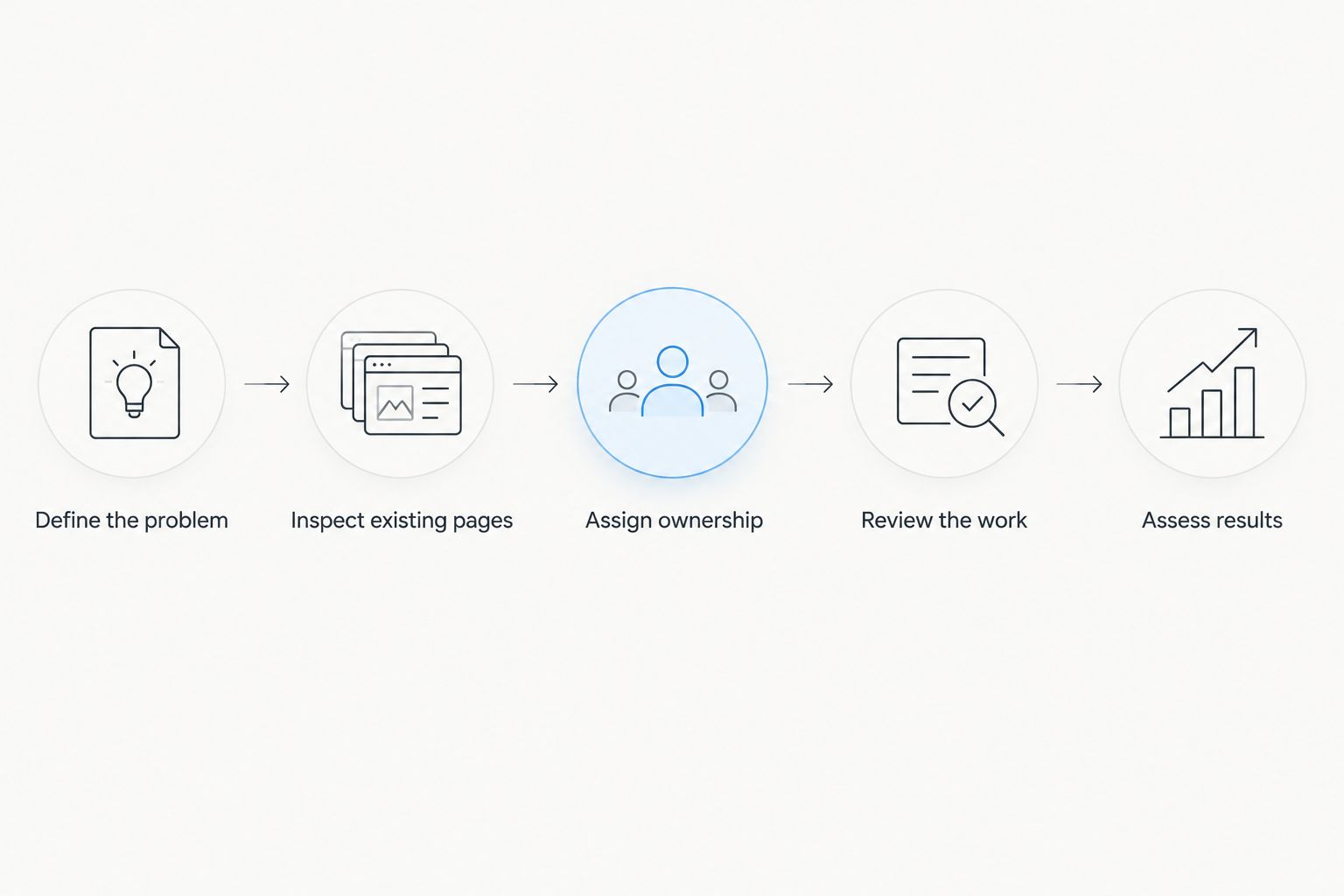
Use this sequence before committing to software or a freelancer. It separates the business problem from the proposed solution and gives you something concrete to evaluate.
- Define the problem. Write a plain-language statement of what needs attention. Be specific enough to distinguish missing service information from a technical concern.
- Inspect existing pages. Identify the page that should address the need. Check whether it needs revision before assuming you need new content.
- Assign ownership. Give each task 1 accountable owner. Other people can contribute, but approval and publication responsibilities should be explicit.
- Review the work. Check the draft, recommendation, or change against the original brief. Confirm that business facts are accurate and that the stated task is complete.
- Assess results. Review search visibility and relevant inquiries separately. Use the evidence available rather than treating publication itself as proof of success.
The sequence works for either purchase. A software trial without a defined task is hard to judge; a freelancer engagement without a defined problem is hard to manage.
What should you check before signing up or hiring?
Use 3 ownership questions for either arrangement: who controls access, who approves changes, and who keeps the work? Get clear answers before connecting a tool or granting a freelancer access.
What exactly will be delivered?
For software, check which functions are included and which steps remain manual. For a freelancer, ask for deliverables specific enough that both parties can recognize completion.
Avoid comparing an entire software feature list with an undefined promise of SEO management. Compare the same task against the same acceptance criteria.
Who checks business accuracy?
Name the person who can confirm that services, locations, and claims are correct. Neither a draft nor a freelancer's recommendation should override facts about your business.
Keep that review separate from writing quality. A polished page can still describe a service you do not provide or imply a service area you do not cover.
What happens when the arrangement ends?
Confirm who retains website access, content, and relevant records. For software, check what happens to your workflow if you stop using it; for a freelancer, agree how unfinished work and access will be handed over.
These are questions to settle before purchase, not assumptions about any provider's policies. Clear answers make the arrangement easier to manage.
Can a small business do SEO without hiring a freelancer?
A small business can handle a defined SEO workflow without a freelancer when someone owns the decisions, reviews the work, and maintains the website. Start with the pages that describe real services and answer real customer questions.
Do not confuse doing the work yourself with doing every specialist task yourself. Bring in help for a problem you cannot diagnose or a change you cannot safely implement.
Should you hire a freelancer before choosing SEO software?
Hire a freelancer first when diagnosis is the missing step, not automatically whenever you consider software. Ask for findings that identify the problem, the proposed action, and the reason for that action.
If your need is already a defined WordPress content workflow, Improveseoplugin addresses that category of work. A separate diagnostic engagement should have its own reason and scope.
Is using both SEO software and a freelancer unnecessary?
Using both is unnecessary when they duplicate the same work without a clear benefit. A combined setup makes sense when each has a distinct assignment and someone coordinates the handoff.
For your 2026 plan, write down the responsibilities before adding another subscription or contractor. If you cannot describe the additional job, postpone the purchase.
FAQ
What's the best choice for a small business: SEO software or a freelancer?
SEO software fits defined, repeatable work; a freelancer fits diagnosis and specialist execution. Choose based on the responsibility you need covered, not the breadth of a feature list or proposal.
Can SEO software replace an SEO freelancer?
SEO software can handle supported tasks, but it does not replace every assignment a freelancer can undertake. Compare the specific workflow with the specific expertise you need.
Do I still need to check content created with SEO software?
You still need to check business facts before publishing software-generated content. Verify services, locations, claims, and contact instructions against your actual business.
What should I ask an SEO freelancer before hiring?
Ask what problem the freelancer will address, what will be delivered, and how completion will be demonstrated. Also agree on access, approvals, and the handover of work.
Is a WordPress SEO plugin enough for a local business?
A WordPress SEO plugin is enough for the tasks it supports, not automatically every search-related need. Separate your content workflow from any technical investigation or specialist assignment.
Should my freelancer and software both publish website changes?
Your freelancer and software need explicit publishing responsibilities if both can change the website. Name an approver and coordinate changes to prevent overlapping work.
How should I compare SEO options in 2026?
Compare SEO options in 2026 against a written task and acceptance criteria. Check supported functions, required expertise, review responsibilities, and ownership before making the decision.
One last thing
Before buying anything, open the page for the service you most want to sell. Check whether a customer can understand what you do, where you do it, and how to take the next step.
If you cannot explain what needs to change, make diagnosis the assignment. If you can explain the change but lack a practical way to produce and publish it, evaluate the workflow. Buy help for the missing step, not for the broad label of SEO.