
Yes, you can write SEO content yourself instead of hiring a writer if you understand your customers, answer their questions accurately, and review each page before publishing. The trade-off is your time: keyword selection, drafting, editing, and maintaining the page remain your responsibility. For a small local business in 2026, start with subjects you know firsthand and hire help when research, writing, or review exceeds your capacity.
- Can I write SEO content myself instead of hiring a writer? Yes—start with customer questions you can answer accurately.
- Improveseoplugin’s WordPress plugin fits local business owners who want keyword discovery, branded drafts, and publishing in one dashboard.
- Write firsthand service content yourself; hire a writer when research, structure, or production blocks publication.
- Review every draft for factual accuracy, search intent, and a useful next step before publishing.
Can I write SEO content myself instead of hiring a writer?
Yes. Choose the writing approach by the work you need done, not by the assumption that SEO requires a professional writer. You need a useful answer, an appropriate page format, and accurate business information.
For a WordPress-based workflow, Improveseoplugin helps local business owners find low-competition local keywords, generate branded content, and publish or schedule it from the dashboard. Those functions support production; you still need to verify what the page says.
| Approach | Best for | Main advantage | Main limitation |
|---|---|---|---|
| Write it yourself | Owners with firsthand knowledge and time to edit | Direct access to customer questions and business details | Research and production use your time |
| Hire a writer | Owners who need help with research, structure, or drafting | You can delegate defined writing tasks | The writer still needs an accurate brief and review |
| Use a WordPress content workflow | Owners who want keyword discovery, drafting, and publishing together | Keeps those tasks inside the WordPress dashboard | Generated drafts still require factual and editorial checks |
These approaches are not mutually exclusive. You can supply the expertise, use drafting assistance, and ask a writer or editor to improve the finished page.
Why this matters
The hiring decision is really a decision about responsibility. Someone must identify the reader’s question, gather the facts, write the answer, and approve publication. Hiring a writer changes who handles parts of that work; it does not remove your responsibility for claims about your business.
For your 2026 content plan, choose a workflow you can maintain and review. A manageable publishing process gives you room to correct mistakes, update changed details, and connect each page to a real customer need.
Your business knowledge is an input, not a finished article. Customers need that knowledge organized around their question rather than presented as everything you know about the subject.
Write it yourself: best for firsthand business questions
Write the page yourself when you can explain the topic clearly from direct experience. Good starting points include what customers need before requesting a quote, how your service process works, and which information helps you assess a job.
The advantage is access. You know the questions customers ask and can verify the answers without passing every detail through another person. You also know when a sentence misrepresents what your business actually does.
The limitation is execution. Knowing the subject does not automatically produce a focused page, and writing can compete with customer work. If every draft becomes a long explanation with no direct answer, get editorial help rather than publishing it unchanged.
Use a simple test: explain the answer aloud, then turn that explanation into headings and short paragraphs. If you cannot answer without guessing, gather the facts before drafting.
Hire a writer: best for a defined writing bottleneck
Hire a writer when you can identify the task you need to delegate. That task might be interviewing you, organizing scattered notes, researching authoritative sources, or turning an approved outline into readable copy.
A writer’s advantage is a separate production role. You can review a draft instead of starting from a blank page. That division is useful when you have the facts but cannot consistently turn them into publishable content.
The limitation is the handoff. A writer cannot safely infer your service boundaries, policies, qualifications, or results. Give the writer approved facts, examples you have permission to use, and a clear description of the intended reader.
Hire for the bottleneck, not for the label “SEO content.” If your drafts are accurate but poorly organized, an editor addresses a different problem from a researcher or a full-service writer.
Use drafting assistance: best for a repeatable WordPress workflow
Drafting assistance is useful when the blank page or the publishing process interrupts work you otherwise understand. It gives you material to review, but review remains a separate task from generation.
Improveseoplugin’s WordPress plugin is best for small local business owners who want local keyword discovery, branded drafts, and publishing in one dashboard. Its described workflow includes scheduling, which lets you prepare content before the intended publication date.
The boundary is straightforward: a draft is not evidence. Check every statement about your business against information you can confirm, and remove any claim that adds detail you did not supply.
In 2026, keep the same approval standard for generated and human-written drafts. Neither method excuses an inaccurate answer, an invented example, or a page that promises a service you do not provide.
How do I write an SEO page myself?
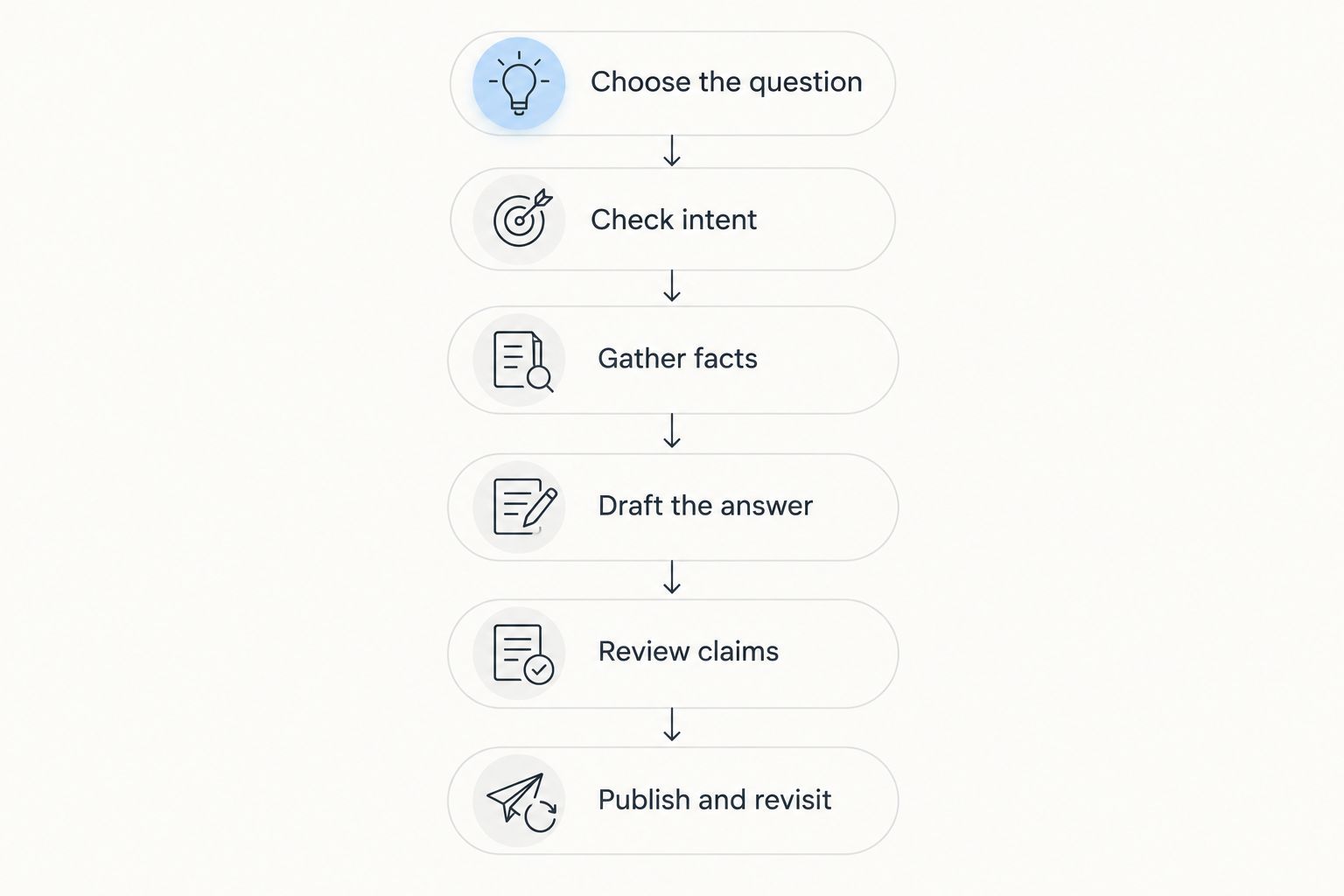
Use this 6-step process to take a customer question from idea to reviewed page. Each step produces something specific, so you can see where you need help rather than treating writing as one indivisible task.
1. Choose the question
Start with a question connected to your actual work. Ask what the reader needs to decide and whether your business can provide a useful answer.
Keep the scope narrow enough to answer directly. A question about preparing for an appointment needs a different page from a broad explanation of every service you offer. Avoid combining unrelated questions just to make an article longer.
2. Check intent
Search the phrase and inspect the kinds of results that appear. Look for whether the query calls for instructions, an explanation, a comparison, or a service page.
Use that observation to choose a format, not to copy another page. If readers need to book a service, a long informational article does not replace clear service information. If they need instructions, a sales pitch does not complete the task.
3. Gather facts
Create a fact sheet before writing. Include confirmed service details, customer preparation requirements, relevant source material, and any limits the answer needs to explain.
Separate business facts from general guidance. You can describe a common consideration without claiming your business offers a particular solution. Leave unsupported details out rather than filling gaps with plausible wording.
4. Draft the answer
Put the complete answer in the opening paragraph. Use the remaining sections to explain the process, exceptions, and decisions that support it.
Write as if you are answering a customer who wants clarity, not a reader who wants a writing performance. Name the task, explain the next action, and remove sentences that repeat an earlier point without adding meaning.
5. Review claims
Read the draft with 3 checks in mind: factual accuracy, question coverage, and business fit. Confirm that the answer is true, that it resolves the query, and that it describes your business correctly.
Then check the page title, headings, links, and next step. A reader should understand what the page covers before committing to a long read. Keyword repetition cannot repair an answer that misses the question.
6. Publish and revisit
Publish only after review. Once the page is live, check that it displays correctly and that its links lead to the intended destinations.
Revisit the page when business details change or customer questions reveal a gap. Publishing is not a promise to leave the wording untouched; maintenance is part of owning the content.
Why the right writing approach varies
The decision depends on the work involved, not simply whether you can write a grammatical sentence. Use these factors to assign responsibility before you begin:
- Firsthand knowledge: Write directly when you know the answer and can verify the relevant details. Request research help when the answer depends on unfamiliar material.
- Available attention: Account for outlining, checking, and publishing—not just typing. Delegate a defined task when those responsibilities prevent completion.
- Consequences of errors: Use an appropriately qualified reviewer for regulated or safety-sensitive claims. Writing skill and subject-matter qualification are separate requirements.
- Page purpose: Match the work to the format. Instructions need a usable sequence; a service page needs accurate information that supports a buying decision.
- Maintenance needs: Assign ownership for changes after publication. A finished draft does not tell you who will correct outdated details.
For your 2026 workflow, document who drafts, who verifies, and who publishes. Those responsibilities matter whether the page starts with your notes, a writer’s interview, or generated text.
Do I need SEO expertise to write useful content?
You do not need SEO expertise to explain your own services accurately. You do need to learn how to choose a focused question, recognize its intent, and make the answer easy to use.
Start with a single page rather than trying to build an entire content library immediately. Completing the research, draft, and review cycle shows which tasks you can own and which ones need support.
Will hiring a writer guarantee rankings?
Hiring a writer does not guarantee rankings. A writer can produce and improve content, but the hiring decision alone does not establish whether a page will appear for a particular search.
Evaluate the work you can inspect: relevance, accuracy, organization, and adherence to your brief. Do not substitute a ranking promise for a clear description of deliverables and review responsibilities.
Should I edit generated content before publishing?
Edit generated content before publishing. Verify business claims, remove unsupported specifics, and check that the draft answers the intended question rather than merely mentioning the topic.
With Improveseoplugin, treat the generated draft as the beginning of approval, not the end. Keep your business knowledge in the loop between content generation and publication.
FAQ
Can I write SEO content myself if I have never done SEO?
Yes, you can begin with questions you understand firsthand. Learn to check search intent, organize the answer clearly, and verify every claim before publishing.
Is writing SEO content myself better than hiring a writer?
Writing it yourself is the better fit when you have the knowledge and time to complete the work. Hiring a writer fits a defined need for research, structure, drafting, or editing.
Can I use generated drafts for my local business website?
Yes, you can use generated drafts as part of your writing process. Review them for accurate business details, unsupported claims, and whether they answer the customer's question.
What should I give a writer before they start?
Give a writer the intended audience, page question, approved business facts, and desired next step. Identify claims that require your approval and any sources the writer must use.
How long should my SEO article be?
Make the article long enough to answer the question and explain the necessary exceptions. Remove repetition rather than adding paragraphs to meet an arbitrary length.
Should I include my city in every paragraph?
No, include your city where location helps explain the service or answer. Repeating a location without adding information makes the page harder to read.
How do I decide whether to hire an editor instead?
Hire an editor when you can supply an accurate draft but need help with clarity, structure, and consistency. Ask for research or writing support separately if the underlying answer is incomplete.
One last thing
Your first useful draft might already exist in a customer email. Find a question you answered carefully, remove private details, and check whether the explanation can stand alone as a public page.
For your next 2026 article, start there instead of inventing a topic from scratch. The test is whether a new reader can understand the answer without the original conversation—and whether every detail still describes your business accurately.