
Yes, you can do local SEO yourself without hiring an expert by maintaining your Google Business Profile, improving your service pages, asking customers for honest reviews, and tracking relevant searches and inquiries. Start with accurate business information and useful pages; hire help when a technical problem, profile issue, or lack of time prevents you from maintaining them.
- Can I do local SEO myself? Yes—Google Business Profile and useful service pages are practical starting points.
- Handle routine updates yourself; get specialist help for unresolved technical problems or profile suspensions.
- Track relevant searches and customer inquiries, not rankings alone.
- WordPress content tools support publishing; they do not replace accurate business details or customer review requests.
Can I do local SEO myself without hiring an expert?
You can handle the core work yourself if you can edit your website, access your business profile, and verify what customers need to know. The job is not to master every SEO term. It is to make your business easier to find, understand, and contact.
For WordPress content work, Improveseoplugin helps small local business owners find low-competition local keywords, create branded content, and publish or schedule it from their dashboard.
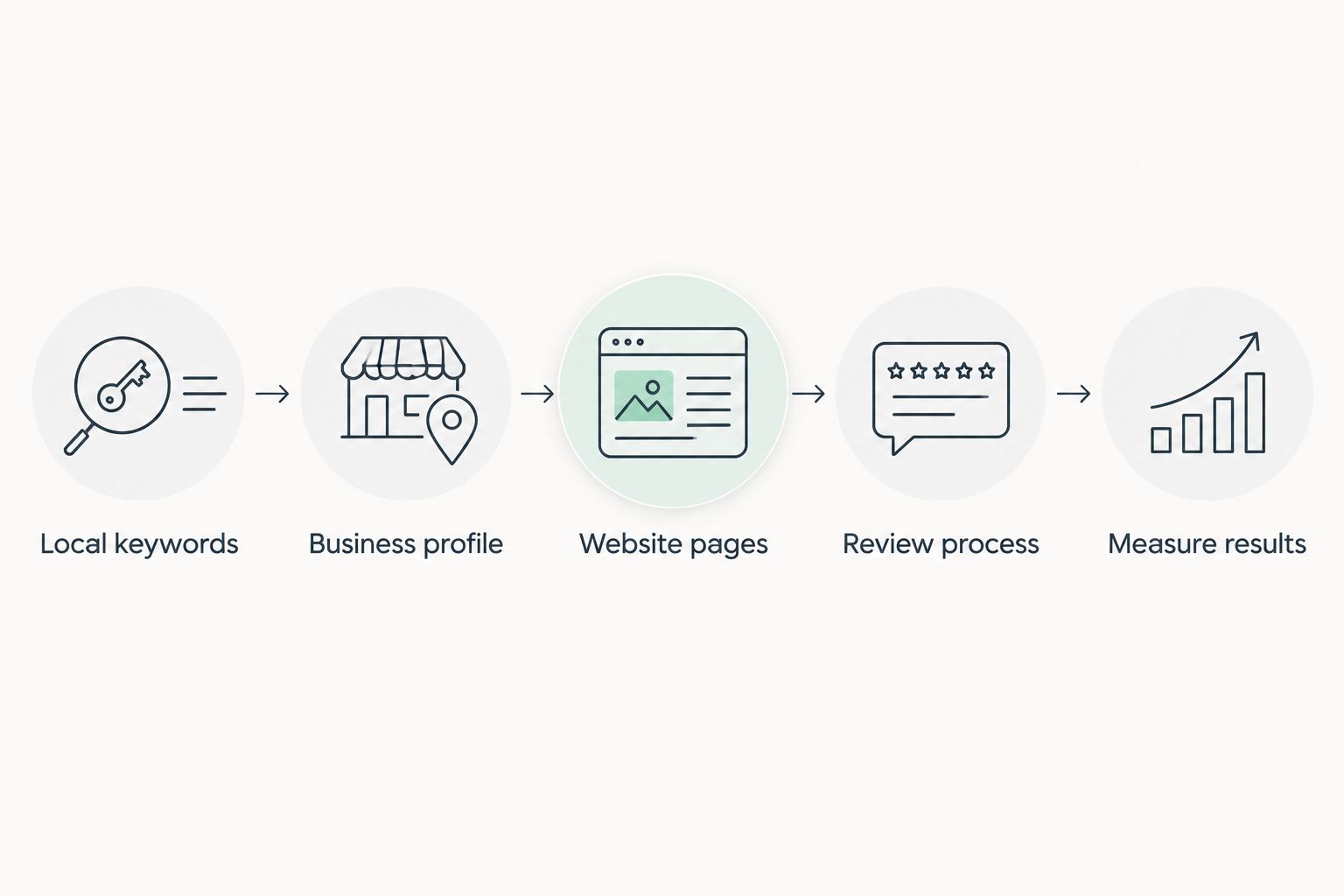
Use this sequence for your 2026 starting plan:
- Local keywords: Identify the services and locations your customers actually search for.
- Business profile: Check eligibility, ownership, categories, contact information, and hours.
- Website pages: Explain your services, coverage, and next steps clearly.
- Review process: Request honest feedback without incentives or selective screening.
- Measure results: Track relevant visibility and customer inquiries before expanding.
Work through the sequence before adding more tools or publishing more articles. Otherwise, you risk creating content while basic contact information or service details remain wrong.
Why this matters
Local SEO helps people understand whether your business serves their location and solves their problem. It involves your website and, for eligible businesses, your presence in Google's local results.
Publishing more is not the same as improving local SEO. A correct opening time, a clear service page, or a working inquiry form can be more useful than another article that repeats existing information.
Your 2026 plan should connect each task to a customer question: Do you provide this service? Do you cover this area? How does someone contact you?
Which local SEO tasks should I do myself?
Choose based on access, confidence, and the consequences of an error. Updating a holiday schedule is different from changing how your entire website handles page addresses.
| Approach | Best for | Main advantage | Main limitation |
|---|---|---|---|
| Do it yourself | Owners who can maintain business details and website content | You supply firsthand knowledge of services and customers | The work still requires attention and follow-through |
| Hire a specialist | Owners facing technical faults, complex changes, or profile problems | You can assign a defined problem to someone with relevant experience | You still need to verify business facts and approve changes |
Start with the work you understand. Record unfamiliar issues rather than changing settings simply because an SEO checklist mentions them.
Business profile: handle routine accuracy checks yourself
If your business is eligible for a Google Business Profile, claim or request access through Google's ownership process. Choose categories that describe the business, enter accurate contact details, and keep regular and special hours current.
Use the real business name rather than adding search terms that are not part of it. Follow Google's address and service-area rules, especially if customers do not visit your location.
Add genuine photos that help customers recognize the business or understand the service. Before uploading, check that images do not expose customer information or suggest work you did not perform.
Website pages: explain the service before writing blog posts
Review the page closest to a purchase or inquiry first. State what you do, where you do it, who the service suits, and how someone takes the next step.
Use a descriptive page title and a clear main heading. Include the location when it helps identify the service area, but do not force a city name into every sentence.
Check the page on a phone. Confirm that contact buttons, forms, navigation, and important service details work without requiring the visitor to hunt for them.
Review process: ask consistently, not selectively
Ask customers for an honest review after a genuine interaction. Make the request part of your normal follow-up instead of sending it only to customers you expect to praise you.
Do not buy reviews, offer rewards for Google reviews, or discourage dissatisfied customers from leaving feedback. Respond professionally and avoid sharing private details in public replies.
Reviews are customer feedback, not copy you control. Your responsibility is to request them fairly and address the issues they reveal.
How do I choose local keywords without SEO expertise?
Start with the language customers use when they call, email, or describe the problem. Combine a real service with a real location when the location changes who you can serve.
An electrician might consider a service-and-city phrase or a specific repair query. Those are research starting points, not evidence that a term has search demand or weak competition.
Build your initial list around these questions:
- Service: What does the customer need done?
- Location: Where can you actually provide it?
- Intent: Is the person looking to hire, compare, or learn?
- Fit: Can your business satisfy the request described?
Inspect the search results before choosing a page format. A query that returns local providers calls for a different response from a question that returns explanatory guides.
Choose relevance before apparent ease. A low-competition phrase has little value if it attracts people outside your service area or looking for something you do not sell.
Do I need a separate page for every town?
No. A separate location page needs a useful reason to exist beyond replacing one place name with another.
Start with 1 page per distinct service as a planning rule, not a search-engine requirement. Add location pages when you can explain genuine differences, such as coverage boundaries, local service arrangements, or location-specific customer questions.
Do not claim offices, teams, or completed projects that you do not have. A service-area statement is better than an invented local presence.
If multiple pages answer the same question with nearly identical text, review whether one stronger page would serve the reader better. Keep the page structure tied to how the business actually operates.
Why does the amount of DIY local SEO work vary?
The workload depends on what needs maintaining and what is already broken. Use these factors to decide whether your 2026 plan fits your available time:
- Location setup: A single operating location is different from maintaining information for several real locations.
- Service range: Distinct services need distinct explanations; closely related services do not automatically need separate pages.
- Website condition: Editing copy is different from repairing inaccessible pages or broken forms.
- Profile status: Routine updates are different from ownership disputes or suspensions.
- Business changes: New hours, changed coverage, and discontinued services require updates wherever customers encounter them.
- Measurement: Inquiry tracking requires a different setup from simply checking whether a page receives impressions.
You do not need to perform every possible task. Prioritize errors that mislead customers, block access, or prevent inquiries before optional improvements.
How do I know whether my local SEO is working?
Create a baseline before making major changes. Use Google Search Console for website search performance and the performance information available in your Google Business Profile for profile interactions.
For your 2026 tracking sheet, compare the latest 28 days with the previous comparable period. Also inspect a broader 3-month period before drawing conclusions from a short-term change; seasonal demand can make adjacent periods misleading.
Record what changed and when. A new service page, corrected business category, and revised contact form are different interventions, so avoid treating them as one undifferentiated SEO update.
Watch the measures that answer specific questions:
- Relevant queries: Are searches about services and places you actually cover?
- Page visibility: Are the intended service pages appearing in search?
- Website visits: Are searchers reaching the pages that answer their needs?
- Inquiries: Are calls and form submissions relevant to the business?
- Customer feedback: Are people finding incorrect details or struggling to contact you?
A ranking is not a customer. Ask how new inquiries found you, and distinguish suitable requests from spam or work outside your coverage.
What can a WordPress plugin do for local SEO?
A plugin can support a defined workflow, but it cannot supply facts you have never provided or verify every claim about your business. Treat generated text as a draft you are responsible for publishing.
Improveseoplugin is best for small local business owners who want to manage WordPress content without SEO expertise. Its stated functions cover finding low-competition local keywords, generating branded content, and publishing or scheduling it from the WordPress dashboard.
The benefit is a content workflow inside WordPress. The boundary is equally clear: those functions do not remove your responsibility to check services, coverage, business details, and every claim in a draft.
Before publishing content created with Improveseoplugin, check:
- Does the page describe a service you actually provide?
- Does every location match your real coverage?
- Are claims about credentials, results, policies, and experience accurate?
- Does the page answer something your existing pages leave unanswered?
- Does the next step work on a phone?
Use Improveseoplugin for the content tasks it describes. Keep profile maintenance, customer feedback, and technical troubleshooting in your plan rather than assuming that publishing replaces them.
When should I hire a local SEO expert?
Hire help when you can describe a problem but cannot safely diagnose or fix it. Useful examples include an unresolved profile suspension, pages that Google cannot access, or a website move involving changed addresses.
Seek technical help when a proposed fix affects many pages at once. Redirects, indexing controls, and website migrations deserve more care than editing a paragraph.
Before assigning work, define the outcome and request an explanation of the changes. You should retain access to your website, business profile, and measurement accounts.
For a 2026 engagement, ask the specialist to identify the affected pages or settings, explain the business consequence, and document the work. Avoid anyone who promises a guaranteed position or proposes fabricated locations and reviews.
Can I do local SEO without writing a blog?
Yes. You can improve business information, service pages, contact paths, and review practices without publishing a blog.
Write an article when it answers a real customer question that does not belong on a service page. Do not create a publishing schedule merely to keep a blog active.
How long should I keep doing local SEO myself?
Keep doing it yourself while you can maintain accurate information, publish verified content, and evaluate relevant inquiries. There is no universal deadline that makes hiring necessary.
Reassess when the work repeatedly goes unfinished or the problems exceed your access and skill. Outsource the specific bottleneck rather than assuming the entire program needs replacing.
FAQ
Can I do local SEO myself if I have no experience?
Yes, you can start with accurate business details, clear service pages, and honest review requests without prior SEO experience. Learn unfamiliar settings before changing them, especially settings that affect website access or indexing.
Do I need a Google Business Profile to do local SEO?
You can improve your website for local searches without a Google Business Profile. Create a profile only if your business meets Google's eligibility requirements.
Can I rank locally without publishing blog posts?
Yes, blog posts are not a requirement for improving local search visibility. Start with relevant service pages and accurate business information; publish articles when they answer additional customer questions.
Should I create a page for every city near me?
No, create a location page only when it provides useful information about an area you genuinely serve. Avoid near-identical pages that change only the city name.
How often should I check my local SEO results?
Compare the latest 28 days with a comparable previous period as a practical review routine. Check broader trends and business seasonality before treating a short-term movement as a result of your changes.
When is hiring an expert better than doing local SEO myself?
Hire an expert when technical faults, profile problems, or unfinished work prevent you from maintaining the basics. Define the problem and retain ownership of your accounts.
One last thing
Before you publish another page, submit your own contact form from your phone and follow the same path a new customer would take. Confirm that the message reaches the right person and that the reply process works.
Being found is only useful if customers can reach you. Make that test part of your 2026 maintenance routine, alongside checking hours, service coverage, and business details.