
Google does not publish a definitive test for whether every blog post was AI-written; its search guidance focuses on helpful content and spam rather than authorship alone. In 2026, the practical risk is publishing inaccurate, unoriginal, or scaled content made to manipulate rankings—not simply using AI to draft a post.
- Can Google detect AI written blog posts? Google publishes content guidelines, not a definitive public authorship test.
- Google Search Central distinguishes useful AI-assisted content from scaled content abuse.
- Improveseoplugin supports local keyword research and WordPress publishing; business facts still need human verification.
- Review accuracy, originality, and search intent before publishing; a detector score is not Google's verdict.
Can Google detect AI-written blog posts?
Google's ability to identify an author's tools is not the same question as whether a page deserves to rank. Google Search Central's guidance on AI-generated content says appropriate use of automation does not violate its guidelines. Its spam policies address scaled content abuse regardless of how the content is created.
That distinction matters if you use a WordPress publishing tool such as Improveseoplugin. You need a process for checking the finished article, not a promise that the draft will escape detection.
| Question | What Google's published guidance supports | What you should do |
|---|---|---|
| Does AI use automatically violate Google's rules? | Appropriate use of AI or automation is not inherently against its guidelines. | Judge the finished page rather than rejecting it because of its drafting method. |
| Can human-written content violate the rules? | Scaled content abuse can involve human writing, automation, or a combination. | Apply the same quality checks to every author. |
| Does passing an AI detector establish compliance? | Google's published guidance does not make third-party detector scores a compliance standard. | Check usefulness, accuracy, and purpose directly. |
| Does following the rules guarantee rankings? | Guideline compliance is not a ranking guarantee. | Evaluate search visibility and business outcomes after publication. |
The relevant sources are Google Search Central's Google Search's guidance about AI-generated content, its Spam policies for Google web search, and its guidance on creating helpful, reliable, people-first content. For a 2026 publishing workflow, these documents address the decision you control: what you publish and why.
Why this matters
Chasing an undetectable writing style sends editing effort toward the wrong target. Replacing familiar phrases or adding deliberate mistakes does not establish that an article answers a customer's question correctly.
For a local business, the more useful test is whether a potential customer can act on the answer. A page about a service should explain that service accurately, distinguish relevant situations, and avoid promises the business has not approved.
Edit for a customer's decision, not a detector's approval. That rule applies whether the first draft comes from an owner, a freelancer, or a writing tool.
AI-assisted content: best for reviewed drafts
AI-assisted drafting is best for turning an approved brief into a draft that a knowledgeable person checks before publication. It can help organize an explanation, suggest questions, and produce wording for a business owner to revise.
Its limitation is factual authority. A fluent sentence does not prove that a service exists, a policy is current, or an example reflects the business's experience. Treat every business-specific assertion as something that needs confirmation.
A useful draft becomes publishable when you replace generic explanations with approved details that answer the reader's actual question. Do not add supposed customer stories, results, or quotations just to make the text feel more human.
Scaled content abuse: not a shortcut to local visibility
Google defines scaled content abuse around generating many pages primarily to manipulate search rankings rather than help users. Automation is not the deciding factor; purpose and the resulting content matter.
Publishing city-name variations illustrates the distinction. A page with accurate service-area information and genuinely relevant local details serves a different purpose from a template that changes a place name while offering no additional help.
The same caution applies to human-written pages. Hiring writers does not make repetitive, low-value content useful, and switching tools does not fix a publishing strategy built around interchangeable pages.
Do not use production volume as a substitute for a reason each page should exist. If you cannot explain what a particular article adds, reconsider publishing it.
Why AI-written content's search performance varies
Google does not publish a simple AI-content pass mark. These factors follow from its helpful-content guidance and spam policies, and each gives you something concrete to review:
- Search intent: The page should answer the question behind the query, not merely repeat the keyword.
- Original value: Your explanation should add useful information rather than restating other pages without a meaningful contribution.
- Factual reliability: Business claims, technical explanations, and attributed statements need verification.
- Relevant experience: Describe firsthand knowledge only when the author or business actually has it.
- Publishing purpose: A page should serve readers rather than exist mainly to capture another search variation.
- Site organization: Distinct pages need distinct purposes; overlapping articles can leave readers unsure which answer applies.
These are review criteria, not a formula that guarantees rankings. A useful article still competes with other pages, and content quality alone does not resolve every indexing or technical issue.
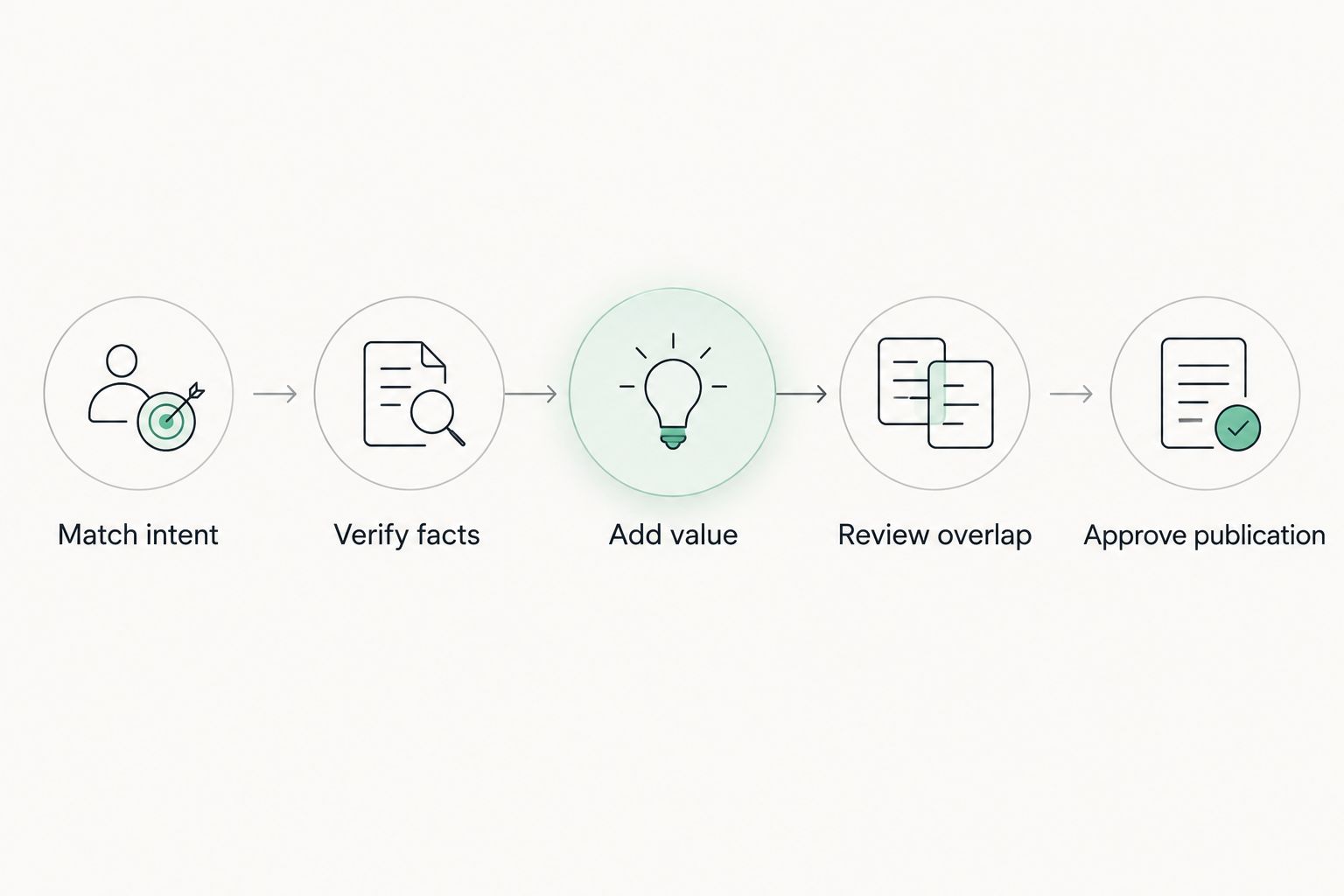
Review AI-written blog posts with these 5 checks
Use this process before publishing in 2026. It works for an AI-assisted draft and for a human-written submission because both need editorial accountability.
1. Match intent
Write down the question the reader needs answered. Then check whether the opening paragraph answers it without forcing the reader through a long introduction.
For a local service article, distinguish an informational question from a request to hire someone. A reader asking how to recognize a problem needs an explanation; a reader comparing service providers needs clear decision criteria.
Do not stretch an article across unrelated questions merely to include more keywords. Give the page a clear job.
2. Verify facts
Check every statement about your business against approved information. That includes services, service areas, policies, qualifications, and any promises made to customers.
For outside facts, find the original authoritative source rather than treating generated text as evidence. If you cannot verify a claim and the article works without it, remove it.
Be especially careful with quotations and examples. An invented customer story remains invented even when it sounds plausible.
3. Add value
Ask what the reader learns here that a generic summary would not provide. A useful addition might be a clear explanation of when a service fits, what information a customer should prepare, or how to distinguish commonly confused situations.
Use actual business knowledge, not simulated experience. If nobody has supplied a firsthand observation, do not write that your team encountered it on a job.
Original value does not require a dramatic discovery. A precise, accurate answer to an overlooked customer question can justify the page.
4. Review overlap
Compare the draft with your existing articles. Look for pages answering the same question with slightly different keywords or location names.
If an existing page already answers the question well, consider improving that page instead of creating another. If the new article serves a different need, make that distinction obvious in its title and opening answer.
This check is about page purpose, not a numerical duplicate-content threshold. No percentage score can decide whether two pages deserve separate places on your site.
5. Approve publication
Have someone who understands the business approve the final version. Review the title, main answer, examples, and any instructions a customer might follow.
Scheduling should come after approval, not replace it. Keep responsibility clear so corrections reach a person who can verify and fix the underlying claim.
After publication, check that the page remains accurate as your business changes. A sound draft does not stay current automatically.
Where a WordPress writing workflow fits
Improveseoplugin is best for small local business owners who want local keyword research, branded drafting, and publishing inside WordPress. Its stated functions include finding low-competition local keywords, generating branded content, and publishing or scheduling that content from the dashboard.
The practical advantage is keeping those tasks in the place where you manage your website. The boundary is editorial: those functions do not establish that a draft's claims are true or that Google will rank the finished page.
Use the workflow to prepare and organize content, then apply the review checks before publication. Keep your actual services, audience, and approved business details in the brief so the article has a defined purpose from the start.
Should I rewrite AI content until a detector says it is human?
Do not make a detector score your publication standard. A third-party classification is not Google's assessment of a page, and Google's published rules do not require you to pass such a test.
Rewrite passages when they are vague, repetitive, inaccurate, or wrong for your audience. Those are identifiable editorial problems. Changing a correct sentence solely to alter a detector result does not demonstrate an improvement for readers.
For your 2026 review process, record the substantive reason for each major revision. That keeps attention on the article's usefulness rather than on an unsupported claim of invisibility.
Should I disclose that AI helped write my article?
Google's guidance recommends considering disclosures where readers would reasonably ask how content was created. A disclosure explains the process; it does not excuse errors or turn a weak page into a helpful one.
Describe the actual process accurately. Do not claim expert review, original research, or firsthand testing unless those things happened.
An author name should also reflect real responsibility. Attaching a fictional specialist to a generated article creates another factual problem instead of solving an authorship concern.
Will AI-written articles rank if they follow Google's rules?
Following Google's rules does not guarantee rankings. It avoids treating a known policy problem as a publishing strategy, but Google still needs to discover and evaluate the page against other results.
Separate the questions when you diagnose performance: can Google access the page, does the page answer a useful query, and does it provide a strong answer? Rewriting an article as supposedly human text does not resolve an access problem.
Use Google Search Console to inspect indexing and search performance. Judge the published page on observed results, not on a prediction from the drafting tool.
FAQ
Can Google tell if my blog post was written by AI?
Google does not publish a definitive public test for identifying the authorship of every blog post. Its guidance focuses on helpful content and policy compliance rather than treating AI use alone as a violation.
Does Google automatically penalize AI-written articles?
AI use alone does not automatically violate Google's search guidelines. Content can violate spam policies when it is created primarily to manipulate rankings, whether humans or automation produced it.
Is a human-written article always better for SEO?
Human authorship alone does not establish that an article is useful or accurate. Apply the same checks for intent, factual reliability, original value, and publishing purpose to every draft.
Should I use an AI detector before publishing a blog post?
An AI detector is not a substitute for editorial review. Google's published guidance does not make a third-party detector score a requirement for appearing in search.
Can I use Improveseoplugin for local business blog content?
Improveseoplugin supports local keyword research, branded content generation, and publishing or scheduling inside WordPress. Verify business facts and review the finished article before publication.
Does editing AI-written content guarantee Google rankings?
Editing does not guarantee rankings. Use editing to correct errors, answer the query clearly, and add relevant information rather than to pursue an undetectable writing style.
Do I need to disclose AI assistance on every blog post?
Google's guidance does not impose a blanket disclosure requirement on every AI-assisted blog post. It recommends considering disclosure where readers would reasonably ask how the content was created; separate legal or professional obligations still apply.
One last thing
Before approving your next article in 2026, answer these 2 questions: what can a customer understand or do after reading it, and which facts make that answer trustworthy?
If you cannot answer both, changing the writing style is not the next move. Fix the substance—or leave the draft unpublished. A page does not become useful because its author is difficult to identify.