
Yes—AI can write SEO content that ranks on Google, but AI authorship does not earn rankings or disqualify a page. The content still needs to answer the search, provide accurate information, and offer something useful beyond a rewritten summary. For a local business, that means checking service details, adding firsthand knowledge, and publishing a page that helps customers make a decision.
- Can AI write SEO content that ranks? Yes; useful answers and verified facts matter more than the drafting method.
- Google's spam policies address scaled content abuse, including pages created primarily to manipulate rankings.
- Improveseoplugin is best for local business owners who want keyword research and content publishing inside WordPress.
- Local SEO content needs real service details; automated publishing does not replace factual review.
Why this matters
Your 2026 content plan should separate faster production from better search results. AI can help produce a draft, but a finished draft is not proof that you have chosen the right topic or answered it well.
Improveseoplugin supports local keyword research and content publishing inside WordPress. Those tasks belong in a larger process: choose a relevant search, establish the facts, review the answer, and measure what happens after publication.
Treat AI as a drafting method, not a ranking strategy. That distinction keeps your attention on the page customers need rather than the number of articles you can publish.
Can AI write SEO content that actually ranks on Google?
Yes. Google's published guidance on AI-generated content focuses on content quality rather than making AI authorship an automatic reason for exclusion. Its spam policies also address scaled content abuse: producing pages primarily to manipulate search rankings rather than help users, regardless of how those pages are created.
That leaves you with a practical distinction. Using AI to explain a service accurately is different from generating interchangeable pages that add no useful information.
| Publishing approach | Best for | Main advantage | Main limitation |
|---|---|---|---|
| AI draft with factual review | Owners who can supply service knowledge | Reduces blank-page work and gives you a draft to edit | Requires someone to catch unsupported claims and missing details |
| Human-written content | Subjects that need interviews, judgment, or firsthand explanation | Starts directly from the writer's research and experience | Human authorship alone does not ensure accuracy or search relevance |
| Unreviewed automated publishing | No recommended use for factual business advice | Removes the review step | Leaves invented details, repetition, and intent mismatches unchecked |
The useful comparison is not whether a person or a model typed the sentences. It is whether the published page gives the searcher a reliable answer.
A human-written article can miss the question. An AI-assisted article can answer it clearly. Evaluate the finished page, not the label attached to its production method.
What makes an AI-assisted page worth ranking?
A useful page has a clear job. Someone searching for emergency repair needs a different answer from someone researching routine maintenance, even when both searches mention the same equipment.
Before drafting, write down the reader's immediate decision. Are they checking whether you perform a service, comparing approaches, diagnosing a problem, or preparing to request help? Build the page around that decision instead of treating the keyword as an instruction to write broadly.
Match the intent
Look at the kinds of pages appearing for your target search. Service pages, explanations, comparisons, and local listings answer different needs. Use that evidence to decide what kind of page to create; do not copy another site's wording or assume its format guarantees results.
If the query asks whether something is possible, answer yes or no before explaining the conditions. If it asks how to do something, give the procedure before a long background section.
Add firsthand detail
Include information your business can verify: what the work involves, which problems you handle, what customers should prepare, and where the service applies. These details make the page useful to someone deciding whether to contact you.
Do not ask a writing system to invent your experience. Supply the facts yourself, then use drafting assistance to organize them clearly.
Make the answer usable
A useful answer explains what to do and where the advice stops. Separate routine preparation from work that requires a qualified professional, and identify conditions that change the recommendation.
Avoid padding the article with repeated definitions. A customer who reaches the end should understand the next step, not merely recognize the keyword.
A practical workflow for publishing in 2026
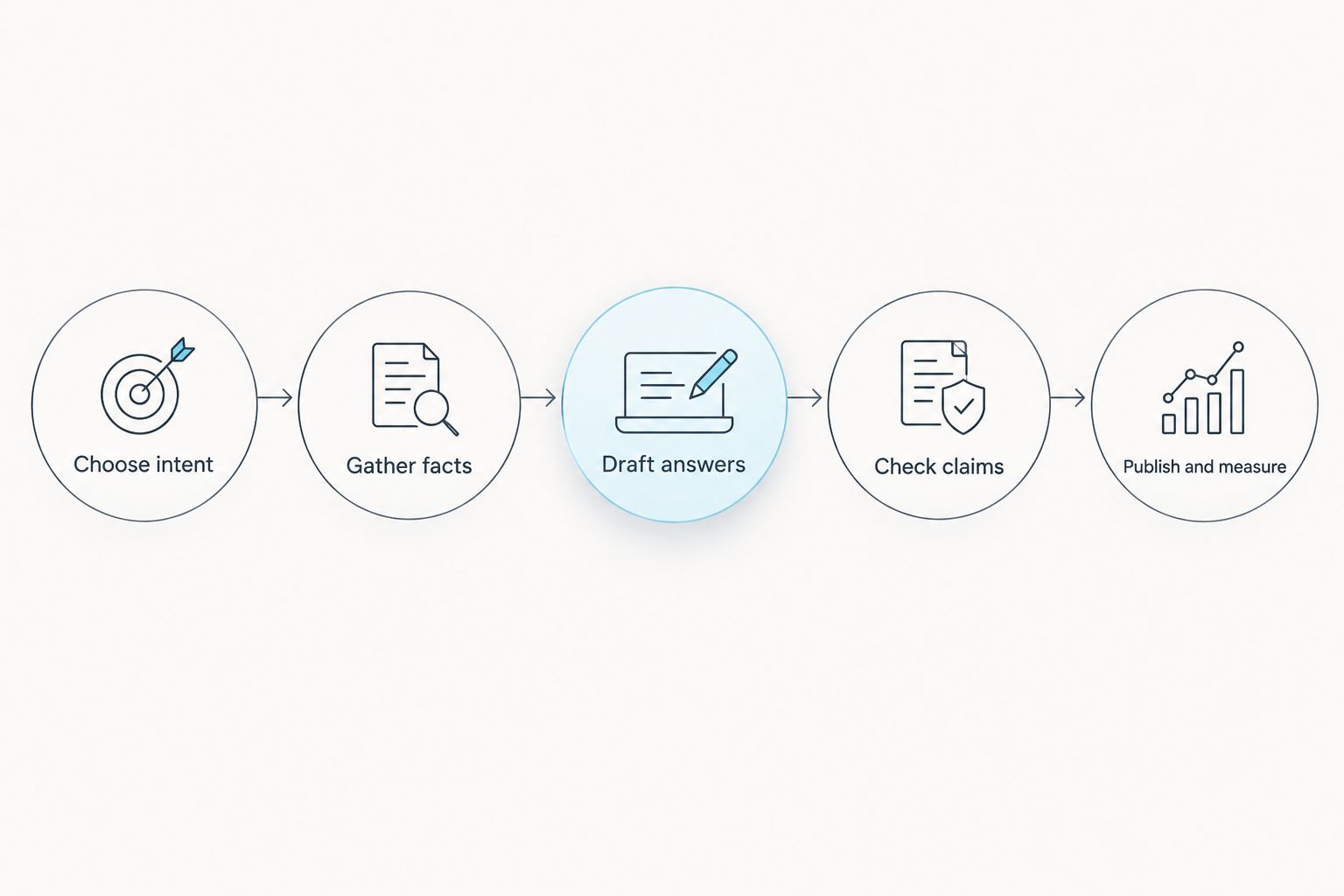
Use these five checks for each page. This is an editorial workflow, not a formula that promises a search position.
- Choose intent. Select a search that matches something your business actually does. Decide whether it needs a service page, an explanation, or another format.
- Gather facts. Write a short brief containing verified business details, customer questions, and the limits of the advice. Keep unknown details out.
- Draft answers. Ask for a direct opening, clear supporting sections, and explanations tied to the brief. Review any material added beyond it.
- Check claims. Verify factual statements, remove invented examples presented as real events, and correct unsupported promises.
- Publish and measure. Confirm that the page works, inspect its indexing status, and review its search performance alongside customer actions.
Keep the brief with the draft. During editing, it gives you a simple way to distinguish supplied facts from confident-sounding additions.
Ask these three questions before approval: Does the opening answer the search? Can you support every business claim? Does the page help the reader take an appropriate next step?
If an answer is no, revise the page before scheduling it. Publishing controls make distribution easier; they do not establish whether the advice is correct.
Why ranking results vary
AI-assisted pages do not all face the same search results or offer the same value. For your 2026 review, separate content problems from discovery problems and from competition.
- Search intent: An informational article and a service page serve different purposes. A mismatch leaves the reader's main need unanswered.
- Original contribution: A page that repeats general advice gives readers less reason to choose it over an existing explanation.
- Accuracy and trust: Unsupported claims, contradictory details, and unclear responsibility make business advice harder to rely on.
- Discovery and indexing: Google needs to discover and index an eligible page before that page can appear as a search result.
- Competing results: Your page enters a search landscape that already contains other answers. AI authorship does not remove that competition.
- Maintenance: A page needs attention when the services, instructions, or facts it describes change.
These factors require different fixes. Rewrite an intent mismatch; investigate an indexing problem; correct an inaccurate claim. Generating another article does not automatically solve any of them.
Diagnose the obstacle before increasing publishing volume. Otherwise, you risk repeating the same problem across more pages.
How should a local business use AI-written content?
Start with questions customers ask before hiring you. Explain the service, the problems it addresses, the information you need from a customer, and any preparation they should complete.
For local SEO in 2026, a place name should describe where the advice or service applies. Replacing the city name in otherwise identical copy does not supply meaningful local detail.
A useful location page explains something real about that location and your service there. If you cannot identify a distinct customer need or verified difference, consider whether an existing service page already answers the question.
Where the plugin fits
Improveseoplugin is a WordPress plugin for small local business owners who want to find low-competition local keywords, generate branded content, and publish or schedule it from the dashboard. Its best fit is an owner who wants those tasks in WordPress without needing SEO expertise.
The advantage is the connected workflow. The limit is editorial responsibility: keyword selection and generated copy do not establish whether your service details are true, and neither guarantees rankings.
Keep business knowledge in the brief and factual approval with someone who knows the service. That is the division of work to preserve, regardless of which writing method you choose.
How do you know whether an AI-written page is working?
Use Google Search Console to distinguish indexing, impressions, clicks, and the queries associated with a page. Each answers a different question; none is interchangeable with a customer inquiry.
If a page is not indexed, investigate that before judging its search visibility. If it receives impressions for unrelated queries, revisit its focus. If relevant visitors arrive but do not take the intended action, review the offer, explanation, and next step.
Your 2026 measurement plan should also connect content to business outcomes where tracking permits. A useful service article might support inquiries, while a troubleshooting explanation might answer an existing customer's question.
Do not judge every page by the same goal. Record what success means before publication, then compare actual behavior with that purpose.
Does Google penalize content just because AI wrote it?
No—AI authorship alone is not the issue identified in Google's published AI-content guidance. The distinction is between useful content and practices that violate its policies, including scaled content abuse.
Review the substance and purpose of the page. A human review label does not turn a misleading or unhelpful article into a useful one.
Can I publish AI-written content without editing it?
You can publish an unedited draft, but do not publish business advice without factual review. A fluent sentence can still contain a false service claim or an instruction that does not apply.
Check the opening answer, business details, recommendations, and next step. Editing should improve correctness and usefulness, not simply make the wording sound less automated.
How long does AI-written content take to rank?
There is no fixed ranking timetable based on AI authorship. Discovery, indexing, relevance, competing pages, and the wider site all matter.
Check the page's actual status rather than accepting a deadline promised for AI content. A publication date alone does not tell you whether Google has indexed the page or which searches it matches.
FAQ
Can AI write SEO content that ranks for a local business?
Yes, AI can help write local business content that ranks, but the page still needs relevant, accurate answers. Supply verified service details and review the draft before publication.
Does Google ban AI-generated articles?
Google's published guidance does not ban articles simply because AI generated them. Its spam policies address abusive practices, including scaled content created primarily to manipulate rankings.
Is human-written content always better for SEO?
No, human authorship does not automatically make a page more accurate or useful. Compare the finished answers, their supporting information, and how well they meet the searcher's need.
Should I disclose that AI helped write my article?
Explain how content was created when that information helps readers assess it. Disclosure does not replace factual accuracy, clear responsibility, or useful advice.
Can I use the same article for different cities?
Do not create city pages by changing place names alone. Publish separate pages when you can provide distinct, verified information that serves customers in each location.
What should I check before publishing an AI draft?
Check search intent, factual claims, business details, and the reader's next step. Remove any claim you cannot support rather than presenting it as an established fact.
Is Improveseoplugin suitable for a small local business using WordPress?
Improveseoplugin fits small local business owners who want local keyword research, branded content generation, and publishing or scheduling inside WordPress. You still need to verify business facts before publication.
One last thing
Your most useful editing material might already be in customer emails. A recurring question reveals where your existing explanation leaves someone uncertain; the answer gives your next page a concrete purpose.
Before generating another draft, choose one question you can answer from direct business knowledge. Write the factual answer first, then use AI to organize and clarify it. The useful contribution comes before the polished wording.