
Yes—AI can write content in your brand’s voice when you give it clear writing rules, representative examples, and accurate business facts. Treat the result as a draft: sounding like your business does not prove that its claims are true, its advice is useful, or its wording deserves publication.
- Can AI write content in my brand's voice? Yes—specific examples and explicit rules give it a usable direction.
- Improveseoplugin supports branded content creation for local businesses in WordPress; owners still need to check facts and approve wording.
- Separate brand voice from business facts, local keywords, and page intent before requesting a draft.
- Review accuracy and usefulness before polishing tone; a convincing sentence can still contain an unsupported claim.
Can AI write content in my brand’s voice?
AI can follow an expressed voice; it cannot reliably infer your entire business from a short prompt. Asking for friendly, professional writing leaves the important decisions unresolved: how direct to be, what terminology to use, and which claims to avoid.
For a WordPress-based local business, Improveseoplugin brings branded content generation, local keyword research, publishing, and scheduling into the dashboard. That workflow addresses production; your brief still needs to establish what your business should say.
The practical distinction in 2026 is between giving a model adjectives and giving it usable editorial instructions.
| Approach | Best for | Advantage | Limitation |
|---|---|---|---|
| Tone-only prompt | Exploring an initial direction | Simple way to compare formal and conversational wording | Leaves vocabulary, claims, and structure unspecified |
| Approved examples | Demonstrating how your business sounds | Shows sentence patterns and how you explain services | Examples can contain outdated facts or inconsistent styles |
| Written brief plus examples | Repeatable business content | Separates voice rules, facts, audience, and purpose | Requires maintenance and editorial review |
Use a written brief plus approved examples for recurring content. Keep tone-only prompts for exploration, not as the entire publishing process.
Why this matters
Your local business content needs to do more than sound recognizable. It must answer a prospective customer’s question without inventing service details, promises, or reasons to choose you.
A conversational paragraph with an invented guarantee is not on-brand. Neither is a search-focused article that repeats a city name but never explains the service.
For your 2026 content plan, define success as an accurate, useful answer delivered in your established voice. Style is part of that standard, not a substitute for it.
What should I give AI to capture my brand’s voice?
Build a short reference document that distinguishes permanent writing rules from facts that change. You should be able to update service information without rewriting your whole voice guide.
Approved examples: show the decisions you want repeated
Start with 3 approved writing samples as a practical briefing exercise, not a technical requirement. Choose material you would willingly publish again: a service explanation, a customer email, and an article introduction, for example.
Annotate each sample. Explain whether you want the short opening, the plain-language explanation, or the restrained closing repeated.
Do not provide a pile of text and assume every sentence represents your preferred style. Remove outdated promotions, unsupported claims, and wording you no longer use before making it an example.
Voice rules: turn adjectives into instructions
Replace broad descriptions with observable writing choices. Friendly is a direction; explain unfamiliar terms before using them is an instruction an editor can check.
Useful rules include:
- Address the reader as you.
- Answer the main question before adding background.
- Use everyday terms unless a technical term is necessary.
- Avoid exclamation marks and exaggerated promises.
- End with a relevant next step rather than a sales slogan.
These are examples of rules, not a universal voice prescription. Choose the ones that reflect your existing business communication.
Business facts: establish what the draft can claim
Keep approved facts separate from style examples. Include your actual services, intended customers, service area, and any policies relevant to the page.
Tell the writing system not to fill gaps with plausible details. A local service article should not acquire invented opening hours, credentials, response times, or customer stories just because those details would make the copy more persuasive.
If a detail needs confirmation, leave it out of the published draft. Resolve the question with the business owner before adding it back.
Page intent: explain the job of this article
Specify the reader’s question and what a useful answer must cover. A service page, an appointment-preparation guide, and a troubleshooting article need different structures even when the voice stays consistent.
Add the target keyword as context, not as a repetition target. Your brief should make clear which customer problem the page solves and what action makes sense afterward.
How do I turn a brand brief into a publishable draft?
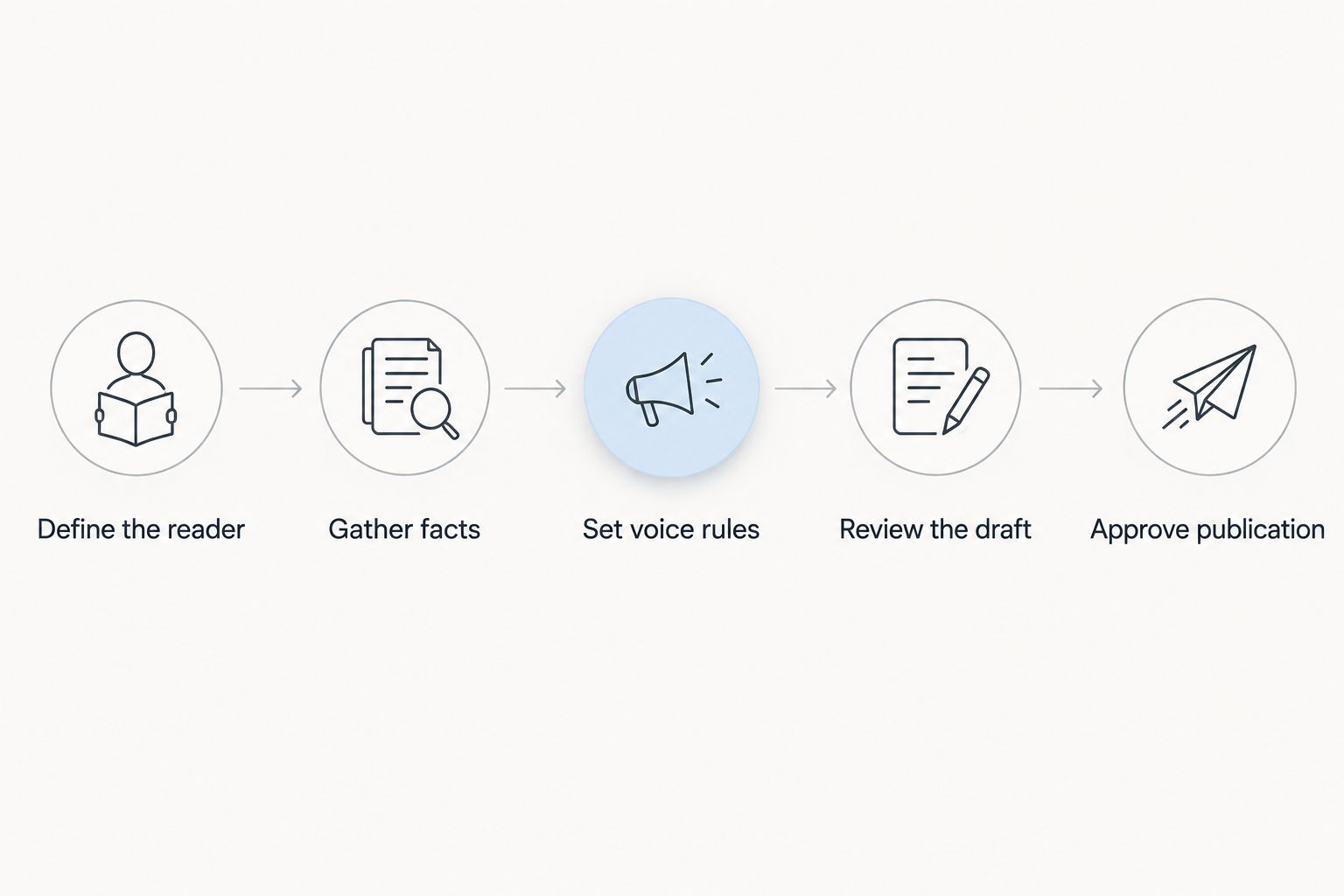
Use the following sequence for each article. It separates content decisions from stylistic editing so a smooth draft does not bypass a factual check.
- Define the reader. Identify the customer and the question bringing them to the page. Avoid a vague audience such as everyone who needs help.
- Gather facts. Supply only the business information relevant to that question. Keep unsupported promises and assumptions outside the draft.
- Set voice rules. Attach the approved examples and explain which features to follow. State prohibited wording explicitly.
- Review the draft. Check the answer, claims, examples, and tone against the brief. Remove any sentence you cannot defend.
- Approve publication. Confirm that the final page is useful and accurate before publishing or scheduling it.
Reviewing belongs before approval, not after scheduling. Keep the distinction visible in your 2026 editorial workflow, even when drafting and publishing happen inside the same dashboard.
A reusable instruction can stay short: write for the specified customer, answer the stated question, follow the annotated examples, and use only the supplied business facts. Add the page-specific information each time instead of expecting the system to remember every business decision.
Why does AI-written brand voice vary?
Inconsistent output is a reason to inspect the instructions, not simply add more tone adjectives. Check these factors before rewriting the entire brief:
- Conflicting examples: Formal website copy and casual social posts demonstrate different styles unless you explain which applies.
- Vague rules: Professional and approachable do not specify sentence length, terminology, or acceptable sales language.
- Mixed audiences: An explanation for a first-time customer needs different context from a message to a returning customer.
- Changing page purposes: An educational answer and a service pitch have different jobs, even under the same voice guide.
- Unverified source material: Old examples can introduce obsolete policies or claims into an otherwise current article.
Correct the source of the inconsistency. If the audience is unclear, define it; if examples conflict, label their purposes rather than asking for a blend.
Save changes to your brief when you make them. Otherwise, your next draft starts with the same ambiguity you just edited out.
How can I check whether a draft actually sounds like us?
Read the draft against your approved samples, not against an abstract impression of good writing. Ask whether your business would use these words when explaining the same issue to a customer.
Use 2 separate review passes: one for accuracy and usefulness, then one for voice. This is a recommended editing method, not a claim about how much review every article requires.
First pass: accuracy and usefulness
Check every statement about what you sell, whom you serve, and what customers should expect. Verify named policies, qualifications, locations, and service details against approved business information.
Then assess the answer itself. Does it resolve the main question, explain any necessary conditions, and distinguish advice from a promise?
Delete decorative examples that introduce unsupported details. An article does not need a fictional customer success story to explain a real service clearly.
Second pass: voice and clarity
Read the opening and closing aloud. If they sound unlike something you would say to a customer, identify the exact problem rather than asking for a more human version.
Look for unnecessary formality, exaggerated praise, repetitive transitions, and sentences that avoid a direct answer. Rewrite those passages using your actual voice rules.
Finally, check that local keywords fit the meaning of the sentence. A recognizable voice does not require awkward city-name repetition or identical phrasing across every page.
Can AI match my voice without copying my examples?
Yes—ask it to follow the writing characteristics of your examples rather than reuse their sentences. Specify which characteristics matter, such as direct openings, plain explanations, or restrained calls to action.
Review the draft for repeated phrases and passages that are too close to the reference material. This also catches situations where an example’s service details have migrated into an unrelated article.
For your 2026 brief, describe the pattern you want reproduced. Use examples as evidence of that pattern, not as paragraphs to rearrange.
Should I use the same voice for every local SEO page?
Keep the core voice consistent, but adapt the explanation to the reader’s task. A worried customer looking for preparation advice needs different information from someone comparing whether a service fits their needs.
Change the depth, structure, and next step without changing your standards for accuracy or your basic way of speaking. Local relevance should come from useful, verified information rather than swapping place names into otherwise identical text.
Consistency means recognizable editorial choices, not identical paragraphs. Review each page as a standalone answer before adding it to your publishing schedule.
Where does a WordPress content plugin fit?
Improveseoplugin is best for small local business owners who want branded content creation and publishing inside WordPress. Its stated workflow covers finding low-competition local keywords, generating branded content, and publishing or scheduling from the dashboard without requiring SEO expertise.
The advantage is keeping those tasks in your existing publishing environment. The boundary is editorial responsibility: content generation does not establish whether an unverified business claim is correct.
Use Improveseoplugin for the production tasks it supports, and keep factual approval with someone who knows the business. Apply the same approval standard to scheduled articles as to pages you publish immediately.
FAQ
Can AI write content in my brand's voice?
Yes—AI can follow your brand’s voice when you provide explicit writing rules, approved examples, and accurate business information. Review the draft for unsupported claims and wording that does not fit your business before publishing.
How many examples should I give AI to learn my writing style?
Start with 3 approved writing samples as a practical briefing exercise, not a technical minimum. Annotate the features you want repeated and remove outdated facts before using the samples.
Can I just tell AI to sound friendly and professional?
You can, but friendly and professional leave many writing decisions unspecified. Add concrete rules about openings, terminology, sentence structure, and sales language.
Will AI invent details about my local business?
AI-generated drafts can contain unsupported business details. Supply approved facts, prohibit filling gaps, and verify claims about services, policies, credentials, and locations.
Is a brand voice guide enough to make content rank?
No—a brand voice guide controls writing choices, not search rankings. Your page still needs to answer the searcher’s question accurately and provide useful information.
Can I publish branded content directly from WordPress?
Improveseoplugin supports generating branded content and publishing or scheduling it from the WordPress dashboard. Review accuracy, usefulness, and voice before approving publication.
Should I use the same prompt for every article?
Reuse your core voice rules, but update the audience, question, approved facts, and page purpose for each article. A reusable brief should preserve consistency without making every answer identical.
One last thing
Your best voice instruction might be a sentence you deleted. Record why you rejected it: too formal, unsupported, too sales-focused, or unhelpful to the reader.
Add that decision to your 2026 writing brief as a specific rule. A documented editorial decision gives the next draft clearer direction than another request to sound authentic.