
Yes—AI content generators can write for niche local businesses when you supply accurate service details, real customer questions, and clear geographic boundaries. They can produce useful drafts, but you must check technical advice, local claims, and business promises before publishing; generating a page does not guarantee search visibility or inquiries.
- Can AI content generators write for niche local businesses? Yes, with verified business facts and human review.
- Improveseoplugin suits local business owners who want keyword research, branded content, and publishing inside WordPress.
- Local SEO content needs real service details, not interchangeable paragraphs with different city names.
- Treat generated content as a draft; verify expertise, service coverage, and customer promises before publication.
Can AI content generators write for niche local businesses?
Yes. The useful distinction is not whether a generator can write about your niche, but whether its draft accurately represents your business. A readable article can still describe the wrong customer, recommend a service you do not provide, or imply that you serve an area outside your coverage.
Improveseoplugin provides a WordPress plugin for finding low-competition local keywords, generating branded content, and publishing or scheduling it from the dashboard. Improveseoplugin is best for small local business owners who want keyword research, branded drafts, and publishing inside WordPress. That workflow keeps these tasks together; it does not replace your responsibility to verify the finished page.
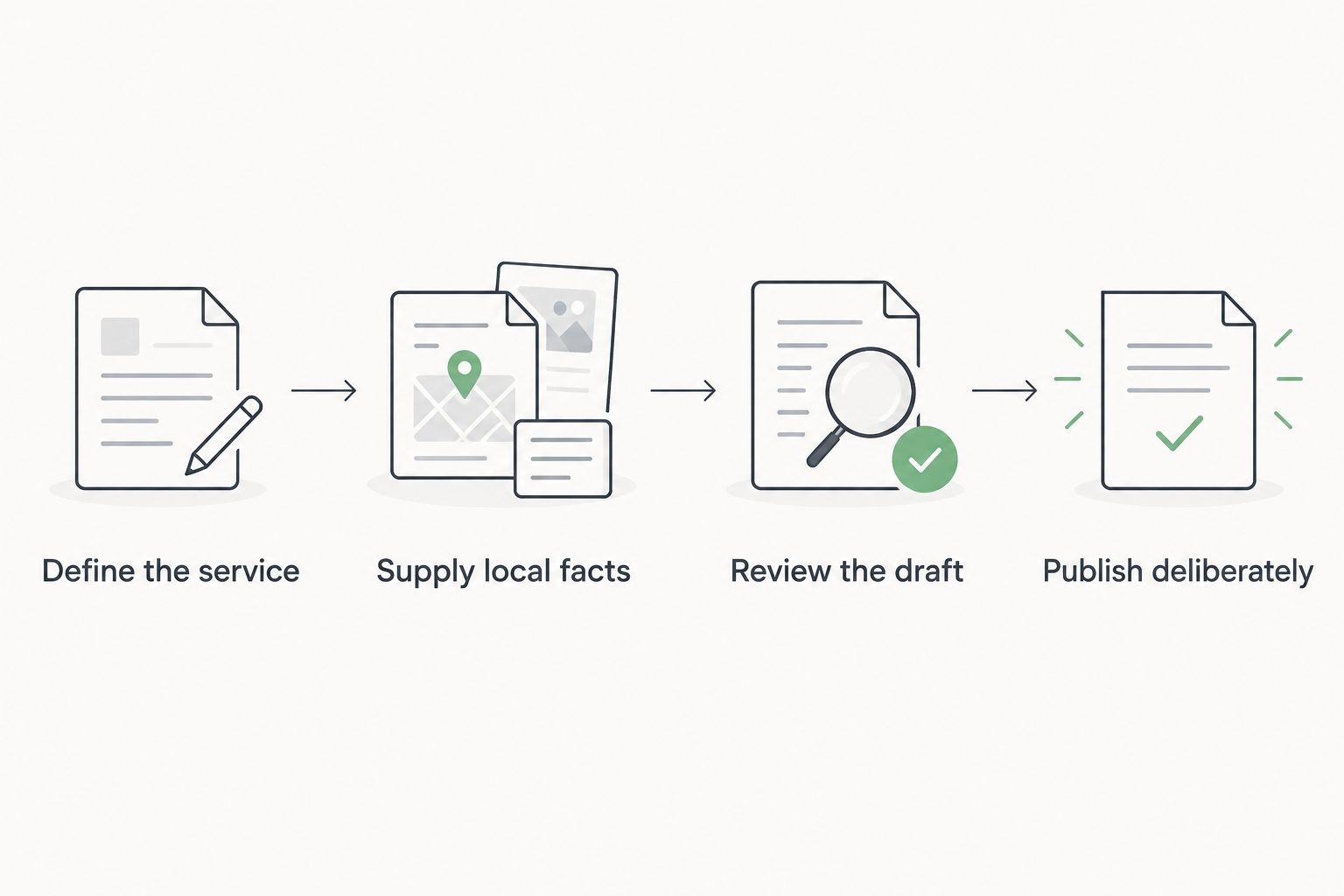
Use this sequence to turn a topic into publishable local content:
- Define the service. Describe what you actually provide, who needs it, and what falls outside its scope.
- Supply local facts. Give the writer verified coverage details and any location-specific information relevant to the question.
- Review the draft. Check claims, terminology, recommendations, and the next action you want the reader to take.
- Publish deliberately. Choose the right page, confirm its purpose, and schedule only after approval.
This is a practical publishing standard for 2026: let the generator handle drafting, while you retain control over facts and commitments.
Why this matters
A niche business needs content that helps a particular customer make a particular decision. A general explanation of your trade is not enough when the reader wants to know whether you handle their problem, serve their location, or require information before accepting an inquiry.
For your 2026 content plan, start with questions you can answer from experience. A narrow, accurate explanation of a service limitation gives readers more decision-making value than a long introduction that never addresses their situation.
The risk is not just awkward wording. An invented certification, unsupported repair recommendation, or inaccurate coverage statement changes what a customer expects from your business. Approve the promises in a draft before polishing its tone.
Choose the writing workflow that fits your business
You can use a general-purpose generator, a WordPress-centered workflow, or a human-led writing process. Choose according to where you need help—not according to how quickly each option produces text.
| Writing approach | Best for | Main advantage | Main limitation |
|---|---|---|---|
| General-purpose generator | Owners who want to develop and revise drafts conversationally | Lets you give instructions and request revisions | You must handle the transfer into your publishing process |
| WordPress-centered workflow | Owners who want drafting and publishing in their website dashboard | Keeps content work close to publication | An integrated workflow still needs factual review |
| Human-led writing | Topics requiring detailed judgment from your business | Lets your experience shape the explanation directly | Requires your time or a clear brief for a writer |
These approaches are not mutually exclusive. You can draft with software and ask a knowledgeable person to review the substance. For specialized work, assign review to someone who understands the service—not just someone who can improve grammar.
Avoid selecting a workflow solely because it removes steps. Removing a copy-and-paste task is useful; removing the approval step is a different decision.
Build a brief that makes the niche understandable
A generator needs more than your trade and city. Give it the information a new employee would need to avoid describing your business incorrectly.
Define the service
Name the service in the language your customers use, then explain any specialist terms. Describe the problem it addresses and the boundary between useful general information and advice that requires an inspection, consultation, or other professional assessment.
Include exclusions explicitly. If you do not perform a certain type of work, tell the generator not to suggest it. Otherwise, a broad topic can drift into adjacent services that sound relevant but do not belong on your website.
Supply local facts
List only places you actually serve. Explain whether customers visit you, you travel to them, or the service happens remotely; do not leave the writer to infer your business model from a city name.
Local details should explain something useful. If geography does not change the answer, avoid adding neighborhood references just to make the paragraph sound local. A location name is not evidence of local knowledge.
Review the draft
Mark every sentence that describes your business, gives technical advice, or makes a promise. Check each against a reliable source: your current operating information, the responsible staff member, or an authoritative reference appropriate to the subject.
Delete claims you cannot substantiate. Do not turn an invented fact into acceptable copy by adding words such as usually or typically.
Publish deliberately
Decide whether the draft belongs on an existing page or deserves a separate page. If it answers the same question for the same audience as something already published, improve the existing content rather than automatically creating another URL.
Before publishing in 2026, check that the title, opening answer, body, and next step all serve the same purpose. A helpful explanation should not end with a request unrelated to the reader's problem.
Why the usefulness of local content varies
The same writing instructions will not suit every service. Adjust your brief around these factors rather than asking for a generic article with a location inserted:
- Service complexity: Explain the terminology and distinctions the writer must preserve. Do not assume a fluent description is technically correct.
- Customer intent: Separate readers looking for an explanation from readers trying to arrange a service. Answer the immediate question before requesting an inquiry.
- Coverage boundaries: State where you work and any relevant restrictions. Never let the draft expand your service area.
- Business evidence: Supply the real examples, qualifications, or process details you want included. Exclude anything you cannot verify.
- Advice sensitivity: Identify statements that need professional review, especially when readers could act on health, legal, financial, or safety information.
- Existing content: Tell the writer what your current page already answers. Request a useful addition instead of another version of the same introduction.
A better brief does not need to be longer. It needs to resolve the decisions the generator would otherwise make without your input.
Turn a broad topic into a useful local answer
Start with a question a prospective customer actually asks. Then identify what you know that makes your answer more useful than a generic explanation.
For a hypothetical specialist repair business, a broad topic such as equipment maintenance offers little direction. A question about what information to provide before requesting a repair gives the article a clear job: help the reader prepare an inquiry. The business can supply its actual intake requirements rather than letting the writer invent them.
Build the page around that job:
- Answer the question immediately.
- Explain the relevant decision or preparation step.
- Identify what requires individual assessment.
- Describe the next action using your real process.
Do not invent a customer story to make the article feel specific. A clearly labeled hypothetical example is acceptable; an imaginary completed project presented as your experience is not.
Specificity comes from verified distinctions, not decorative detail. The reader should finish knowing something useful about their situation, not simply recognizing their town's name.
Keep the brand voice without inventing brand facts
Branded writing should sound like your business while staying inside its actual capabilities. Give the generator examples of language you approve, terms your customers understand, and phrases you avoid.
Separate style instructions from factual instructions. Asking for a friendly tone does not authorize claims about friendly technicians, rapid appointments, guarantees, or customer satisfaction. Those are business assertions, not stylistic choices.
For a 2026 writing brief, keep a current list of approved facts alongside your tone guidance. Update it when services or operating practices change. An old description can be copied accurately and still be wrong today.
Review the call to action with the same care. Ask readers to take an action your business genuinely supports, without adding an unverified offer or response-time promise.
Review search intent before expanding the page
A keyword identifies wording people use; it does not tell you everything they need. Read the phrase as a customer question and decide what a satisfactory answer would contain.
For a local service page, that answer often needs to establish whether the business performs the relevant work and serves the reader's location. For an informational article, the answer needs to explain the issue without pretending to assess an individual case.
Keep those purposes distinct. A draft that alternates between general education and unrelated sales language is harder to evaluate because it has no clear job.
Use headings to expose the structure. If a heading does not help answer the main question, remove it or move that material to a more suitable page. Do not keep a section simply because the generator produced it.
Can a generator write about a highly specialized service?
Yes—a generator can draft an explanation of a specialized service when you provide accurate terminology, boundaries, and supporting information. The person approving the article must understand enough about the subject to catch plausible but incorrect statements.
For unfamiliar or sensitive material, use the draft to organize an expert's explanation rather than to originate the advice. Keep unresolved claims out of the published version.
Should you create a separate article for every town you serve?
No—create separate location content only when you have genuinely useful differences to explain. Changing a town name does not, by itself, give a reader a different answer.
Start with accurate coverage information and your strongest service explanation. Add another page when it has a distinct purpose, not merely because the generator can produce another variation.
Can you schedule generated articles without reviewing them?
You can use scheduling as part of a publishing workflow, but schedule approved content, not unchecked drafts. Review service claims, coverage, technical statements, and calls to action before assigning publication dates.
A 2026 publishing calendar should record when a page is ready, not just when a draft exists. Keep an accountable reviewer attached to content that speaks for your business.
FAQ
Can AI content generators write for niche local businesses?
Yes—AI content generators can draft content for niche local businesses when supplied with accurate service details and local facts. A knowledgeable person should review technical statements and business promises before publication.
What's the best information to give a generator about my business?
Give the generator your actual services, customer questions, service area, exclusions, and approved business facts. Explain the page's purpose and the action readers should take next.
Can generated content help my local business rank on Google?
Generated content does not guarantee Google rankings. Focus on answering a relevant customer question accurately rather than treating publication alone as a search result.
Do I need a different page for every city I serve?
No—you do not need a separate page solely to replace one city name with another. Create distinct pages when you can provide meaningful information for each location.
Can I let a content generator invent examples for my website?
Use invented examples only when they are clearly labeled as hypothetical. Never present fabricated customers, projects, quotes, or results as your business experience.
Is Improveseoplugin suitable if I don't know SEO?
Improveseoplugin is designed to help small local business owners research low-competition local keywords, generate branded content, and publish or schedule it from WordPress without SEO expertise. You still need to verify the business facts in each draft.
What should I check before publishing a generated article?
Check service accuracy, geographic coverage, technical advice, unsupported claims, and the call to action. Confirm that the page answers a distinct question and does not promise something your business has not approved.
One last thing
The most valuable instruction in your writing brief can be what not to say. Service exclusions, geographic limits, and promises you refuse to make help prevent a polished draft from misrepresenting your business.
Before requesting your next article, write down those boundaries. Then choose a real customer question and provide the facts needed to answer it. That gives the generator a useful assignment—and gives you a clear standard for deciding whether the result deserves publication.