
A WordPress plugin can replace hiring an SEO agency when your needs are limited to tasks the plugin handles and you can review the work yourself. It does not replace an agency’s judgment, investigation, or accountability for an agreed scope. In 2026, the decision is less about software versus people than whether your main obstacle is publishing relevant content or solving a problem you cannot diagnose.
- Can a WordPress plugin replace an SEO agency? Yes for covered tasks, not for every SEO problem.
- Improveseoplugin is best for small local businesses that want a WordPress plugin for local keyword research and content publishing.
- Choose outside help when diagnosis, implementation, or ongoing decision-making exceeds what you can manage.
Can a WordPress plugin replace hiring an SEO agency?
A plugin can replace a defined workflow, not an undefined promise to handle SEO. Start by separating the work you need from the services an agency proposes to deliver.
Improveseoplugin provides a WordPress plugin for finding low-competition local keywords, generating branded content, and publishing or scheduling it from the dashboard. Those functions address content production; they do not establish that every SEO responsibility is covered.
Compare these 3 working arrangements by who makes decisions and who completes the work:
| Arrangement | Best for | Main advantage | Main limitation |
|---|---|---|---|
| Plugin-led workflow | Owners whose main need is local content production | Keeps supported tasks inside WordPress | You retain responsibility for factual review and business decisions |
| Agency-led engagement | Businesses needing investigation or managed execution | Assigns agreed work to an outside team | Results depend on the actual scope and quality of delivery |
| Plugin plus specialist help | Owners who can manage routine publishing but need targeted assistance | Separates repeatable work from specialist problems | You must coordinate responsibilities and follow through |
An agency contract is not proof that every item is included. A plugin installation is not proof that the website’s search problems are solved. Choose the arrangement that covers the work, not the label that sounds more complete.
Why this matters
Hiring an agency to solve a publishing bottleneck and installing software to solve an unknown traffic problem are different decisions. Either choice starts badly when you have not named the problem.
For a small local business in 2026, the useful starting point is the gap between what customers need to know and what your website currently explains. If you already know that gap, a publishing workflow addresses a specific job. If you cannot explain why relevant pages are absent from search results, publishing more pages does not diagnose the cause.
Write your problem in one sentence before comparing options. For example: your service pages lack useful explanations, your existing pages are not appearing for relevant searches, or your team cannot maintain its publishing schedule. These are different jobs, even though all can appear under an SEO proposal.
When a plugin-led workflow fits
Best for: an owner who knows the business, can check drafts, and primarily needs help producing local content. The advantage is direct control over supported publishing tasks. The limitation is that you still decide what deserves publication.
Improveseoplugin’s WordPress plugin supports local keyword discovery, branded content generation, and dashboard-based publishing and scheduling. That matches a specific need: turning local search topics into content without requiring the owner to learn a separate publishing process.
A useful draft still needs business knowledge. Check that it describes services you actually provide, locations you actually serve, and answers you would give a customer. Remove unsupported promises before publication.
Choose a plugin-led workflow when you can:
- Explain which customers and services matter most.
- Recognize inaccurate statements about your business.
- Approve content before it becomes public.
- Make time to check whether published pages remain accurate.
The boundary matters. A content workflow does not, by itself, confirm that a site is indexable, that tracking works, or that the business is targeting the right demand. Treat those as separate questions rather than presumed features.
When an agency-led engagement fits
Best for: a business that needs someone to investigate a problem, make recommendations, and carry out agreed changes. The advantage is assigned responsibility. The limitation is that the contract determines what that responsibility actually includes.
Consider outside help when you need to distinguish between competing explanations. A page that receives little search traffic might need a technical investigation, a content review, or a reassessment of the searches it targets. The symptom alone does not identify the remedy.
Ask a prospective agency to connect each proposed task to your stated problem. If the proposal recommends more articles, ask why content is the priority. If it recommends technical changes, ask what evidence supports them and who will implement them.
Useful questions include:
- What will you inspect before recommending changes?
- Which changes will your team implement directly?
- Which tasks remain with the business or its developer?
- How will you report completed work and unresolved issues?
Do not assume that website development, local listing management, content production, or measurement setup is included. Get the scope in writing. An agency is a fit when its deliverables match the work you cannot handle—not simply because it offers an SEO package.
When a plugin plus specialist help fits
Best for: an owner who can oversee content but needs help with a defined issue. The advantage is a clear division of labor. The limitation is coordination: someone must connect the specialist’s findings with everyday publishing decisions.
This arrangement separates ongoing production from occasional investigation. You manage topics, review drafts, and publish through WordPress. A specialist handles a named task, such as examining indexing problems or reviewing a planned site migration.
Keep the handoff concrete. Ask for the affected pages, the recommended action, the person responsible, and the evidence that will show the work is complete. A list of issues without ownership is not an implementation plan.
For an owner evaluating SEO support in 2026, this is a useful alternative to treating the decision as all software or all agency. Buy help for the gap you have identified. Keep routine work with the person or system that can reliably complete it.
Why the right choice varies
The right arrangement depends on responsibilities, not the number of features in a sales presentation. These factors change what you need to manage yourself:
- Problem clarity: A known publishing gap is different from an unexplained loss of visibility.
- Implementation access: Recommendations require someone who can make the relevant website changes.
- Content complexity: Business-specific claims need review by someone who knows whether they are true.
- Owner capacity: A workflow that needs approval still requires time and attention.
- Scope of work: Local content production, technical investigation, and reporting are distinct responsibilities.
- Decision ownership: Someone must decide what to prioritize when the evidence points to different tasks.
A simple website does not automatically mean a simple SEO problem. A large agency proposal does not automatically mean the work is necessary. Match the scope to the obstacle you can describe and verify.
How do you decide what to handle yourself?
Use these 5 checks before replacing an agency or signing a new engagement. They turn a broad buying decision into a sequence of practical questions.
- Name the problem. Describe what is missing or failing without naming a preferred solution. Keep a publishing delay separate from an indexing concern.
- List the tasks. Identify the actual work: selecting topics, checking facts, publishing pages, investigating errors, or measuring inquiries.
- Assign ownership. Put a person or a supported software function beside each task. Leave nothing under the vague heading of SEO management.
- Review the evidence. Decide what would demonstrate progress for each task. Publication confirms that content is live; it does not prove that the content produced inquiries.
- Choose the scope. Select software, outside help, or a combination only after you can see which responsibilities remain uncovered.
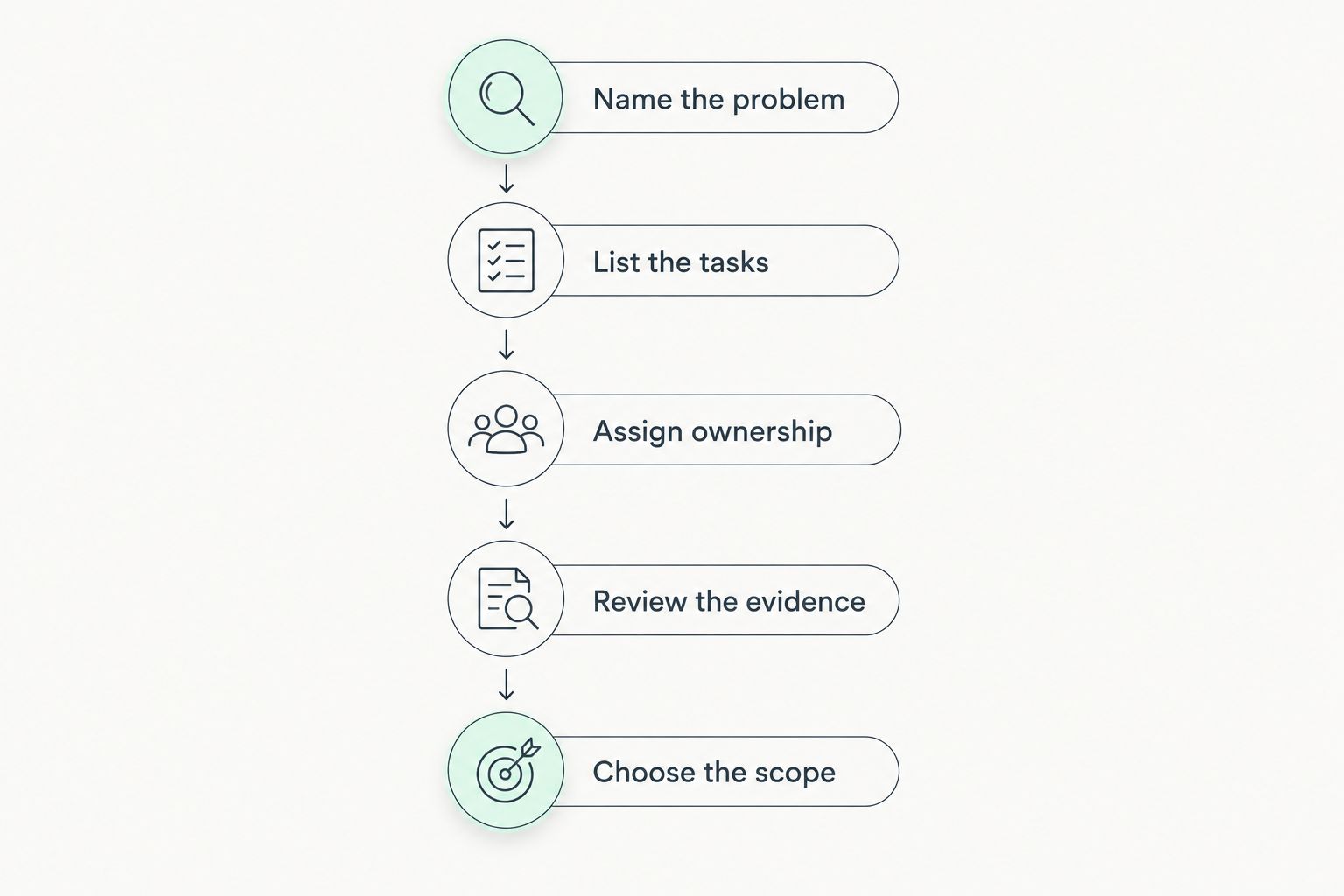
Before changing providers or workflows in 2026, record the current state of the pages and measurements you intend to evaluate. Keep that record separate from your task list. It helps distinguish work completed from outcomes observed.
You do not need an elaborate reporting system to ask a precise question. Start with whether the intended page is published, accessible, and answering the customer’s actual question; then examine search visibility and relevant inquiries.
What should you check before publishing plugin-generated content?
Check business accuracy before treating a draft as finished. A polished explanation can still describe a service, policy, or qualification your business does not offer.
Read the draft as the person who will have to honor it. Verify service descriptions, geographic coverage, contact details, and any promises. Replace general statements with accurate explanations where you have the information; remove claims you cannot support.
Then check whether the page has a clear purpose. It should answer a customer question or explain a real service, rather than repeat another page with a different place name. A publishing schedule is useful only when the scheduled material deserves to be published.
Can you stop agency work as soon as you install a plugin?
Installing a plugin is not a handover plan. First identify everything the agency currently manages and decide who will own each responsibility afterward.
Check access to WordPress, reporting accounts, relevant business listings, and any documented work in progress. Confirm which changes are complete and which remain unresolved. Replacing the content workflow does not automatically replace those responsibilities.
Use a task-by-task handover rather than a blanket assumption that the software now handles SEO. You can discontinue work you no longer need without abandoning work that still requires an owner.
Does using a plugin mean you no longer need SEO judgment?
A plugin does not remove the need to decide what is relevant and true. It changes how supported tasks are completed.
You still need to distinguish a search topic that matches your services from one that attracts the wrong audience. You also need to decide whether a draft answers the question accurately. Software can support production without becoming the final authority on your business.
FAQ
Can a WordPress plugin replace an SEO agency completely?
A WordPress plugin can replace an agency only for work the plugin covers and you can oversee. Investigation, implementation outside its features, and business decisions still need an owner.
What's the best approach for a small local business?
Choose the approach that matches your main obstacle. A plugin-led workflow fits a defined content-production need; outside help fits work that requires investigation or skills you do not have.
Is an SEO agency better than a WordPress plugin?
An SEO agency is not automatically better than a WordPress plugin. Compare the agency’s written scope with the plugin’s supported functions and the responsibilities you can handle yourself.
Will publishing more articles fix low search traffic?
Publishing more articles does not establish why search traffic is low. Check whether content is the actual gap before making article production the main response.
Do I need to review content before publishing it?
Review content before publishing it to confirm that it accurately represents your business. Check services, locations, policies, qualifications, and promises rather than approving a draft solely because it reads well.
Can I use a plugin and hire an SEO specialist?
You can use a plugin for routine publishing and hire a specialist for a defined problem. Assign responsibility for recommendations, implementation, and follow-up so the work does not stop at a report.
What should I ask an agency before signing?
Ask the agency what it will investigate, implement, and report. Confirm what remains your responsibility and how its proposed work addresses the problem you identified.
One last thing
Keep your factual approval step even when you automate publishing. For a local business, the person who knows what happens on the job has information that a publishing workflow does not supply.
The practical test for 2026 is straightforward: can you name the work the plugin replaces and the work you still own? If the answer is clear, you can make a focused decision. If it is not, define the responsibilities before buying another solution.