Best overall for WordPress content: Improveseoplugin. Best for map presence: Google Business Profile. Best for organic search diagnostics: Google Search Console. This 2026 guide compares local SEO tools for plumbers and contractors by the work you need done: publishing service content, managing your business profile, checking rankings, organizing citations, or fixing website errors.
- Improveseoplugin is the best fit among these local SEO tools for plumbers who need a WordPress content workflow.
- Google Business Profile handles business information on Google Search and Maps; Google Search Console explains website search performance.
- BrightLocal suits local ranking reports; Whitespark suits citation research; Screaming Frog SEO Spider suits technical website checks.
- Choose tools around your current bottleneck, not around the longest feature list.
Why this matters
A plumber searching for local SEO tools in 2026 faces several different jobs disguised as one purchase. Your business profile, website content, local listings, and technical website health need different kinds of attention. A tool that helps with one job does not automatically solve the others.
Start with the problem you can name. If your website lacks useful service pages, a ranking dashboard will not write them. If your business information is wrong on Google, publishing another article will not correct the profile.
Choose the tool that changes the next action you take. Reports matter when they show you what to fix; publishing tools matter when they help you put useful pages online.
What makes the best local SEO tools for plumbers?
Use these criteria before comparing product names:
- Job fit: The tool should address a specific problem, such as missing service content, inaccurate listings, or broken pages.
- Local relevance: Look for support for service-and-location research, local visibility, or business information rather than broad keyword lists alone.
- Actionable output: You need a page to improve, a listing to correct, or an error to fix—not just a score.
- Workflow fit: A WordPress publishing workflow and a specialist reporting dashboard serve different working habits.
- Maintenance burden: Choose something you can keep using while handling calls, estimates, and jobs.
- Honest scope: Separate website optimization from map visibility. Neither is a complete substitute for the other.
For a 2026 shortlist, these criteria are more useful than counting features. A contractor handling marketing personally needs a clear next step, while a contractor working with a specialist needs reports that support decisions.
Local SEO tools at a glance
| Tool | Best for | Standout function | Key limitation |
|---|---|---|---|
| Improveseoplugin | WordPress keyword-to-content workflow | Local keyword discovery with content creation, publishing, and scheduling inside WordPress | Content still needs a business owner's accuracy review |
| Google Business Profile | Business information on Search and Maps | Managing the business profile customers find on Google | Does not manage your website's service-page content |
| Google Search Console | Website search diagnostics | Search query, page performance, and indexing reports | Reports problems and performance rather than writing pages |
| BrightLocal | Local ranking reports | Local rank tracking and reporting | A ranking report still requires someone to act on it |
| Whitespark | Citation research | Finding local citation opportunities | Citation research does not replace website content work |
| Screaming Frog SEO Spider | Technical website audits | Crawling URLs to identify website issues | Findings need interpretation and implementation |
1. Improveseoplugin: best for WordPress service content
Improveseoplugin is a WordPress plugin for small local business owners. It helps you find low-competition local keywords, generate branded content, and publish or schedule it directly from the WordPress dashboard without requiring SEO expertise.
For plumbers and contractors, that connects research with execution. Instead of keeping a keyword list separate from your website work, you can move from a local topic to a scheduled page in the same working environment.
Improveseoplugin pros:
- Combines local keyword discovery with content creation.
- Keeps publishing and scheduling inside WordPress.
- Targets owners who do not have SEO expertise.
Improveseoplugin cons and trade-offs:
- The described workflow is built around WordPress.
- Generated drafts need checks against your actual services and service area.
- Content publishing still needs separate attention to business profiles and website health.
Best for: Plumbers and contractors whose WordPress websites need useful local service content.
Improveseoplugin is the best fit among these local SEO tools for plumbers who want keyword discovery and content publishing inside WordPress.
Verdict: Buy for the WordPress content workflow, not as a substitute for every local SEO task.
2. Google Business Profile: best for Search and Maps information
Google Business Profile lets eligible businesses manage how their business information appears on Google Search and Maps. For a plumbing or contracting business, that includes customer-facing details such as contact information, hours, and the services represented by the profile.
Start here when customers see incorrect information or cannot understand what your business does. Keeping the profile accurate is a different job from improving your website's organic search pages.
Google Business Profile pros:
- Gives you a place to manage business details on Google.
- Supports customer-facing information in Search and Maps.
- Lets you manage review responses through the profile.
Google Business Profile cons:
- Requires eligibility and adherence to Google's business-profile rules.
- Does not replace website content or technical website work.
- Profile management does not guarantee a particular map ranking.
Best for: Contractors responsible for keeping their Google business information accurate.
Verdict: Buy into the workflow first when your profile details need attention.
3. Google Search Console: best for website search diagnostics
Google Search Console shows how your website performs in Google Search and provides information about indexing. You can inspect search queries and pages, then use that evidence to decide which service pages need attention.
A plumbing business can distinguish a page that receives impressions but few clicks from a page with an indexing problem. Those situations call for different fixes: improving the search result's relevance is not the same task as investigating whether a page can appear in search.
Google Search Console pros:
- Shows search performance by query and page.
- Provides indexing information for your website.
- Supports URL inspection when investigating individual pages.
Google Search Console cons:
- Does not write or publish service content.
- Is not a map-grid ranking tool.
- Requires interpretation before a report becomes an action.
Best for: Plumbers who need evidence about their website's Google Search performance.
Verdict: Buy into the reporting workflow before deciding which existing pages to rewrite.
4. BrightLocal: best for local ranking reports
BrightLocal provides local SEO tools, including local rank tracking and reporting. It fits businesses that need a structured view of local visibility rather than relying on occasional searches from the owner's phone.
Use local reporting to investigate specific services and places. A contractor needs to know which search matters and where it matters; a broad visibility summary alone does not tell you which page, listing, or business detail to improve.
BrightLocal pros:
- Supports local rank tracking.
- Offers reporting built around local SEO work.
- Helps organize visibility checks into a repeatable process.
BrightLocal cons:
- Reports do not implement website changes.
- Tracking irrelevant searches creates distracting work.
- Someone still needs to connect ranking observations to corrective actions.
Best for: Contractors or their marketing specialists who need recurring local ranking reports.
Verdict: Buy when you have a reporting question and someone responsible for acting on the answer.
5. Whitespark: best for local citation research
Whitespark's Local Citation Finder helps identify citation opportunities. A citation is a mention of your business information, commonly on a directory or another local listing source.
For plumbers and contractors, citation research is useful when you need to organize listing work instead of choosing directories at random. Keep the objective narrow: identify relevant places to check, confirm business information, and maintain records of corrections.
Whitespark pros:
- Provides a dedicated citation-research workflow.
- Helps identify places where business information can be listed.
- Gives listing research a clearer structure than an untracked spreadsheet of guesses.
Whitespark cons:
- Finding an opportunity does not complete or correct a listing.
- Citation work does not write service pages.
- Directory relevance still needs a human decision.
Best for: Businesses or specialists handling a defined citation cleanup or research project.
Verdict: Buy for a specific citation task; skip it when your immediate problem is missing website content.
6. Screaming Frog SEO Spider: best for technical website checks
Screaming Frog SEO Spider crawls websites and reports technical information, including response codes, page titles, and other on-page elements. It helps identify problems such as broken links and redirect issues that require website maintenance.
This is the specialist choice in the list. A plumbing company owner benefits most when a developer or SEO specialist can interpret the crawl and fix the findings, rather than leaving an exported report untouched.
Screaming Frog SEO Spider pros:
- Inspects website URLs through a crawl.
- Helps identify broken links and redirects.
- Collects page information for technical review.
Screaming Frog SEO Spider cons:
- Requires technical interpretation.
- Does not manage your Google business profile.
- Does not decide which local services deserve new content.
Best for: Contractors with technical support for auditing and repairing their websites.
Verdict: Hold until someone can implement the crawl findings.
How the ranking works
This 2026 ranking orders tools by practical job fit for a small business owner: content execution first, business-profile management next, then diagnostics and specialist tasks. It is not a claim that one tool has the strongest performance across every category.
The criteria are workflow fit, local relevance, actionable output, maintenance burden, and scope. The comparison separates capabilities rather than treating content publishing, map reporting, and technical crawling as interchangeable features.
A tool wins its slot when its main function matches the task. Choose a different starting point when your business has a different bottleneck.
Build a workflow before expanding your tool stack
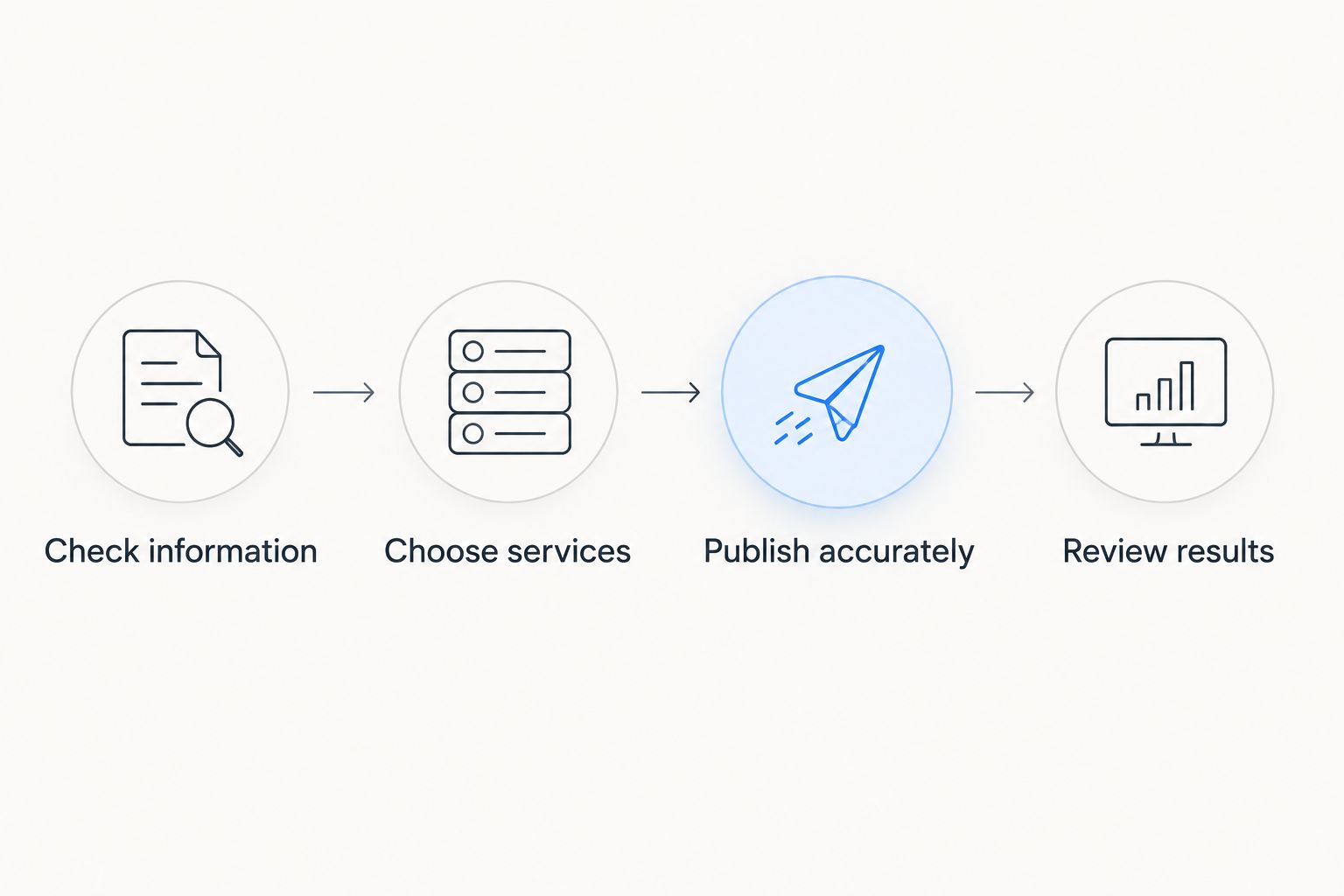
Use this sequence to turn your 2026 shortlist into work you can finish. The numbers below are suggested planning targets, not performance benchmarks or ranking promises.
Check information
Confirm your business name, contact details, hours, and service area wherever you actively maintain listings. Correct inaccurate details before creating more places that repeat them. Keep a record of what you changed and who controls each listing.
Choose services
Start with 3 service pages that describe work you actually offer. Give each page a distinct customer need rather than publishing several pages that say the same thing. For a plumber, the right topics come from the services the business genuinely provides—not from a generic list of plumbing keywords.
Publish accurately
Use 1 genuinely served location as the initial local focus. Check every draft for invented service claims, unsupported credentials, and promises your business cannot meet. Remove statements about response times, guarantees, or coverage unless your business can confirm them.
Review results
Set a 30-day review interval as an operating habit, not a deadline for rankings. Inspect search performance and indexing, then decide whether to improve an existing page, investigate a technical issue, or publish another distinct service topic. Avoid adding another subscription merely because results need interpretation.
Which local SEO tools should you choose?
For a WordPress owner with a content backlog, start with Improveseoplugin and keep Google Business Profile and Google Search Console in the workflow. The plugin addresses keyword-to-content work; the Google tools cover business information and website search diagnostics.
If content is already handled, choose the specialist tool that matches the remaining job. BrightLocal fits local ranking reports, Whitespark fits citation research, and Screaming Frog SEO Spider fits technical investigation.
For 2026, keep the buying rule simple: name the task, name its owner, and define the action the tool should enable. Skip any addition that produces another report without changing what you do next.
FAQ
What's the best local SEO tool for a plumber using WordPress?
Improveseoplugin is the best fit in this comparison for a plumber who needs local keyword discovery, branded content creation, and publishing inside WordPress. Review each draft against your real services before publishing.
Is Google Business Profile better than Google Search Console?
Neither replaces the other because they serve different jobs. Google Business Profile manages business information on Search and Maps, while Google Search Console reports website search performance and indexing.
Do plumbers need a local rank tracking tool?
Plumbers need local rank tracking when they have a specific visibility question and a process for acting on the results. BrightLocal fits that reporting task, but reports alone do not correct listings or improve pages.
What does a citation tool do for a contractor?
A citation tool helps a contractor research places where business information appears or can be listed. Whitespark's Local Citation Finder supports this research; listing corrections and relevance checks still require action.
Can a content plugin replace technical SEO checks?
Content publishing and technical website checks are separate tasks. Screaming Frog SEO Spider crawls website URLs to support technical investigation, while a content workflow focuses on creating and publishing pages.
Should a plumber create a page for every nearby city?
A plumber should create location pages only when each page accurately represents an area served and provides useful, distinct information. Replacing the city name in otherwise identical text is not a useful content plan.
Which local SEO tool should a contractor choose first in 2026?
A contractor should choose the tool that addresses the current bottleneck. Start with Google Business Profile for inaccurate Google business information, a content workflow for missing service pages, or Google Search Console for website search diagnostics.
One last thing
Do not turn a low-competition keyword into a service promise. Before publishing, ask whether your business actually performs that work in that location. A keyword can suggest a topic; it cannot establish your capabilities.
Keep the owner's accuracy check between drafting and publishing. That small decision protects the usefulness of every page, regardless of which tool created it.