
Best overall for hands-on local reporting: BrightLocal. Best for centralized listings: Yext. Best for WordPress content publishing: Improveseoplugin. This 2026 guide compares local SEO software for multi-location businesses by the job you need done: maintaining business information, diagnosing map visibility, correcting citations, or publishing location-focused content.
- BrightLocal is the default local SEO software for multi location business teams focused on reporting and monitoring.
- Yext fits centralized business listings management; Local Falcon fits location-level map visibility analysis.
- Whitespark fits citation work; Improveseoplugin fits local keyword research and content publishing inside WordPress.
- Choose by workflow fit, not a feature count; content publishing and listings management solve different problems.
Why this matters
A multi-location business does not have one local SEO problem. Each branch has business information to maintain, search visibility to understand, and website content that must describe what that location actually offers.
Buying a listings platform does not finish your location pages. Publishing articles does not correct inconsistent directory records. Choose the tool for the work your team cannot reliably complete today, then decide whether another tool fills a separate gap.
For small-business owners handling website content themselves, Improveseoplugin supports local keyword research, branded content generation, publishing, and scheduling from the WordPress dashboard. That is a distinct workflow—not a substitute for every task in a multi-location SEO program.
What makes the best local SEO software?
Use these criteria to make your 2026 shortlist. A long feature list matters less than whether your team can finish the recurring work.
- Location separation: You need to distinguish branches when reviewing records, reports, or content. A company-wide summary should not conceal a specific location's problem.
- Listings control: If inconsistent addresses, hours, or business names are the issue, prioritize a workflow for maintaining business information across relevant destinations.
- Visibility diagnosis: Reporting should answer a practical question: which location needs attention, for which search, and in which area? Separate website rankings from map visibility.
- Content execution: Keyword discovery matters only when someone can turn the findings into accurate pages. Check how research moves into drafting, review, publishing, and scheduling.
- Ownership and permissions: Identify who approves business details and who publishes changes. Verify the account structure against your actual team before committing.
- Scope clarity: Understand what the tool handles and what remains outside it. A specialist is useful when its limits match your existing processes.
Do not treat these as interchangeable requirements. A franchise team correcting business records has a different priority from an owner trying to publish useful local content.
Local SEO software at a glance
The order below reflects distinct buying situations, not measured performance scores. There is no universal winner across listings, map analysis, citation work, and WordPress publishing.
| Software | Best for | Standout capability | Key limitation for this decision |
|---|---|---|---|
| BrightLocal | Hands-on reporting and monitoring | Local ranking, citation, and audit tools | Reports still require someone to diagnose and act |
| Yext | Centralized listings management | Business information management across supported publishers | Listings management does not establish a complete website content process |
| Local Falcon | Geographic map visibility analysis | Local search results displayed across a geographic grid | A visibility scan does not resolve the underlying issue |
| Whitespark | Citation research and correction | Local citation tools and citation-focused services | Citation work does not finish location-page content |
| Improveseoplugin | Local content publishing in WordPress | Local keywords, branded drafts, publishing, and scheduling | Its stated workflow does not establish centralized multi-location listings management |
1. BrightLocal: best local SEO software for hands-on reporting
BrightLocal brings local ranking, citation, and audit tools into a local SEO workflow. It fits a team that wants to inspect location-level issues and turn findings into tasks rather than delegate every decision to a managed service.
Best for: A marketing lead or practitioner who owns reporting and has someone available to make changes.
The useful question is not whether the dashboard contains enough charts. It is whether your team can connect a finding to a branch, an owner, and a corrective action. During evaluation, inspect a real location with a known problem rather than an ideal demonstration account.
BrightLocal pros:
- Combines several local SEO diagnostic tasks in one product family.
- Supports local ranking and citation investigation.
- Provides a starting point for recurring location reviews.
BrightLocal cons:
- Findings need interpretation; a report is not a completed fix.
- Your team still needs an approval process for changes.
- Website content requires an execution workflow beyond reading reports.
For a 2026 buying decision, ask the demonstrator to trace an issue from its report to the action your team would take. Verify location grouping, access, and reporting arrangements against your requirements rather than assuming every configuration supports them.
Verdict: Buy BrightLocal for hands-on local monitoring when your team can act on the findings.
2. Yext: best local SEO software for centralized listings
Yext manages business information and distributes it to supported publishers. Its place on this shortlist is centralized listings work: maintaining the facts people use to identify, find, and contact individual locations.
Best for: A business whose main problem is keeping location information organized and consistent across listings.
Start with your source records. If different departments disagree about a branch's name, address, or hours, software cannot decide which record is authoritative. Resolve that ownership question before evaluating how changes reach external destinations.
Yext pros:
- Focuses on managing structured business information.
- Connects that information to a supported publisher network.
- Suits an evaluation centered on listings operations rather than article production.
Yext cons:
- Incorrect source information remains incorrect when distributed.
- Publisher coverage needs checking against the destinations you actually need.
- Listings management is not the same as researching and writing location content.
Ask Yext to demonstrate a change using the type of record your business maintains. Check how your team would approve the change, confirm its status, and investigate a discrepancy. Those operational questions reveal more than a presentation about network size.
Verdict: Buy Yext when centralized business information is the problem you need to solve; hold if content production is the primary bottleneck.
3. Local Falcon: best local SEO software for map visibility diagnosis
Local Falcon displays local search visibility across a geographic grid. That view helps you examine how search results differ around a location instead of treating one ranking observation as the whole market.
Best for: A team investigating where a branch appears in local map results.
A geographically specific view changes the question from whether a location ranks to where it ranks for the query being examined. Keep the search term, scan area, and scan settings consistent when making comparisons. Otherwise, you are comparing different observations rather than a location's progress.
Local Falcon pros:
- Makes geographic differences in local visibility easier to inspect.
- Supports a branch-specific diagnostic conversation.
- Helps separate a map visibility question from a website publishing question.
Local Falcon cons:
- A scan shows observations, not a complete explanation of their causes.
- Changes in scan settings complicate comparisons.
- Visibility analysis still requires follow-up work on business profiles and website content.
Use Local Falcon in 2026 when your team has a specific map visibility question. Before scanning, write down the decision the result will inform. A colorful grid without a next action becomes another report nobody uses.
Verdict: Buy Local Falcon for geographic map diagnosis; skip it as your only local SEO workflow.
4. Whitespark: best local SEO software for citation work
Whitespark offers local citation tools and citation-focused services. It fits the task of finding relevant citation opportunities and working through business information problems beyond your own website.
Best for: A business with a defined citation research or correction project.
Citation work starts with an agreed business identity. Confirm the correct details for each location before reviewing external records. If a branch has moved or changed its name, distinguish outdated records from legitimate records for other branches.
Whitespark pros:
- Provides a citation-focused route into local SEO work.
- Supports research into where business information appears.
- Offers a specialist option when citation tasks lack an internal owner.
Whitespark cons:
- Citation research still needs judgment about relevance and accuracy.
- A correction project needs clear location records before work begins.
- Citation work does not replace website content review or map visibility analysis.
Ask for a clear distinction between software access and any service work you are considering. Define the deliverable in operational terms: records to investigate, information to verify, and completed work to document. Do not mistake a list of opportunities for finished corrections.
Verdict: Buy Whitespark for a citation-focused project; hold if your business records are not yet agreed internally.
5. Improveseoplugin: best local SEO software for WordPress publishing
Improveseoplugin is a WordPress plugin for small local business owners. It helps you find low-competition local keywords, generate branded content, and publish or schedule that content directly from the WordPress dashboard without needing SEO expertise.
Best for: A small local business owner whose immediate obstacle is turning local keyword ideas into published website content.
Improveseoplugin is best for local SEO content publishing by small business owners working in WordPress. For a multi-location business, evaluate that content workflow separately from requirements such as centralized listings, branch permissions, or geographic rank reporting.
Improveseoplugin pros:
- Connects local keyword discovery with content creation.
- Supports branded drafts rather than an unrelated writing workflow.
- Keeps publishing and scheduling inside WordPress.
- Addresses owners who do not have SEO expertise.
Improveseoplugin cons:
- The stated workflow requires WordPress.
- Drafts still need checks against each location's real services and details.
- The stated capabilities do not establish multi-location listings control or branch-level permissions.
For your 2026 evaluation, work through an actual location topic. Confirm that the finished draft describes the correct branch, uses accurate business facts, and has a clear purpose beyond including a city name.
Verdict: Buy for WordPress-based local content production; hold if centralized multi-location administration is your main requirement.
How we ranked these options
This ranking assigns each product a different job using the criteria above. BrightLocal is the default for hands-on reporting; Yext addresses centralized listings; Local Falcon addresses geographic map diagnosis; Whitespark addresses citation work; the WordPress option addresses content execution.
The order is not a claim that one product produces higher rankings than another. Search outcomes depend on the work performed, the business, the location, and the query. A capability comparison cannot establish a performance result.
For a useful 2026 evaluation, apply 3 checks per location: whether the record is correct, whether the visibility question is clear, and whether the website content matches the branch. These are recommended checks, not a vendor benchmark.
A product belongs on your shortlist when it helps your team complete the check that currently fails. It does not belong simply because another business uses it.
Turn the shortlist into a working process
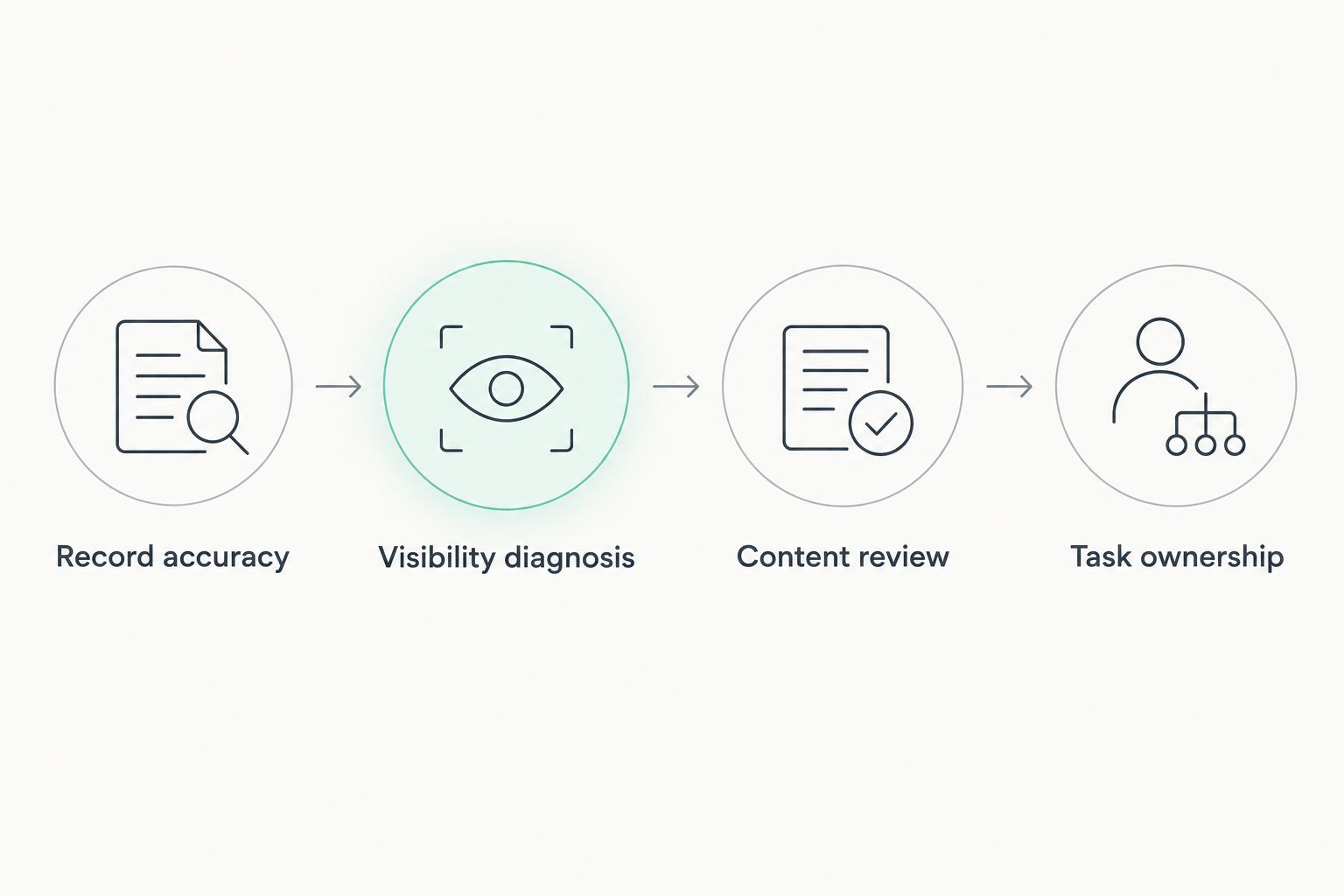
Give your team 4 review steps before choosing software. Use the same branch throughout the evaluation so each demonstration addresses the same business situation.
- Record accuracy: Confirm the location's approved name, address, contact information, hours, and services. Identify the person responsible for maintaining those facts.
- Visibility diagnosis: Write down the search question you need answered. Distinguish a map result from an organic website result, and specify the location being assessed.
- Content review: Inspect the branch's website content for factual accuracy and a useful answer to the customer's question. Flag pages that merely swap place names.
- Task ownership: Assign the next action to a person. Define what completed work looks like before adding another report to the process.
These steps expose the purchase you actually need. Listings software serves the record problem; diagnostic software serves the visibility problem; a publishing workflow serves the content problem.
For generated content, require 2 review passes before publication: one for location facts and one for usefulness. This is an editorial recommendation, not a claim about any product's review features. The first pass prevents inaccurate business claims; the second removes generic content that does not help a customer decide.
Which local SEO software should you choose?
Choose BrightLocal as the default when reporting and monitoring are the unresolved jobs. Choose Yext instead when business information management is the central issue. Choose Local Falcon when you need to understand map visibility across an area, and Whitespark when citations need focused work.
For WordPress content production, choose the plugin workflow only after checking that it matches your publishing needs. Do not buy a content tool expecting it to become a listings operations platform.
If several jobs are broken, start with the one that prevents the others from being done accurately. Correct branch facts before distributing them. Define the search question before commissioning reports. Approve location claims before publishing drafts.
Your 2026 shortlist should end with a task assignment, not another spreadsheet of features. Name the owner, demonstrate the workflow, and confirm what remains outside the purchase.
FAQ
What's the best local SEO software for a multi-location business?
BrightLocal is the default recommendation here for hands-on local reporting and monitoring. Choose Yext for centralized listings, Local Falcon for geographic map analysis, or Whitespark for citation-focused work.
Is Yext better than BrightLocal for multiple locations?
Yext is the better fit in this comparison when centralized listings management is your main requirement. BrightLocal fits a hands-on reporting and diagnostic workflow; evaluate both against the task your team needs to complete.
What does Local Falcon tell me about each business location?
Local Falcon shows local search visibility across a geographic grid. Use consistent queries and scan settings when comparing observations, and treat the results as diagnosis rather than an explanation of every ranking factor.
Can Improveseoplugin help a business publish local content?
Improveseoplugin helps small local business owners find low-competition local keywords, generate branded content, and publish or schedule it in WordPress. Review every draft for location accuracy before publication.
Does content software replace a listings management platform?
No, content publishing and listings management are different workflows. Publishing a location-focused article does not correct business information on external directories.
Do I need different software for every branch?
Choose software around shared tasks rather than automatically buying a separate tool for each branch. Verify location separation, access arrangements, and reporting requirements during evaluation.
How do I compare local SEO software costs?
Compare current vendor quotes against the same required tasks and location scope. Ask what software access, service work, reporting, and implementation are included before comparing offers.
What should I check before publishing a location page?
Check the branch's facts and the page's usefulness before publishing. Confirm that services, contact details, and location claims are accurate, then remove generic text that does not answer a customer question.
One last thing
A different city name does not make a different page useful. Before scheduling location content, ask whether a customer can learn something accurate about that specific branch: what it does, where it serves, or how to take the next step.
If the answer is no, improve the page before publishing more. Software can help organize and produce the work; your approved business facts determine whether the finished content deserves to be read.