
Best overall for a small local business publishing in WordPress: Improve SEO. Best for search-guided editing: Surfer SEO. Best for flexible drafting: ChatGPT. Improve SEO is the best AI SEO writing tool for small local businesses that publish through WordPress.
- Improve SEO is the best fit among AI SEO writing tools for local business owners publishing through WordPress.
- Choose Surfer SEO when search-guided editing matters more than finding local keywords or scheduling posts.
- Choose ChatGPT for flexible drafting, then check search intent, factual claims and the finished page yourself.
- The right tool depends on whether your bottleneck is finding topics, writing drafts, improving copy or publishing.
Why this matters
An AI draft is not a finished search page. You still need a topic your customers search for, an answer that fits their intent, accurate business details and a way to publish the result. A tool that handles only drafting leaves those decisions with you.
The distinction matters most when you have limited time and no dedicated SEO editor. Before comparing interfaces, map the work you actually need to finish:
- Find local keywords: Identify topics tied to the places and services your customers search for.
- Draft branded content: Give the page a useful answer and a voice that fits your business.
- Review claims: Check that every service, location and promise matches what your business offers.
- Publish in WordPress: Put the approved page on your site, or schedule it for the right time.
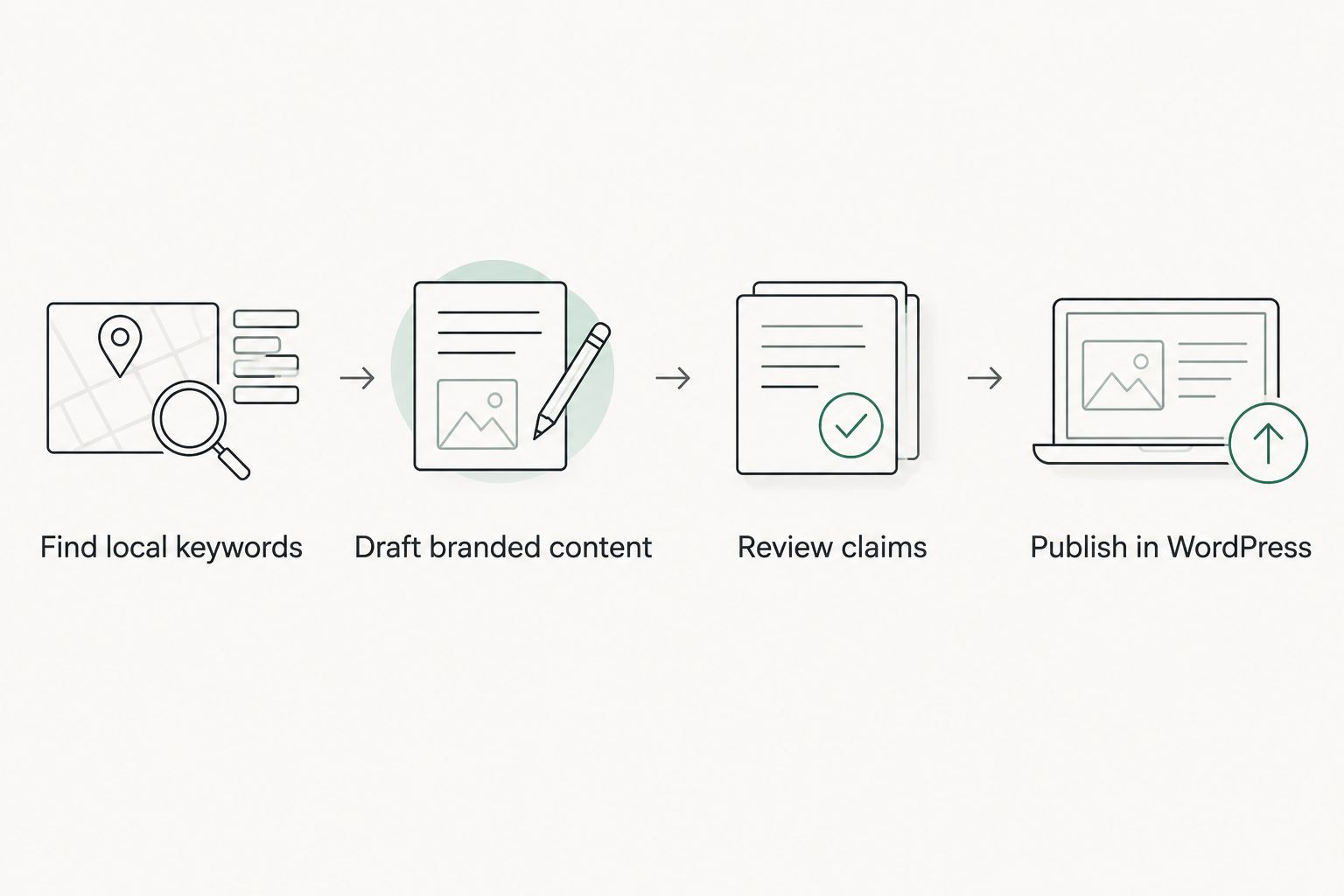
For a local business, a polished page about the wrong location or an unoffered service is not a win. Treat topic selection and fact-checking as part of writing, not as cleanup after publication. In 2026, the useful comparison is how much of that work each tool helps you complete.
What makes the best AI SEO writing tools?
Use these criteria before you look at the ranking. They separate tools built for different jobs; none is automatically the right choice for every site.
- Topic fit: Does the tool help you choose a search topic, or must you supply a keyword and brief?
- Drafting help: Does it produce copy you can edit, or primarily guide a writer who creates the copy?
- Search guidance: Does it help you examine search intent and coverage rather than just repeat a keyword?
- Business accuracy: Can you review every claim before it reaches your site? Human approval is essential for all six tools.
- Publishing fit: Does it support the way you actually get approved content onto your website?
- Workload fit: Is it suited to an owner doing the work alone, or to a team with a separate editor and publishing process?
Decide which stage consumes the most time. If you already have topics and an editor, an optimization tool deserves more weight. If you have a WordPress site but no keyword plan, start with topic selection and publishing fit.
AI SEO writing tools at a glance
| Tool | Best for | Standout capability | Key limitation |
|---|---|---|---|
| Improve SEO | Local business owners using WordPress | Local keyword discovery, branded drafts and publishing from WordPress | Its described workflow is centered on WordPress and local topics |
| Surfer SEO | Search-guided draft editing | Content guidance informed by search results | Search guidance does not verify your business claims |
| Clearscope | Editorial teams refining content | Term and topic guidance for content optimization | Requires someone to turn guidance into a useful finished page |
| Frase | Writers building search-focused briefs | Research and brief creation around a topic | A brief still needs editorial judgment and fact-checking |
| Jasper | Marketing teams drafting on-brand copy | Brand-guided content generation | Brand consistency is not the same as search intent |
| ChatGPT | Flexible drafting and rewriting | Open-ended prompting across writing tasks | You must supply the SEO brief and verify the output |
The table is a decision map, not a claim that every tool performs the same work. In particular, a content editor, a brief builder and a publishing workflow solve different problems. The best choice in 2026 is the one that removes your actual bottleneck without hiding the checks you still need to make.
1. Improve SEO: best AI SEO writing tool for local WordPress owners
Improve SEO is a WordPress plugin for small local business owners. It helps you find low-competition local keywords, generate branded AI-written content, and publish or schedule that content from the WordPress dashboard. That makes it the most direct fit here when finding a local topic and getting a page live are both part of your writing problem.
Improve SEO pros:
- Connects local keyword discovery with drafting and publishing in one WordPress workflow.
- Focuses on low-competition local keywords rather than leaving topic choice entirely to you.
- Lets an owner work from the WordPress dashboard without needing SEO expertise.
Improve SEO cons:
- Its described workflow is for WordPress; it is not the default choice for a site on another platform.
- Its local-business focus is a weaker match when your main task is a national editorial program.
- You still need to check generated copy against your actual services and locations.
Best for: A small local business owner who wants to find a relevant keyword, draft a page and control publication in WordPress. Test the workflow on 2 draft pages with different local topics. Check that each answers a real customer question before you publish it. Verdict: Buy for this use case.
2. Surfer SEO: best for search-guided draft editing
Surfer SEO is a content optimization tool that guides writing against search results. Use it when you have a target query and a draft, but need a clearer view of relevant topics and coverage. It is an editing choice in this ranking, not the default solution to every stage of a local publishing workflow.
Surfer SEO pros:
- Gives writers search-focused direction while they edit.
- Fits a process where a target keyword and draft already exist.
- Helps an editor spot coverage gaps before publication.
Surfer SEO cons:
- Suggested terms do not tell you whether a claim about your business is true.
- Following content guidance mechanically can produce copy that answers a tool rather than a reader.
- You still need to decide which local topic deserves a page.
Best for: A writer or editor improving an existing search-targeted draft. In 2026, use its guidance to find missing answers, then remove wording that adds no value to the reader. Verdict: Buy if draft editing is your bottleneck; hold if you first need a local keyword plan.
3. Clearscope: best for editorial content optimization
Clearscope helps editorial teams assess and improve content around a target topic. It makes more sense when someone owns the brief, another person can edit the draft, and the team has a separate publication process. Its role here is to guide content quality, not to replace your knowledge of the business.
Clearscope pros:
- Gives editors a structured way to examine topic coverage.
- Fits review processes that already include a writer and editor.
- Helps keep attention on relevant concepts rather than a single repeated phrase.
Clearscope cons:
- Content guidance cannot decide whether your page satisfies a specific customer's need.
- It does not remove the need for a clear brief or an accountable reviewer.
- It is more process than a solo owner needs if the immediate problem is getting a local page published.
Best for: An editorial team that already has topics and wants a consistent optimization review. Check the finished page for a clear answer before treating any coverage guidance as complete. Verdict: Buy for an established editing process; skip as a substitute for local topic discovery.
4. Frase: best for building search-focused briefs
Frase focuses on researching a topic and turning that work into a content brief. Pick it when writers regularly start with an empty brief and need a clearer picture of the questions a page should address. A brief saves planning time only if someone still chooses the right angle and checks the answer.
Frase pros:
- Helps organize research before drafting begins.
- Gives a writer a defined set of questions and topics to consider.
- Fits a workflow in which briefs are handed to a separate writer or editor.
Frase cons:
- A summary of search results does not establish which facts apply to your business.
- A broad brief can lead to a broad page unless you narrow its purpose.
- Brief creation is not the same task as approving and publishing content.
Best for: A marketer assigning search-focused articles to writers. Write the intended reader and primary question at the top of each brief; cut sections that do not help answer it. Verdict: Buy when briefing slows production; hold if you need a publishing workflow first.
5. Jasper: best for brand-guided marketing drafts
Jasper is a writing tool for marketing content, including work shaped by brand guidance. It belongs on this list for teams that need drafting help across marketing tasks, not because brand voice alone makes a page ready to rank. Give it a precise search brief before you ask for an SEO article.
Jasper pros:
- Suits teams producing different kinds of marketing copy.
- Gives writers a starting draft they can revise for audience and tone.
- Keeps brand guidance part of the drafting task.
Jasper cons:
- A consistent voice does not prove the page matches search intent.
- Generated claims still need review against your actual business information.
- You must supply a sound keyword choice and a clear purpose for the page.
Best for: A marketing team that already knows its target topic and needs a branded first draft. In 2026, judge the result by whether a customer gets an answer, not by how polished the opening sounds. Verdict: Buy for brand-guided drafting; skip if local keyword discovery is the missing step.
6. ChatGPT: best for flexible drafting and rewriting
ChatGPT is a general-purpose assistant that can draft, outline and rewrite text from your instructions. It is useful when you can supply the keyword, audience, facts and page goal yourself. Without that direction, the output is a draft to investigate, not an SEO strategy or an approved business page.
ChatGPT pros:
- Handles outlines, rewrites and question-led drafts in one conversation.
- Lets you change the audience or angle through follow-up instructions.
- Works well for testing how clearly a draft answers a customer question.
ChatGPT cons:
- It does not know which claims about your business are current unless you provide and verify them.
- It can produce plausible text that misses the intent behind a local query.
- You remain responsible for keyword selection, editorial approval and publication.
Best for: A writer who already has a topic and wants a flexible drafting partner. Provide 1 approved brief with the location, question and verified business facts before requesting copy. Verdict: Buy for drafting flexibility; skip as a complete local SEO workflow.
How we ranked these tools
The ranking gives priority to the entire job facing the reader: choose a relevant topic, create a useful draft, check it and publish it. That is why a WordPress-centered local workflow leads for a small local business owner, while specialist editors rank by the narrower tasks they handle best. It is not a universal order for every company.
Run 3 review checks on any draft, regardless of the tool: Does it answer the query? Are its business claims accurate? Is it ready to publish in the right place? A score or fluent paragraph does not settle those questions. The responsible person does.
Which AI SEO writing tool should you choose?
Choose Improve SEO if you run a small local business on WordPress and need help from keyword selection through scheduling. Choose Surfer SEO when you already have drafts and need search-guided editing. Choose Clearscope for an editorial review process, Frase for briefs, Jasper for brand-guided marketing drafts, or ChatGPT when flexibility matters more than a built-in SEO process.
For an undecided local WordPress owner, the default is the tool that addresses more than the writing step. Start with one customer question tied to a service and location, review the draft against your real business details, then decide whether the workflow saves you work. Do not select a writing tool on the quality of its first paragraph alone.
Start with a local topic
Find local keywords, create branded content and manage publication from WordPress.
FAQ
What are the best AI SEO writing tools for a small local business?
Improve SEO is the best fit in this ranking for a small local business publishing through WordPress. It connects local keyword discovery, branded content generation and publishing; review every draft before it goes live.
Is Surfer SEO better than ChatGPT for SEO writing?
Surfer SEO is better suited to search-guided editing of a targeted draft, while ChatGPT is better suited to flexible drafting and rewriting. Choose based on whether you already have a draft and a defined search topic.
Which tool helps me find local keywords and publish in WordPress?
Improve SEO helps small local business owners find low-competition local keywords and publish or schedule generated content from WordPress. Check each topic against your services and service area before publishing.
Can ChatGPT write an SEO article on its own?
ChatGPT can produce a draft, but you must supply the search goal, accurate business facts and editorial review. A readable draft is not proof that the page answers the right query.
Should I use Frase or Clearscope?
Use Frase when building a search-focused brief is the main task; use Clearscope when an editorial team needs guidance refining content. Neither replaces a reviewer who can judge accuracy and usefulness.
Does a high content score guarantee rankings?
No content score guarantees rankings. Use optimization guidance to examine coverage, then judge whether the page answers the query accurately and serves its intended reader.
Where should I check current plans for these tools?
Check each provider's current plan details on its own site before choosing. Compare the work each plan supports rather than assuming every AI writing tool covers keyword research, editing and publishing.
One last thing
The easiest way to choose among AI SEO writing tools in 2026 is to name the step you keep postponing. If it is finding a local topic and getting an approved page into WordPress, a better sentence generator alone will not fix it. If it is improving drafts your team already publishes, start with an editing tool instead. Buy for the unfinished step, then keep a person responsible for the final page.